
Kelly’s Global Tech Intelligence #239; Issue 51, 2026
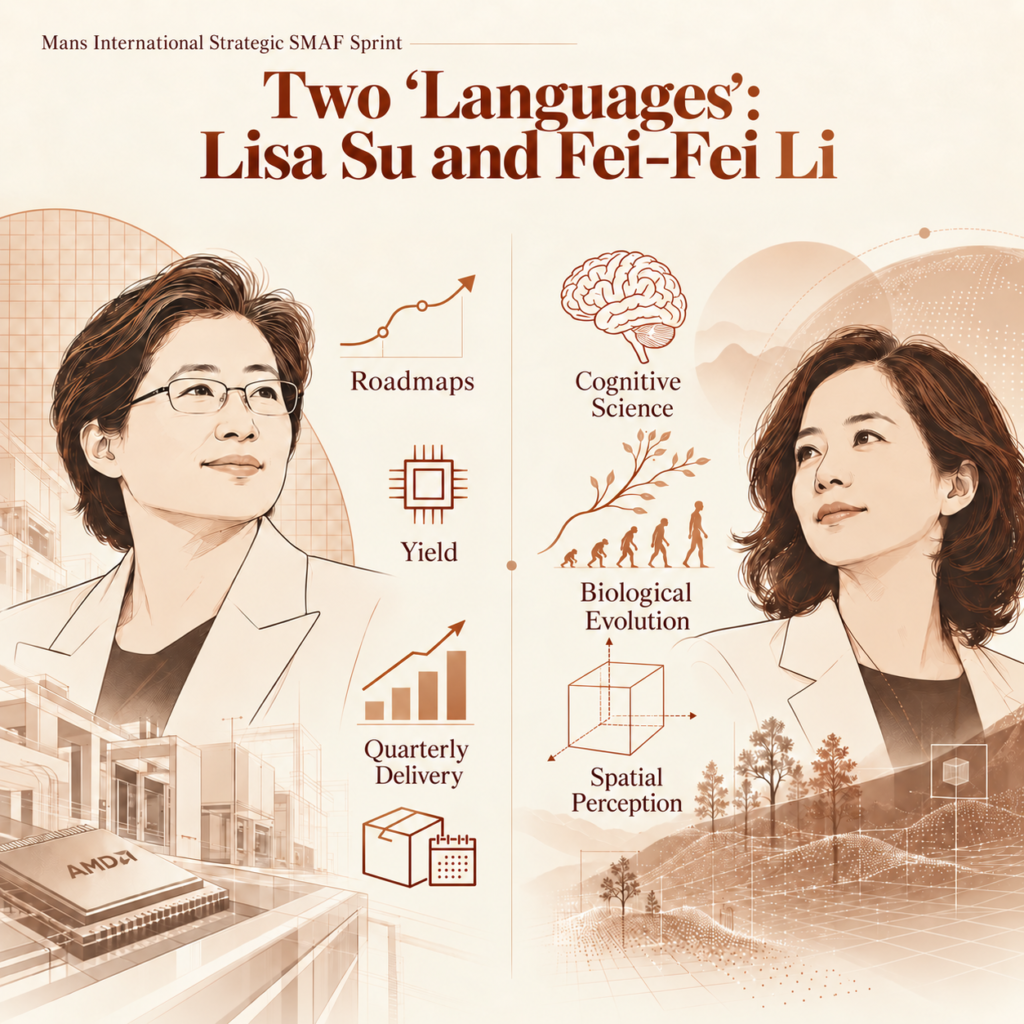
Lisa Su speaks the language of product roadmaps, yield rates, and quarterly delivery. Fei-Fei Li speaks the language of cognitive science, biological evolution, and spatial perception.
After the deal closes, these two languages will need to coexist in the same conference room, deciding the exact same thing: What rhythm does World Labs move to next?
One is the engineering-driven CEO who pulled AMD back from the margins into the main arena. The other is the pioneer who has been chasing the nature of intelligence from ImageNet all the way to spatial AI. They are meeting at the intersection of AI compute and spatial intelligence—a head-on encounter between two distinct organizational cultures.
- Fact one: The Transaction: On September 28, AMD announced a definitive agreement to acquire World Labs in an all-stock deal valued at approximately $8.2 billion, expected to close by late 2026. World Labs has roughly 70 employees—that is about $117 million per person. Upon closing, Fei-Fei Li will become AMD’s Executive Vice President and Chief Scientist, reporting directly to Lisa Su, while retaining her Stanford faculty position.
- Fact two: Why AMD is buying. NVIDIA launched its Cosmos world foundation model platform in early 2025, integrating it with Omniverse for synthetic data and simulation. AMD is not entering a vacuum—it is chasing an essential loop: the direction models take directly shapes how chips are designed. The filing is explicit: World Labs’ modeling research will directly influence AMD’s future hardware technology roadmap.
- Fact three: How the money works. It is all stock, and the mechanics matter. AMD’s 8-K says the share count is not yet fixed. It will be calculated from AMD’s daily volume-weighted average price over the ten trading days ending two trading days before closing. In practice, the value is anchored near $8.2 billion and the number of shares floats. World Labs was valued at ~$1 billion after its September 2024 raise, and completed a $1 billion round in February 2026 at a reported $5 billion post-money valuation—making this deal roughly a 60% premium on that baseline.
From “Dare to Leap” to “Whose Ground Are You Standing On?”
A year ago, I closed my article “AI’s Next Frontier: Fei-Fei Li, Spatial Intelligence, and the Wisdom of Navigating Uncertainty” with this thought: the watershed between investing and building is whether you can complete the perilous leap from knowing to doing. That means turning the conviction that “spatial intelligence is the future” into a firm commitment of strategy, resources, and time.
One year later, that leap has landed, just not the way many expected. World Labs did not walk the path to product alone. AMD bought the leap into its own system for $8.2 billion.
The question has shifted. It is no longer “do you dare to leap?” It is “after you land, whose ground are you standing on?”
Fei-Fei Li’s Next Threshold: From Breaker of Barriers to Insider of a System
When the mission stays the same but the organizational container changes completely, how do you redefine the way you lead?
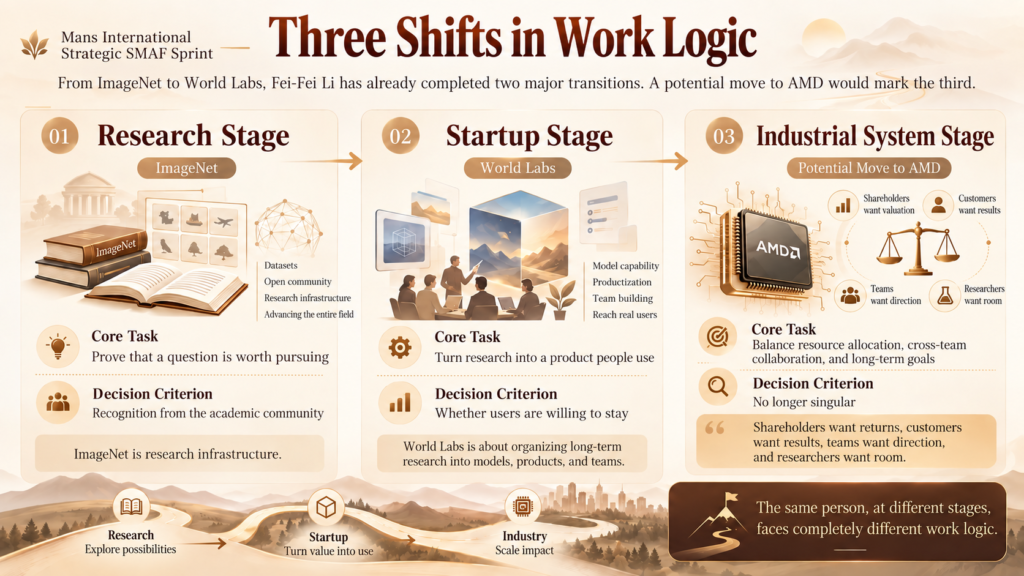
From ImageNet to World Labs, Fei-Fei Li completed two major transitions:
- 2009 (ImageNet): Organized 48,000 contributors to label 22,000 categories. Driven by raw conviction, she fought against being misunderstood.
- 2024 (World Labs): Organized a long-term research direction into models, products, and a startup team. The primary yardstick became user retention and technical validation.
Now comes the third transition. This time, the challenge is not opposition, but conflicting expectations: shareholders want financial returns, enterprise clients want stability, the startup team wants direction, and researchers want room to explore.
The Three Structural Tensions
- Rhythm Disparity: World Labs’ creative tools (like Marble) operate on an exploratory rhythm: discover a spatial capability, refine, release, observe. AMD operates on a quarterly hardware rhythm: tape-out schedules, enterprise SLA commitments, and supply chain constraints. How these two rhythms coexist is a weekly resource allocation battle.
- Identity Boundary: Retaining her Stanford faculty title eases academic concerns, but time ownership cannot be dual-hatted easily. The faculty role asks “What is the nature of intelligence?” The corporate Chief Scientist role demands accountability to product execution. The boundary between inquiry and delivery must be renegotiated in every executive decision.
- User Identity: When an independent boutique studio becomes a division inside a semiconductor giant, will creative developers who chose Marble for its agility stay, or will they view it as overly enterprise-bound?
Fei-Fei Li did not simply choose to sell; her research roadmap arrived at a point where the compute required exceeds what a 70-person startup can supply on its own.
II. Hold the Core, Change the Method
Last year, I summarized her core philosophy as: Hold the core, change the method. When 3D data acquisition proved difficult, she pivoted away from brute-force data scale toward spatial reasoning with minimal labeled data.
Today, she faces a much harder test. Previously, what changed was the technical path—a shift in experiment design where costs were contained. This time, what changes is the organizational structure, and what is surrendered is absolute autonomy.
This challenge is not hers alone. Every founder scaling deep technology will encounter this exact dilemma: When external constraints shift, how do you defend the underlying vision while completely altering the vehicle?
Three Questions for Deep-Tech Founders
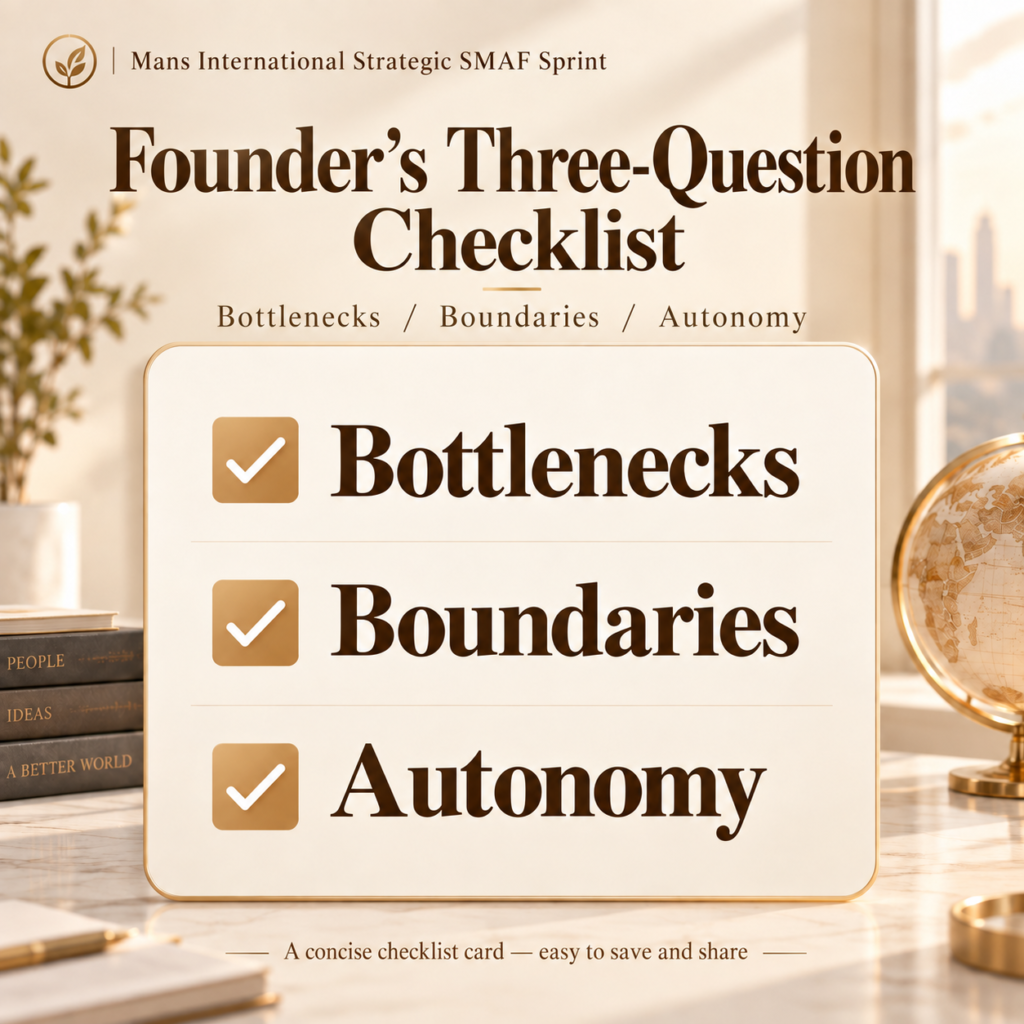
- What is your critical bottleneck right now? Not the most urgent—the most critical. Urgent issues consume calendar space; critical issues dictate structural survival.
- Which capabilities must be built in-house, and which should be acquired via ecosystem collaboration? Fei-Fei Li’s boundary: Keep core spatial research in-house; delegate mega-scale compute and chip architecture integration to a strategic partner.
- To gain scale and resources, how much autonomy are you willing to cede? Teams that fail to define this boundary upfront pay the highest tax during post-acquisition integration.
A Note on “Commercial Loop”: Equating an acquisition exit with commercial success is a dangerous comfort. Shareholders getting liquidity and a team joining a platform are preliminary steps. Sustainable commercial success still requires end users paying for measurable utility over time.
Three Signals for Investors to Watch
Here are three verifiable signals worth watching over the 12 months after closing:
- Hardware-Model Co-Optimization: Does the combined entity deliver measurable compute efficiency gains for spatial workloads compared to standard hardware stacks?
- Ecosystem Adoption: Are third-party developers actively building spatial applications on top of the joint platform?
- Commercial Retention: Are enterprise clients continuing to pay for measurable spatial AI outcomes?
If any one of these shows no clear progress within 12 months, it is worth re-examining the assumptions behind this deal.
The Comma, Not the Period
An $8.2 billion deal is a comma in this narrative, not a period.
The I Ching’s Kan hexagram (坎卦)—the hexagram of water flowing through steep terrain—teaches a vital lesson: After every perilous pass, another inevitably forms.

Water pauses in every hollow, gathers strength, and continues to flow. It skips no stretch of danger and is trapped by none—not because it foresees the ocean, but because it maintains its intrinsic nature while adapting to every present constraint.
- Hold the core: Remember why you set out.
- Change the method: Accept that every new scale brings new constraints.
The next domain for spatial intelligence is forming precisely where foundational research, hardware engineering, and market execution collide.
A question for the founders and strategists in my network:
If you are building in the spatial AI or robotics ecosystem today, does AMD’s acquisition of World Labs open up greater opportunities for your roadmap—or does it squeeze the space for independent players?
I would love to hear your perspective in the comments below.
Author: Kelly Luo, strategic advisor and technology investor, focused on helping technology leaders turn innovation into sustainable commercial growth. This article does not constitute investment advice.