
When AI Levels the Playing Field, What Still Makes a Winning Founder?

When AI Levels the Playing Field, What Still Makes a Winning Founder?

The 2026 World Cup final gave us a case study in a question that keeps every founder and investor up at night:

When AI hands everyone the same playbook, what’s left to compete on?

I. Data Can Be Equal. Judgment Cannot.

I. Data Can Be Equal. Judgment Cannot.

For the first time, all 48 participating teams received access to FIFA AI Pro, an AI platform developed by FIFA and Lenovo.

It gave every team a common analytical foundation for studying matches, players, and performance data.

But FIFA added one condition:

Once the whistle blew, no team could consult it. No sideline algorithms. No live probability feeds. The models went silent the moment the game started.

Sixty-two minutes into a scoreless final, Spain’s coach pulled his top scorer — solid numbers, nothing spectacular — and brought on Ferrán Torres, whose recent form was unremarkable but whose movement had an unpredictable, disruptive quality.

Torres found a gap in Argentina’s back line in the 106th minute. Goal. World Cup.

That call didn’t come from a model. It came from a coach’s profound perception of the game and the ingrained intuition of experience.
The Business Implication:

“Military tactics are like water… water shapes its course according to the nature of the ground; the soldier works out his victory in relation to the foe. Therefore, just as water retains no constant shape, in warfare there are no constant conditions.” — Sun Tzu
AI is rapidly becoming the world’s infrastructure. Any founder who wants a perfect competitive analysis can have it in seconds.
But business doesn’t happen in a pre-match calm. It happens during the game, when the ground shifts, signals conflict, and you have to decide.

For founders, the truth is blunt:

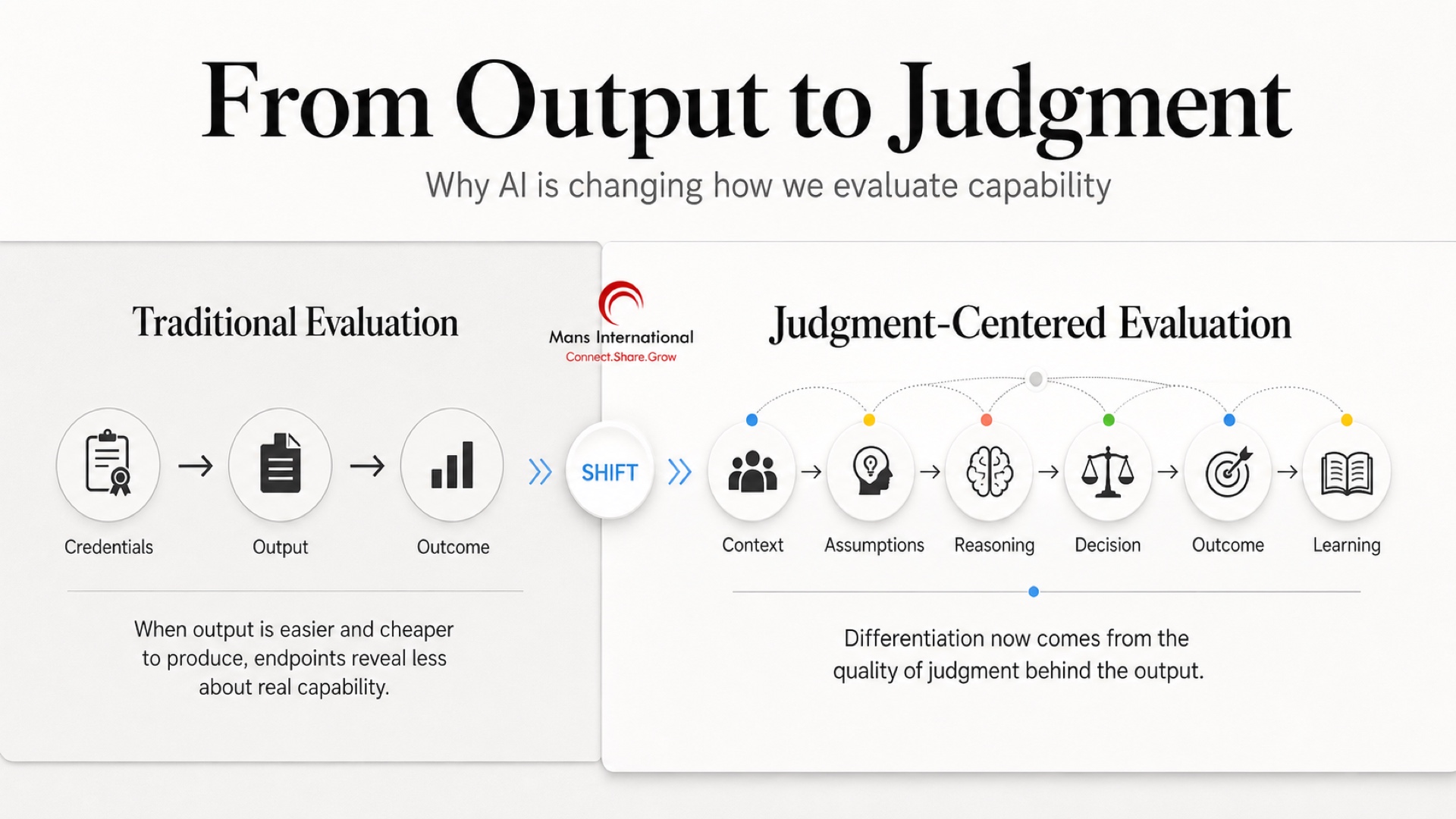
“Knowing how to use AI” is no longer a differentiator. What separates the winners is judgment in the face of ambiguity.

II. Monetizing the Unknown

II. Monetizing the Unknown

If the World Cup showed the value of judgment under uncertainty, Pop Mart has shown what happens when a company builds an entire business on uncertainty itself.

The Chinese toy company crossed HK$200 billion in market value on the strength of “blind box” retail — genuinely uncertain product bundles that turned unboxing into the product itself.

Their latest financials show overseas revenue exceeding 44%, with the Americas market growing over 700% year-over-year.

They are successfully exporting a methodology of “emotional pricing and scenario construction” to the rest of the world.

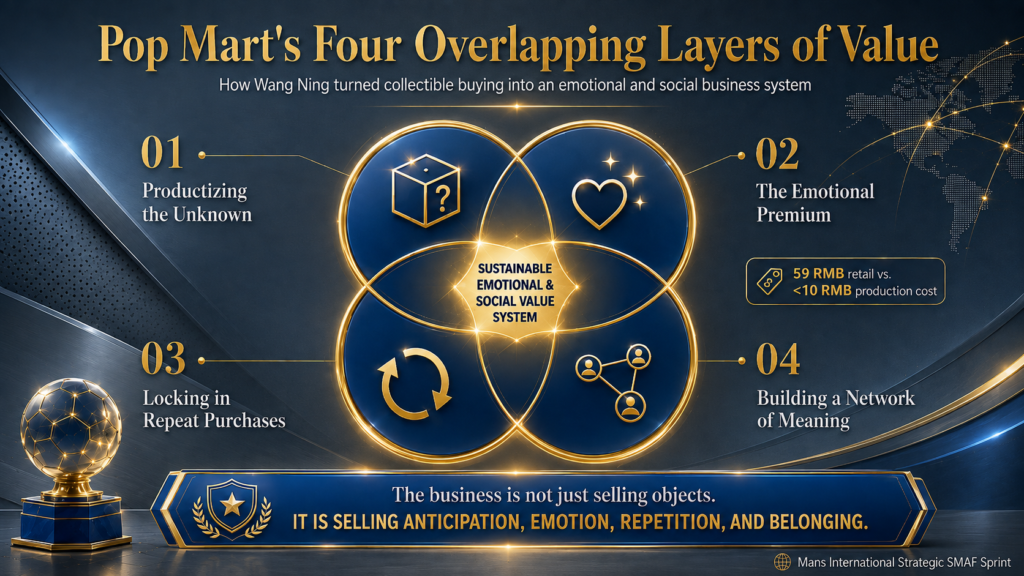
Pop Mart’s four overlapping layers of value Mans International
Pop Mart’s four overlapping layers of value

The surface story is “blind boxes” and lottery-style addiction. But Pop Mart’s founder, Wang Ning, has engineered four overlapping layers of value:

  1. Productizing the Unknown: buyers pay for the emotional peak of not knowing what’s inside, not for the object itself.
  2. The Emotional Premium: a Molly doll retails for roughly 59 RMB against a production cost under 10 RMB. That 49 RMB premium is psychological compensation for the total experience, not merely the materials.
  3. Locking in Repeat Purchases: the tension between “not finding it” and “finally getting it” turns single purchases into a habit loop.
  4. Building a Network of Meaning: exhibitions, designer signings, hidden-tier communities, a thriving resale market. Pop Mart isn’t just selling toys anymore — it’s selling belonging.

The Business Implication:

Stop pricing purely for function — learn to price for emotion. Stop staring only at the transaction — learn to construct a “network of meaning” where users voluntarily choose to linger.

III. The Real Differentiator

III. The Real Differentiator

The coach’s substitution and Pop Mart’s emotional engineering are, underneath, the same capability: a deep read of context that no model hands you.

At Mans International, we assess this through our Scenario Maturity Assessment Framework (SMAF), built around three questions.

  1. Can you make a correct, counter-consensus call before the data is complete?
  2. Does your product sell utility, or does it sell a meaning people will pay a premium for?
  3. And is your growth a string of one-off transactions, or a system that reinforces itself?

Most businesses are trapped in the comfort zone of commoditized, standardized earnings. Very few have turned uncertainty itself into their competitive advantage.

Concluding Thoughts

Concluding Thoughts
Concluding Thoughts

The cruelest truth of the AI era is that everything standard, quantifiable, and definitive will become infinitely cheap—as ubiquitous and inexpensive as tap water.

The messy, dynamic, uncertain reality is the actual battlefield.

Average managers freeze in front of it. Exceptional founders learn to work with it — and the best ones build it into the business model itself.

When AI neutralizes technical horsepower, your read of what’s really happening in the human, emotional terrain of your market becomes the one card no one can copy.

Which of these three questions is your team still avoiding?

高盛戳破AI幻象:创始人必须警惕的“0.5%陷阱”

高盛戳破AI幻象:创始人必须警惕的“0.5%陷阱” Mans International
高盛戳破AI幻象:创始人必须警惕的“0.5%陷阱”

当行业仍在卷模型参数、拼工具功能,一场更深层的价值迁徙已经开始。

高盛近期报告指出,SaaS占全球GDP的比重不足0.5%。更大的AI机会,仍藏在制造、能源、物流、医疗、建筑等真实经济中。

但99.5%不等于一片可以轻松收割的蓝海。AI进入生产线、医疗流程和复杂工程后,必须面对物理规律、安全责任、行业认证与真实损失。这里的商业规则,和互联网时代的轻量SaaS截然不同。

一、皮克斯的启示:技术没错,场景可能错了

一、皮克斯的启示:技术没错,场景可能错了

上世纪80年代,皮克斯曾是一家图像计算硬件公司。核心产品Pixar Image Computer技术领先,却难以打开医院和科研市场。

为了展示技术能力,团队持续制作动画短片。市场最终证明,计算设备的价值有限,这套技术创造出的内容体验拥有更广阔的付费空间。

皮克斯随后逐步转向动画内容,《玩具总动员》改写了动画工业,也完成了从技术公司到文化巨头的跃迁。

这个故事提醒AI创始人:技术能力只有进入合适场景,才会转化为收入、信任与规模。很多公司商业化受阻,往往卡在价值对象、购买路径和应用环境。

二、警惕“0.5%陷阱”

二、警惕“0.5%陷阱”

传统SaaS逻辑建立在账号、席位和功能之上。当自主 AI Agent 开始直接承接工作、产出结果,商业价值的核心,就从「软件的访问权限」,转向了「可信赖的、可落地的实体结果」。也就是说,客户更愿意为“拿到手的结果”付费,节省多少成本、减少多少停机、提升多少良率、降低多少风险。

定价权也会随之迁移。仅靠界面和功能堆叠,很难形成长期护城河。掌握专有数据、嵌入关键流程并持续交付结果的公司,更有机会获得高价值。

嗅觉敏锐的资本,早已提前为工业 AI 的长期价值下注。 贝索斯押注的 AI 工程初创公司 Prometheus,近期以 410 亿美元估值完成 120 亿美元融资。它的目标是打造能够参与喷气发动机、医疗设备和复杂工业系统设计的AI工程能力。

但高估值只印证了资本对长期趋势的期待,并不代表落地场景已经走向成熟。

三、工业AI必须跨过五道门槛

工业AI必须跨过五道门槛 Mans International
三、工业AI必须跨过五道门槛

在软件世界里,AI 出现幻觉,顶多浪费算力、输出错误文案; 但在工业场景中,一个自信却错误的 AI 决策,可能意味着生产线停机、设备损毁,甚至安全事故,直接演变成信任危机与巨额法律责任。

高盛在报告中提出了 5 项核心能力,它们将成为工业 AI 领导者与同质化竞品的分水岭:

  1. 理解物理规律。 模型需要掌握材料、温度、运动和机械约束,才能参与关键决策。
  2. 积累私有运营数据。 故障记录、极端案例和现场反馈,构成最难复制的数据壁垒。
  3. 具备边缘部署能力。 核心系统需要低延迟、高可靠,断网后仍能运行。
  4. 实现可认证、可追溯。 在工业与医疗场景中,安全、责任和审计能力直接决定准入资格。
  5. 融入现有工作流。 客户很少愿意为一项新技术彻底改造流程。低摩擦集成,决定部署速度与续约概率。

四、市场再大,也要先通过场景成熟度测试

四、市场再大,也要先通过场景成熟度测试

高盛报告揭示的是宏观的“万亿市场”,但创始人必须直面微观的“生死落地”。这正是我们引入 SMAF(场景成熟度评估框架) 的核心原因:一项技术再顶尖,只要商业环境没准备好,照样做不起来。

现在就用 SMAF 场景成熟度框架给你的项目做一次“体检”,请先直面以下三个灵魂拷问:

1. 预算是否真实存在?

谁对结果负责?资金来自哪个部门?客户不采购会承受什么损失?找不到明确买家,需求往往停留在兴趣层面。

2. 部署摩擦有多大?

谁需要改变工作习惯?谁承担系统改造成本?从签约到首次看到结果需要多久?集成成本越高,项目越容易停在试点阶段。

3. 结果能否被量化?

效率提升必须进入运营指标和财务指标,例如停机时间、良率、人工成本、风险事件和回收周期。无法量化的价值,很难支撑规模化采购。

写在最后

AI的下一轮分水岭,取决于谁能让模型进入真实工作流,对真实结果负责。

如果买家、预算、集成路径和价值指标仍然模糊,市场规模再大,也未必属于你。技术越先进,试错成本可能越高。

SMAF场景成熟度框架关注的核心,是帮助创始人与投资人判断一项技术是否已经进入可以被购买、被信任、被规模化的场景。

萃有集通过SMAF场景成熟度评估,帮助深科技项目识别商业化卡点,让技术真正转化为收入、信任与增长。

研究了 OpenEvidence 120 亿估值后,我发现 AI 赢家都在做同一件事

研究了OpenEvidence 120亿估值后,我发现AI赢家都在做同一件事 Mans International

从潜龙到亢龙,一套写给创始人的 AI 穿越心法

研究了 OpenEvidence 120 亿估值后,我发现 AI 赢家都在做同一件事

从潜龙到亢龙,一套穿越指数变革的心智地图

2026年,AI Agent 的进化速度让无数创始人夜不能寐。

有人担心行业被重写,有人焦虑自己的技术、资金和团队都拼不过巨头。每天醒来,新的模型、新的产品、新的融资消息扑面而来,仿佛稍微慢一步,就会被时代抛下。

但真正危险的,也许并非AI太强,而是我们在恐惧中失去了判断力。

《易经》首卦「乾」,以龙的进阶轨迹,写尽了从蛰伏到巅峰的完整成长法则。结合《吾辈如神》(We Are As Gods)中的五大心智,我们得以构建一套在AI时代穿越周期的心智地图。

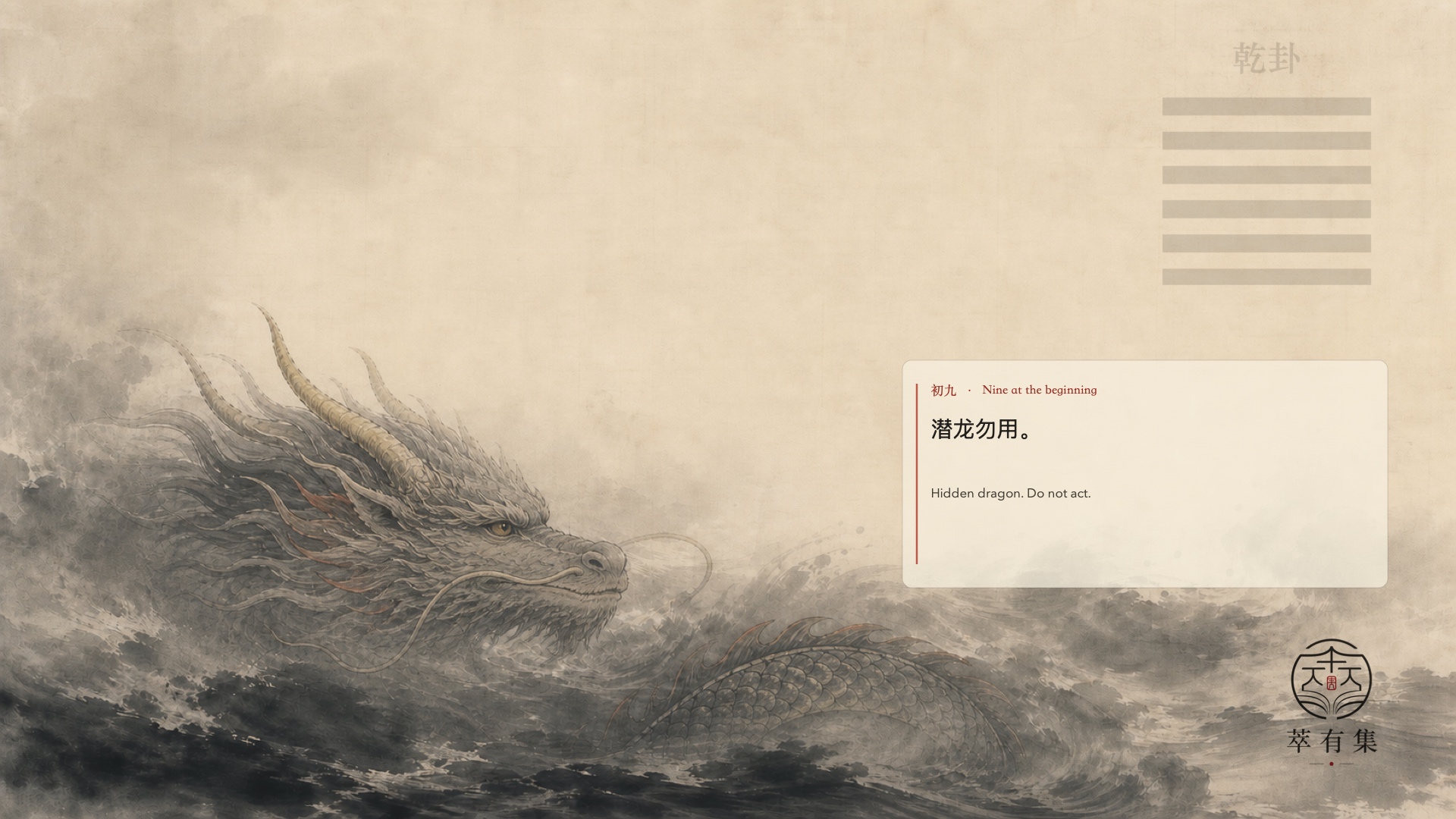
一、潜龙勿用——好奇心心智 (The Creative Mindset)

“潜龙,勿用。”

一、潜龙勿用——好奇心心智 (The Creative Mindset) Mans International
一、潜龙勿用——好奇心心智 (The Creative Mindset)

初创阶段,市场不知道你是谁,反而是最好的窗口期。太多人拿到一点技术就仓促下场,却连一个核心问题都没答透:这项技术,到底为谁、解决了什么具体的、比现有方案好十倍的问题?

好奇心心智是这一阶段唯一的燃料。不急于证明自己,不仓促下场厮杀,沉下去把行业痛点、技术边界、用户真实需求摸得一清二楚。正如《We Are As Gods》中传递的内核:人类掌控技术神力的第一步,从来不是急于建造,而是先保持对世界的纯粹追问。

沉得住气的潜龙,才有资格一飞冲天。

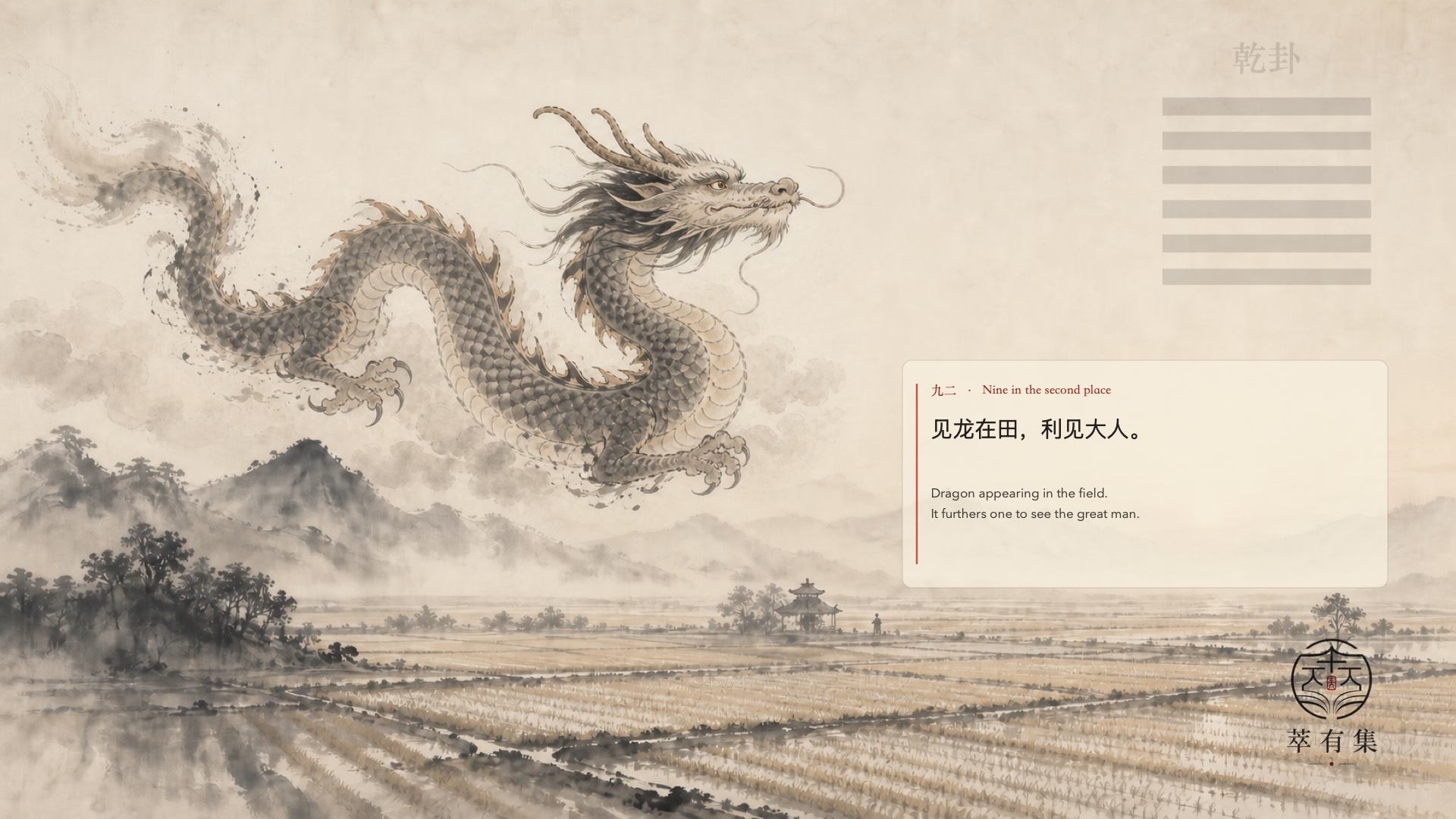
九二:见龙在田——富足心智 (The Abundance Mindset)

“见龙在田,利见大人。”

九二:见龙在田——富足心智 (The Abundance Mindset) Mans International
九二:见龙在田——富足心智 (The Abundance Mindset)

产品一上线,你就会直面现实:身边的对手算力比你强、数据比你多、融资额是你的几十倍。稀缺思维就是在这里杀死创始人的 —— 他们把 AI 当成一块固定大小的蛋糕,认定最终只会剩下几家巨头。

但富足心智的人看得懂本质:AI 正在把智能的边际成本推向零,整个蛋糕不是被分完,而是在被无限做大。几年前需要几十人工程团队才能搭建的系统,今天几个人靠 AI 工具就能完成。

稀缺者争夺存量,创造者定义增量。你不需要抢巨头的蛋糕,你要去烤一块以前根本不存在的新蛋糕。

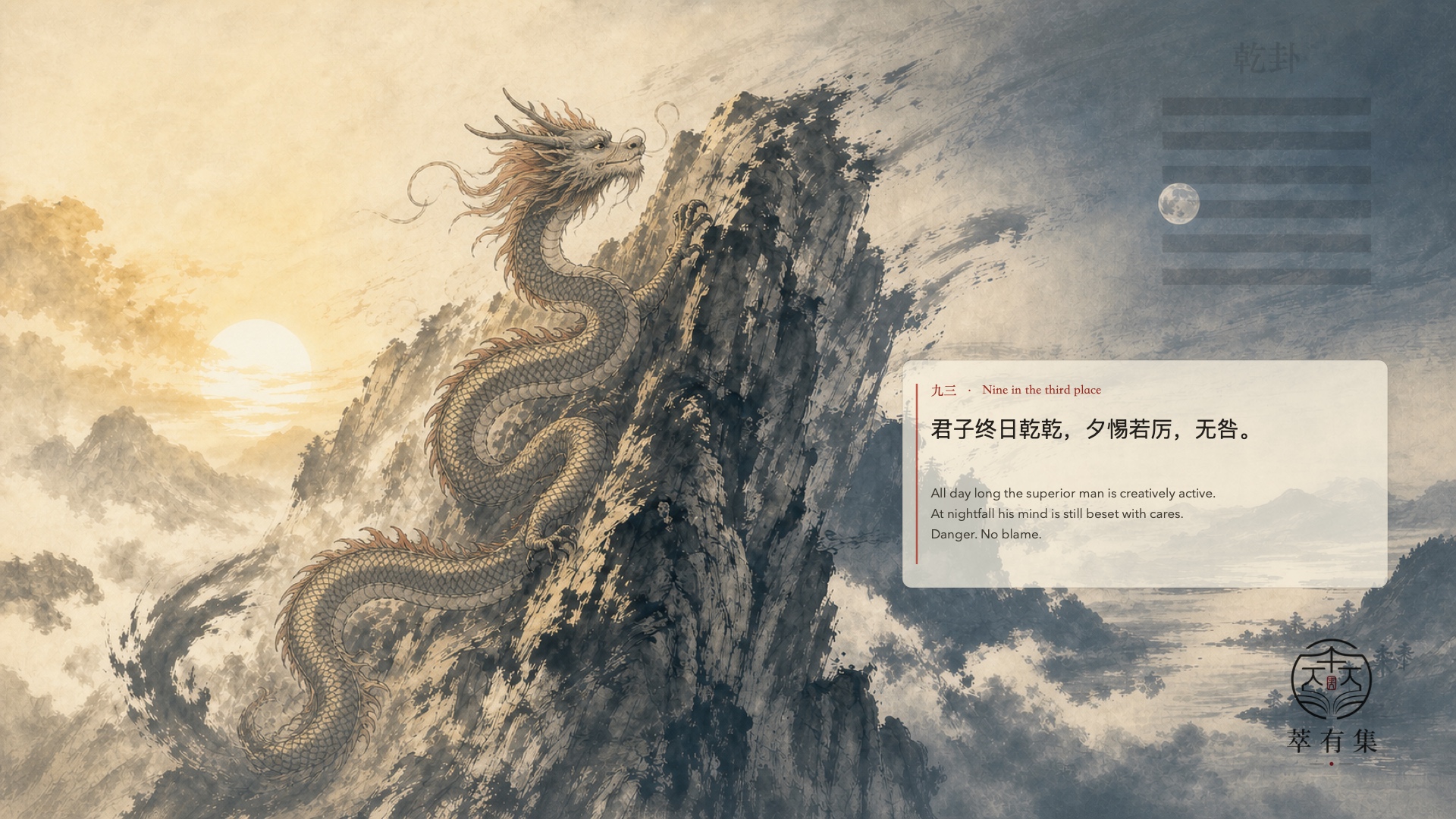
九三:终日乾乾 ——长期主义心智 (The Longevity Mindset)

“君子终日乾乾,夕惕若厉,无咎。”

九三:终日乾乾 ——长期主义心智 (The Longevity Mindset) Mans International
九三:终日乾乾 ——长期主义心智 (The Longevity Mindset)

这是创业最磨人的阶段:白天全速推进业务,夜里仍忧思重重,身心都在高压边缘反复拉扯。绝大多数人不是输在能力,而是输在中途垮掉。

耶鲁大学公共卫生学院 Becca Levy 教授及其团队的长期追踪研究,对衰老持有更积极自我认知(positive self-perceptions of aging)的老年人,平均寿命长出约7.5年。对创始人而言,长期主义心智的本质,是把韧性当成组织的核心基础设施 —— 你永远不能靠透支的身体、涣散的团队去完成关键跃迁。

创业不是百米冲刺,是连续的跨栏跑。能扛过周期的人,才等得到风口。

九四:或跃在渊——指数型心智 (The Exponetial Mindset)

“或跃在渊,无咎。”

九四:或跃在渊——指数型心智 (The Exponetial Mindset) Mans International
九四:或跃在渊——指数型心智 (The Exponetial Mindset)

公司开始扩张,也进入最危险的跃迁期。

人类大脑天生习惯线性思考,但AI呈指数级进化。

指数思维的核心,是为 18 个月后的技术能力设计架构,而不是盯着当下的天花板。你要预判技术的跃迁,提前搭建能和模型智能复利增长同频扩张的产品底座与数据闭环。

以当下能力设限的人,从第一天就在建造一件过时的产品。

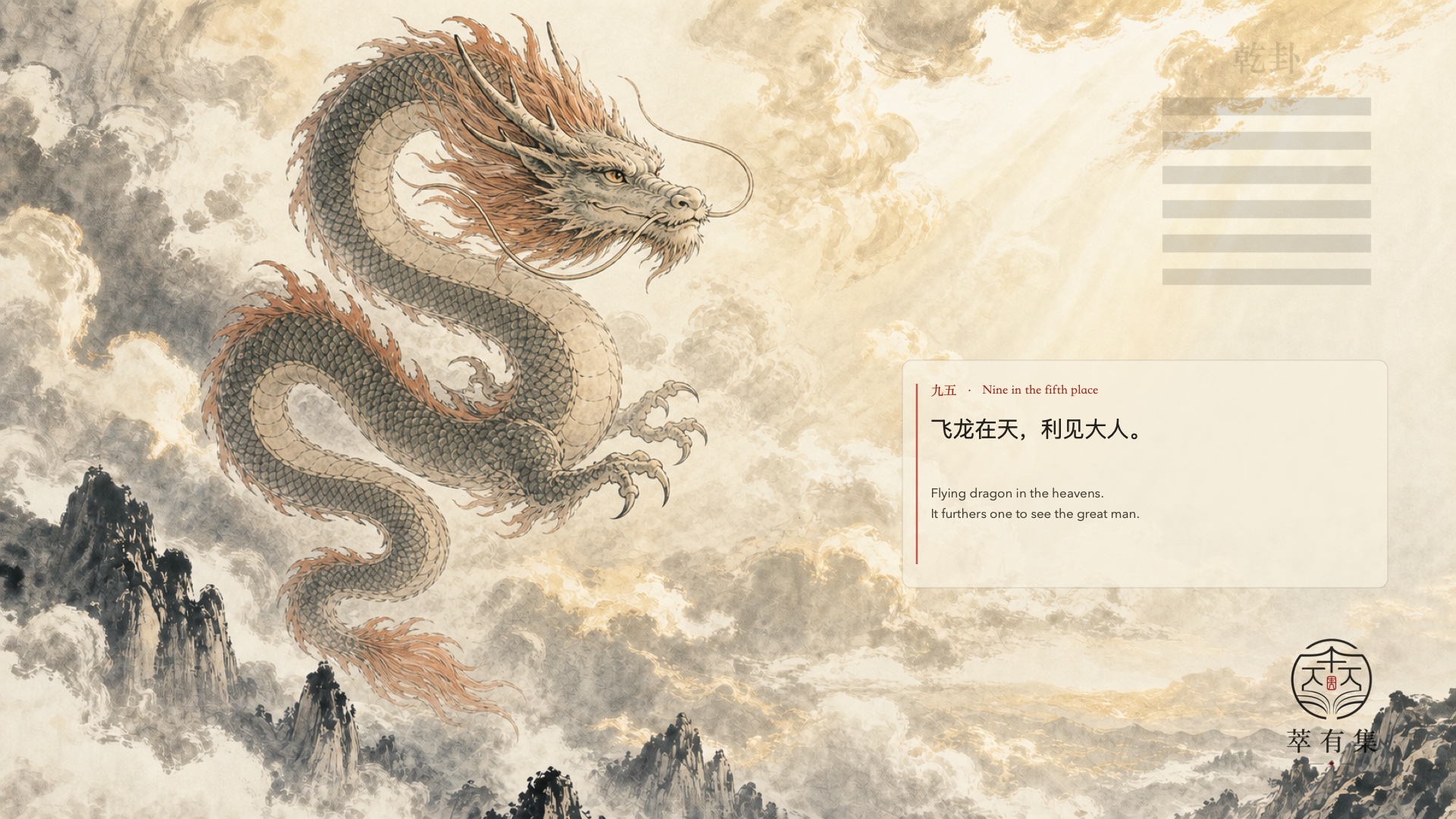
九五:飞龙在天——登月心智 (The Moonshot Mindset) + 场景成熟度 (Scenario Maturity)

“飞龙在天,利见大人。”

九五:飞龙在天——登月心智 (The Moonshot Mindset) + 场景成熟度 (Scenario Maturity) Mans International
九五:飞龙在天——登月心智 (The Moonshot Mindset) + 场景成熟度 (Scenario Maturity)

“登月心智”将“不可能”视为待解的工程问题。但没有着陆点的登月,只是制作精良的幻觉。

区分真正的飞龙和昂贵烟花的核心标尺,就是场景成熟度(Scenario Maturity)—— 别去评判技术牛不牛,要判断你选的这个具体场景,到底有没有真正具备起飞条件。

问自己三个灵魂问题:

  • 有没有真实买家,手握真实预算、带着真实紧迫感,愿意现在就买单?
  • 你的业务流程能不能生成正向反馈闭环,跑得越久,壁垒就越厚?
  • 当下的模型能力,能不能在真实使用场景里稳定、可靠地完成任务?

三个问题全部达标,野心才有落地的土壤;只追酷炫概念,最终只会摔得很惨。

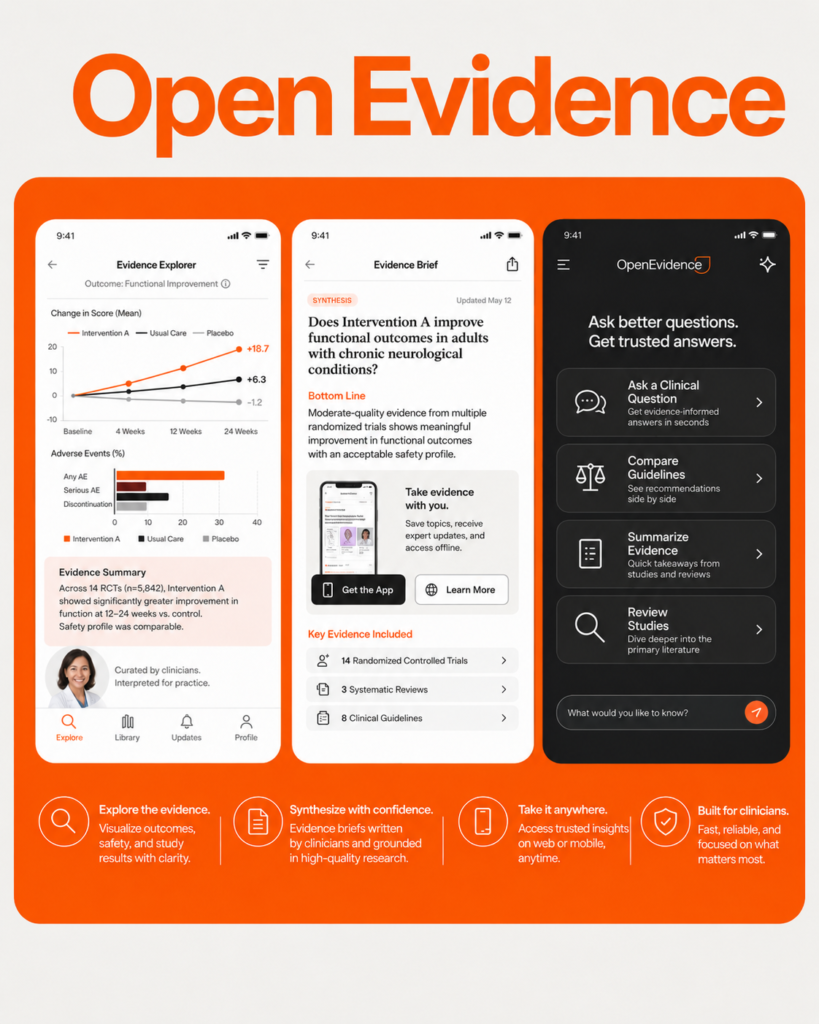
案例:AI医疗平台 OpenEvidence

这家 AI 医疗决策平台,就是场景成熟度的完美范本。它不做泛泛的聊天机器人,只聚焦临床医生的诊疗决策场景:

OpenEvidence 案例
  • 商业精准:不凭空创造预算,切入现有药企营销体系 —— 医生免费使用,靠场景化药企广告变现;
  • 壁垒深厚:独家对接顶级医学期刊与机构,自有认证临床咨询闭环,数据资产越跑越厚;
  • 能力匹配:严格限定临床医学领域,让当前模型的可靠性足以支撑高风险场景。

从 2025 年 2 月估值 10 亿美元,到 2026 年 1 月突破 120 亿美元,全美 65% 的医生在使用,单月支撑 2700 万次临床咨询 —— 它的爆发,从来不是因为模型最先进,而是因为场景踩得最准。

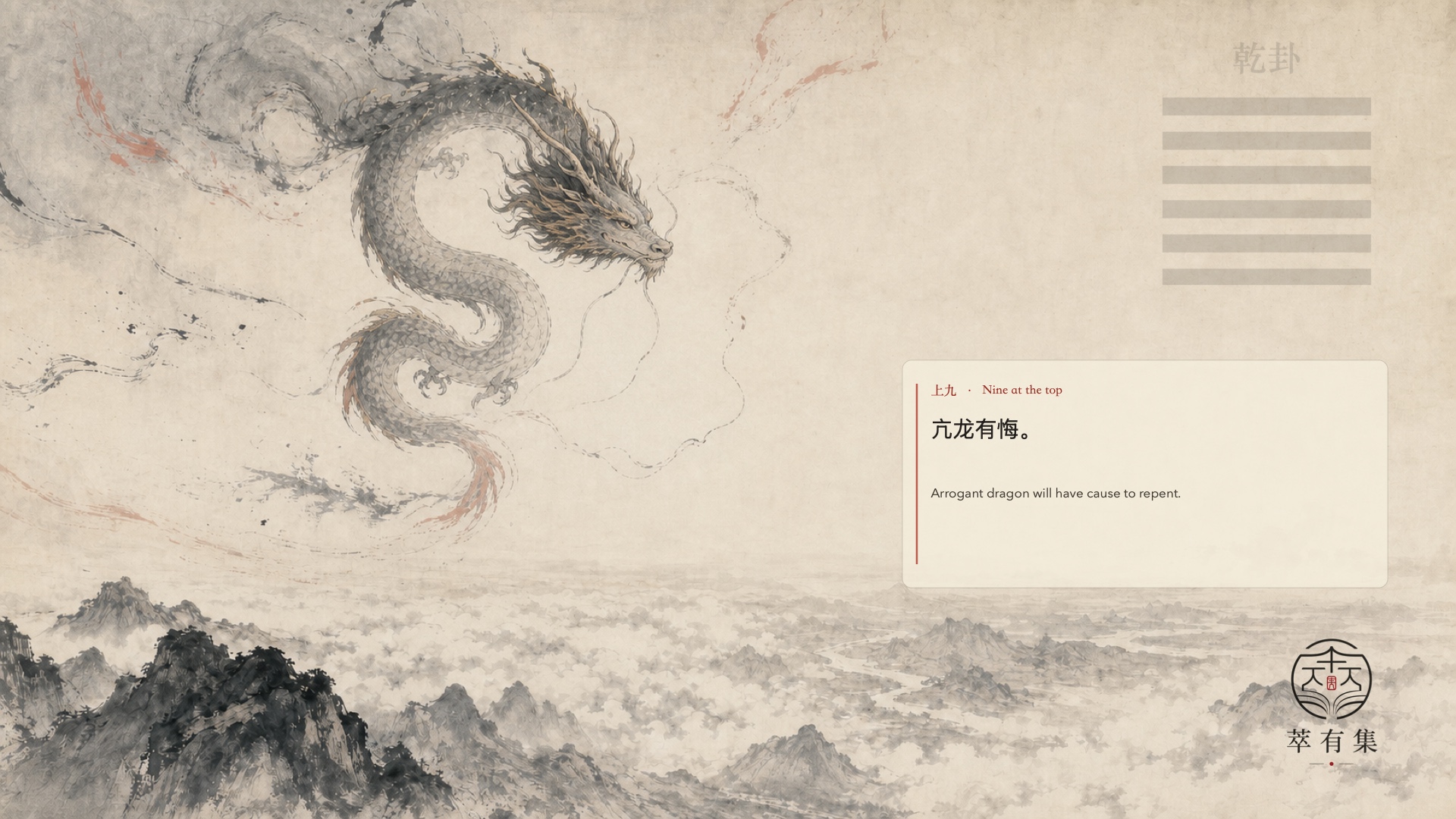
上九:亢龙有悔——90% 的 AI 创业,死在飞得太早

“亢龙有悔。”

上九:亢龙有悔——90% 的 AI 创业,死在飞得太早 Mans International
上九:亢龙有悔——90% 的 AI 创业,死在飞得太早

很多人以为乾卦的终点是飞龙在天。但乾卦的第六爻,写的是一句冰冷的警示:「亢龙有悔。」

飞得过高的龙,终将迎来悔恨。

这正是当下无数 AI 创始人的缩影:把「接入了大模型」等同于「做成了生意」,把资本砸向最酷炫、最有话题度的方向,而不是最成熟、最有真实需求的场景。野心跑在了业务、数据、技术的前面,最终只能从高空坠落。

这条警示的真正含义是在每一个高度,都要停下来重新校验:你的商业闭环、你的数据积累、你的技术储备,真的配得上你想去的地方吗?

人类的终极护城河:判断力,永远高于数据

讲完了六阶成长,我们回到最本质的问题:当 AI 能瞬间处理所有信息,人类的优势到底在哪里?

橡树资本联合创始人霍华德·马克斯(Howard Marks),早在 AI 出现前就划出了这条分界线:

  • 第一层次思维止步于显而易见的结论;
  • 第二层次思维则追问别人遗漏了什么,以及随之而来的后果。
人类终极护城河 判断力 > 数据 Mans International
人类的终极护城河:判断力,永远高于数据

AI让第一层次思维变得免费,这迫使创始人和投资者的护城河全面上移至第二层次:

  1. 判断数据背后真实的二阶效应,而不只是读懂字面信息。
  2. 权衡无法被量化的事物——团队的韧性、场景的真实成熟度、行业的深层结构。
  3. 在市场达成共识前,凭信念决定哪个未来值得全力奔赴。

AI 是威力无穷的引擎,但它没有灵魂,没有意图。理解 AI 的局限,我们才能摆脱受害者心态,重新拿回创造者的主动权。

无论机器变得多么强大,评估场景、设定航向、决定去向哪里的,永远是人类。

不必畏惧那条名为 AI 的巨龙。找到你真正成熟的场景,然后,驾驭它。

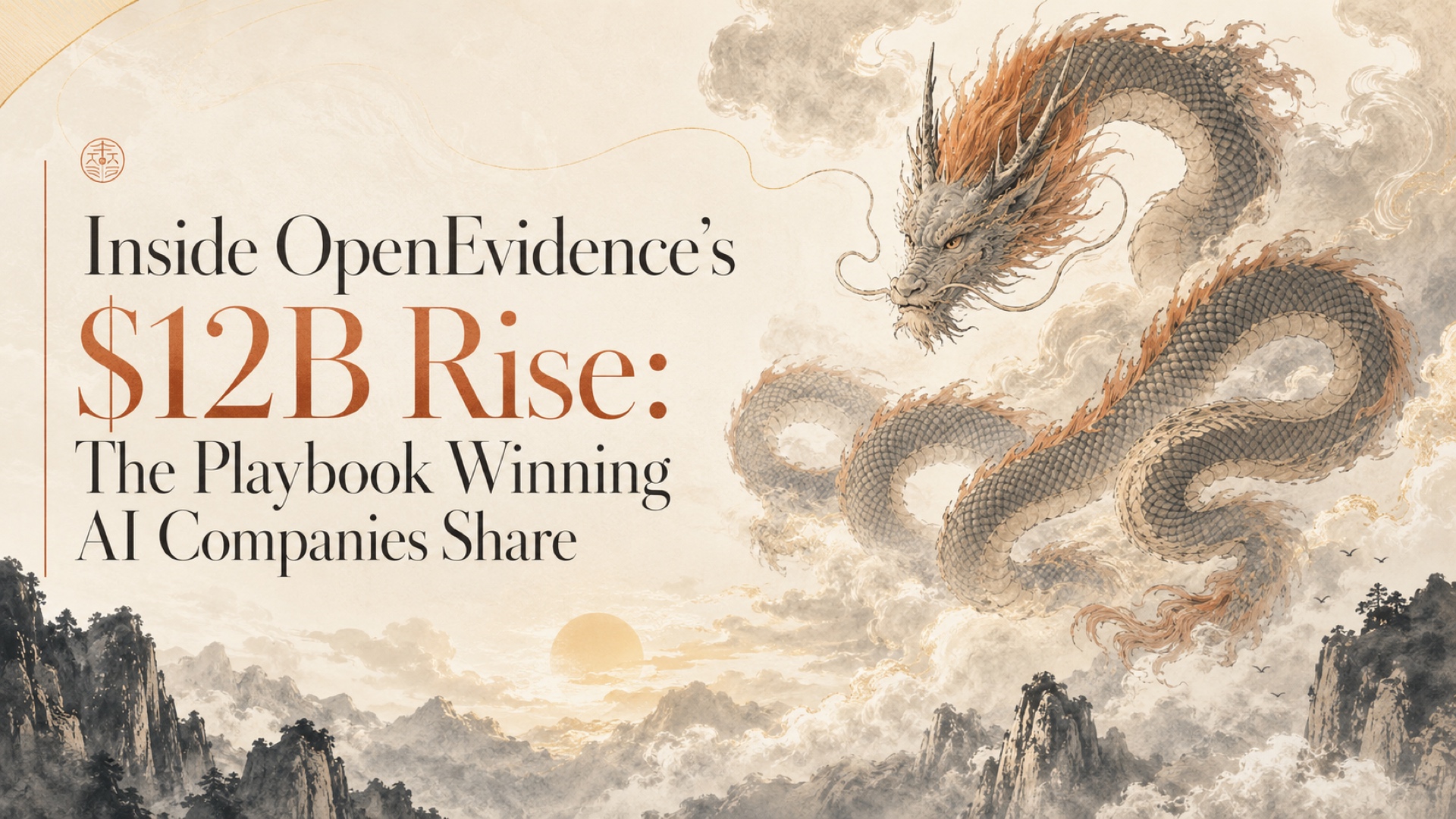
Inside OpenEvidence’s $12B Rise: The Playbook Winning AI Companies Share

Inside OpenEvidence’s $12B Rise: The Playbook Winning AI Companies Share Mans International
Inside OpenEvidence’s $12B Rise: The Playbook Winning AI Companies Share

In eleven months, OpenEvidence went from a $1 billion valuation to $12 billion. By April 2026, the company reported that its platform was being used by approximately 65% of US physicians and supported nearly 27 million clinical consultations that month, with much of its adoption attributed to physician word-of-mouth.

Think explosive growth is just about having the best AI tech? It’s not. If you look at the AI companies truly scaling today, their real competitive edge is deep market insight. Too many founders skip this step because they’re rushing to build something impressive instead.

Many view AI as a dragon coming to burn down their industry. But it also represents transformative and generative power. If you cannot outmuscle a force like that, you learn to ride it to become stronger.

As AI shifts from a simple tool to an autonomous agent, completing complex work with less and less human intervention, founders face a clear choice: draw a sword, or learn to fly.

Qian and the Anatomy of a Founder

The I Ching (Book of Changes), an ancient Chinese philosophical text, uses the dragon as a central metaphor in its first hexagram, Qian (The Creative). It tracks a dragon through six stages of maturation — from total obscurity to full command of the sky. It perfectly mirrors the modern founder’s journey.

Peter Diamandis, founder of the XPRIZE Foundation, describes five mindsets that keep people stable and effective through accelerating change: curiosity, abundance, exponential thinking, longevity, and moonshot thinking. Map them onto the dragon’s ascent and you get an operating system for building through the AI era — one altitude at a time, plus a warning at the top that most founders skip.

1. Hidden Dragon — The Curiosity Mindset

“The dragon is hidden. Do not act.”

1. Hidden Dragon — The Curiosity Mindset Mans International
1. Hidden Dragon — The Curiosity Mindset

At the earliest stage, the market doesn’t know you exist, and that’s fine. This is a research phase. The Curiosity Mindset is the fuel: what specific problem does this technology actually solve, for whom, better than the current alternative? Curiosity prevents premature action and allows you to deeply understand the landscape before making your move.

2. Dragon in the Field — The Abundance Mindset

“The dragon appears in the field. It furthers one to see the great man.”

2. Dragon in the Field — The Abundance Mindset Mans International
2. Dragon in the Field — The Abundance Mindset

You launch, and suddenly you’re standing next to other companies with more computing power, more data, and more capital than you’ll ever have. This is where scarcity thinking kills founders, treating AI as a fixed pie that a handful of giants will win.

An abundance mindset realizes that AI is driving the cost of intelligence toward zero, baking an infinitely larger pie. You now have the tools to build things that would have required a much larger engineering team just a few years ago.

3. The Diligent Dragon — The Longevity Mindset

3. The Diligent Dragon — The Longevity Mindset Mans International
3. The Diligent Dragon — The Longevity Mindset

“All day long the superior man is creatively active. At nightfall his mind is still beset with cares. Danger. No blame.”

This is the grind. You have entered the market and are building furiously, but the psychological and physical pressure is immense. You are active all day, yet anxious at night. To survive this perilous phase of non-stop execution, founders must adopt the Longevity Mindset.

A Yale study led by Professor Becca Levy found that older adults with more positive views of aging lived about 7.5 years longer. For founders, the Longevity Mindset applies this same logic to the body and the organization: you cannot reach the next stage on a burned-out founder or a brittle team. Resilience works as load-bearing infrastructure for the leap itself.

4. Leaping Dragon — The Exponential Mindset

4. Leaping Dragon — The Exponential Mindset Mans International
4. Leaping Dragon — The Exponential Mindset

“The dragon leaps over the abyss. No blame.”

This is the scaling phase, the most dangerous part of the journey. To cross the chasm, founders must adopt the Exponential Mindset.

Human brains are wired to think linearly, but AI advances exponentially. The Exponential Mindset means architecting for where the model will be in eighteen months, not where it is on launch day.

Founders who build their product roadmap against today’s capability ceiling are already building a legacy product. You must anticipate the leap, building infrastructure that scales with the compounding intelligence of the models themselves.

5. Flying Dragon — The Moonshot Mindset and Scenario Maturity

5. Flying Dragon — The Moonshot Mindset and Scenario Maturity Mans International
5. Flying Dragon — The Moonshot Mindset and Scenario Maturity

“The flying dragon is in the heavens. It furthers one to see the great man.”

The Moonshot Mindset treats “impossible” as an unsolved engineering problem rather than a wall. But a moonshot without a landing site is just a hallucination with better production values. What separates a flying dragon from an expensive fireworks show is Scenario Maturity — a check on whether the specific use case you’ve chosen, not the technology in general, is actually ready to fly.

That means asking harder questions, such as:

  • Is there a real buyer, with real budget and real urgency, ready to act now rather than someday?
  • Does the workflow generate a feedback loop that compounds in your favor the longer you run it?
  • Can today’s models actually do the job reliably at the point of use?

Get that match right, and the moonshot has somewhere to land. Chase ambition alone, and you’ve built a very well-funded crash.

Case in Point: Open Evidence

Open Evidence is an AI-powered medical search engine and clinical decision-support platform that allows verified healthcare professionals to ask complex medical questions and receive rapid answers grounded in peer-reviewed literature. It demonstrates scenario maturity through a precise, high-stakes alignment of buyer, monetization, moat, and capability match:

  • The Buyer & Monetization: Targeted physicians making time-sensitive decisions at the point of care. Instead of inventing a new budget, it tapped into existing pharmaceutical marketing dollars by keeping the tool free for verified doctors and monetizing via contextually relevant pharma advertising.
  • The Moat: Built exclusively on peer-reviewed medical journals and direct content partnerships with elite institutions like the American Medical Association and the New England Journal of Medicine. The data asset is compounded by proprietary, verified clinical consultation loops that competitors cannot easily replicate.
  • The Capability Match: Bounded the problem domain tightly to clinical medicine rather than attempting open-ended consumer chat, allowing current-generation models to maintain exceptional reliability.

That combination, not a superior model, is what turned a niche physician tool into the fastest-scaling case in the sector.

One Line Further: The Arrogant Dragon

One Line Further: The Arrogant Dragon Mans International
One Line Further: The Arrogant Dragon

The Qian hexagram doesn’t stop at the flying dragon. Its sixth and final line describes a dragon that has flown too high — an overreaching dragon with cause for regret. It’s the founder who mistakes access to a powerful model for scenario readiness, and pours capital into the most exciting application instead of the most prepared one.

The lesson isn’t to stop climbing. It’s to keep re-checking, at every altitude, whether the business, the data, and the technology are actually ready for where ambition wants to take you.

The Human Edge: Judgment Over Data

If AI can already process the available information instantly, where does human advantage come from?

Howard Marks, co-founder of Oaktree Capital, drew this line decades before anyone was worried about AI:

  • first-level thinking stops at the obvious conclusion;
  • second-level thinking asks what everyone else is missing, and what happens next because of it.

AI has made first-level thinking free — any model can summarize the data, the consensus, the obvious take, instantly. That pushes the entire edge left for founders and investors up to the second level:

  • Judging the second-order effects of what the data actually implies, not just what it states.
  • Weighing what can’t be measured — management quality, grit, the structural maturity of a scenario.
  • Deciding, on conviction, which future is worth building toward before the market has agreed with you.
The Human Edge: Judgment Over Data Mans International
The Human Edge: Judgment Over Data

AI is an incredibly powerful engine, but it lacks a soul. It lacks intent. Understanding the limitations of AI allows us to shed the victim mindset and reclaim our natural birthright as creators.

No matter how powerful the machine becomes, the human founder still evaluates the scenario and sets the destination – at least for now. We remain in charge of our lives, fully capable of shaping our own destinies.

Do not fear the dragon. Find your scenario, and ride it.

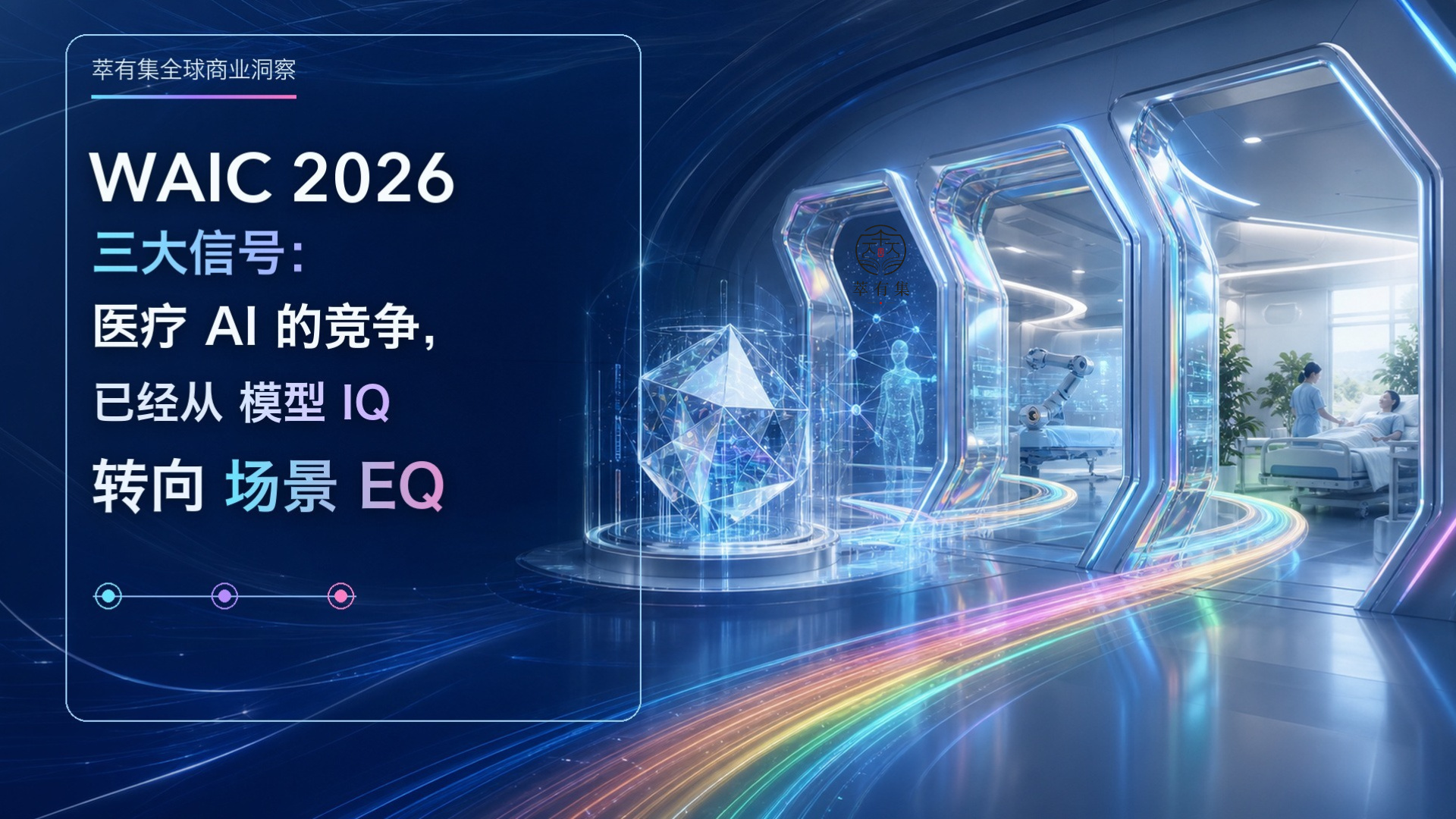
WAIC 2026 三大信号:医疗 AI 的竞争,已经从模型 IQ 转向场景 EQ

WAIC 2026 三大信号:医疗 AI 的竞争,已经从模型 IQ 转向场景 EQ Mans International
WAIC 2026 三大信号:医疗 AI 的竞争,已经从模型 IQ 转向场景 EQ

开源大模型遍地开花、推理 token 成本一降再降,那么,你到底拥有什么别人拿不走的东西?这个问题,贯穿了我对整个 WAIC 2026 的观察。

1100 多家企业,3000 多项展品。创始人和投资人关注的是哪些技术还停留在展台上,哪些产品已经开始接近可防御、可收费、可规模化的真实部署?

WAIC 2026 Mans International
WAIC 2026

依托更贴近商业本质的场景成熟度评估框架(SMAF),我们跳出单一的模型评测维度,重新审视那些真正具备竞争壁垒、可实现稳定营收的医疗 AI 落地项目。

我们从中梳理出三个最清晰的行业信号,而它们的成熟度,天差地别。

信号一:护城河,已经从模型转向了专有数据

本届大会一个明确的信号是:头部玩家早已不再拿通用大模型直接回答医疗问题,而是扎根独家数据,打造医疗增强大模型。当通用能力快速商品化,真正的壁垒,已经从 “模型做得好” 变成了 “数据独一份、场景扎得深”。

百川智能与北京儿童医院共建的「福棠・百川」儿科大模型,就是这一路径的标杆样本。

这套模型不是通用模型套上医疗语料的 “半成品”,而是深度整合了北京儿童医院 300 余位资深专家的临床经验,沉淀数十年高质量脱敏病历数据,覆盖儿科常见病到疑难罕见病的完整知识体系,首创儿科循证诊疗逻辑。

专有数据 Mans International

临床验证的结果足够有冲击力:在 60 份真实门诊病例的真人对照测试中,该模型诊断准确率达到 91.7%,比同场 12 位主治、住院医师的平均水平高出近 15 个百分点,儿科用药安全合规率也达到 92%,远超通用 AI 工具的表现。如今这套系统已经常态化落地倪鑫院长的多学科联合门诊,同时下沉到河北 150 余家县级医院。

这背后,恰恰戳中了中国医疗最痛的现实:顶级儿科专家高度集中在三甲医院,基层和县域长期缺乏优质医生。AI 的真正价值是让专家经验跨机构、跨地域流动,把顶级诊疗能力普惠下去。

SMAF 判断

静态数据集最终可能被复制,单次模型领先也可能很快被追平。

但一个已经嵌入诊疗流程、拥有持续反馈机制,并得到医生与医院信任的临床系统,替换成本要高得多。

因此,未来医疗AI的数据护城河,归结为三个核心问题:

  1. 这些数据能不能在合规前提下持续流动?
  2. 能不能持续转化为更好的临床结果?
  3. 能不能最终沉淀成用户离不开的高黏性?

信号二:具身智能很吸睛,但场景成熟度还没跟上

如果说医疗软件 AI 是本届大会的 “基本盘”,那么 AI + 具身智能的康养、康复机器人,就是全场最吸睛的 “流量担当”。

这其中有两类玩家的壁垒截然不同:

  1. 一类是以联影智能为代表的 “软硬一体” 派 —— 依托 “设备 – 数据 – 算法” 的完整栈结构,设备铺到哪里,AI 能力就能同步落地到哪里,这是纯软件 AI 公司很难复制的硬件护城河。
  2. 另一类是层出不穷的人形 / 服务机器人演示:银河辰的具身医疗机器人完成从问诊到照护的全流程执行;傅利叶智能的康复机器人听懂一句 “我渴了” 就能完成取物递水的完整闭环;光谷东智的康养机器人覆盖巡检、陪伴、健康管理全场景……
具身智能 Mans International

演示足够震撼,但从展台走进真实的医院病房、老人家里,还有三道演示里看不到的核心关卡:

  1. 安全关:照护对象多为失能老人、康复患者,身体脆弱,系统的容错率极低。需要多重安全冗余与失效保护,远不是实验室里能稳定运行就够。
  2. 隐私关:贴身陪伴意味着持续采集高度敏感的健康与生活数据,不能只靠一份用户协议打天下,必须有清晰的数据边界与完整的授权机制。
  3. 人文关:照护的本质是 “托举”,不是完成任务。一件衣服叠得再整齐、一杯水递得再精准,如果没有尊严、安全感和情绪信任,就没有解决照护的真正痛点。

SMAF 判断

具身智能在医疗养老领域呈现出典型的“技术潜力很高、场景成熟度有限”特征。

医院内部物流、设备巡检、物资搬运等标准化、低接触、责任边界清晰的场景,有望率先成熟。

而家庭护理、老人陪伴和高风险身体协助,由于环境开放、行为不可预测、伦理责任复杂,商业化周期明显更长。

信号三:窄切口、真付费,小团队也能快速跑通成熟度

本届 WAIC 最让人惊喜的创业故事,不是大厂的重磅发布,也不是实验室的技术突破,而是一个一人公司(OPC)跑出的项目 ——TideFlow AI 个性化睡眠决策系统。

医疗 AI OPC Mans International

创始人吴松芸没有医学背景,创业的起点只是自己长期受失眠困扰的真实体验。 她的核心洞察很精准:很多人失眠不是环境不好,而是大脑长期处于高唤醒状态,没法自然从清醒过渡到睡眠。TideFlow 用 AI 实时感知用户状态,动态匹配放松音频、呼吸引导等干预方案,帮大脑自然入睡,区别于市面上千篇一律的白噪音、冥想产品。

就是这样一个轻量的小团队,靠 12 次快速产品迭代,不仅拿下了 WAIC OPC 成都站冠军、登上全球总决赛舞台,更已经收获了海外真实付费用户,跑出了轻资产的商业闭环。

SMAF 判断

这就是场景成熟度的 “快车道” 范本:痛点足够窄、定义足够清晰,创始人离用户足够近、能快速迭代,而付费用户的认可,比任何融资轮次都更能证明产品价值。

融资可以放大验证结果,却不能替代验证本身。

Mans International 结语

这场产业迭代的本质,是中国医疗 AI 的竞争逻辑正在发生结构性重塑—— 行业核心已经从”模型智力(Model IQ)”,全面转向”场景情商(Scenario EQ)”。这不是短期的技术风口,而是整个赛道价值创造、价值捕获、壁垒构建的底层更替。

驾驭这种结构性变化,只看财报数据和模型参数远远不够。它需要对中国医疗体制痛点的深刻理解,对监管边界的精准判断,更需要一套专业框架,去系统评估场景成熟度、识别真正的战略缺口 —— 这也正是 SMAF(场景成熟度评估框架)的设计初衷。

从 Model IQ 到场景 EQ Mans International

最后想问问每一位医疗 AI 创业者与投资人: 你的 AI 战略,到底是为了在展台上赢得一阵掌声,还是为了真正破解 “排队三小时,看病五分钟” 的行业真困境?

如果你正在判断一个医疗 AI 项目的真实成熟度,或是想把中国医疗 AI 产品推向全球市场,SMAF 框架正是为解决这类问题而生。欢迎交流,我们一起拆解场景、找准路径。

Mans International 专注以 SMAF 场景成熟度评估框架,帮助医疗 AI 创业者与投资人区分「技术就绪度」与「场景就绪度」,深耕中国与全球市场的跨境产业桥梁服务。

WAIC 2026: When Medical AI Moves Beyond the Model

WAIC 2026: When Medical AI Moves Beyond the Model Mans International

Your tokens are cheap. Your model is open-source. So what do you actually own?

That question shaped my review of WAIC 2026, held in Shanghai.

More than 1,100 companies presented over 3,000 exhibits. But the real divide was not between larger and smaller models. It was between technologies that attract attention and those approaching defensible, revenue-generating deployment.

WAIC 2026 Shanghai

Over three days, I examined the most relevant medical AI cases through the Mans International SMAF lens: the Scenario Maturity Assessment Framework, which looks beyond model parameters to assess proprietary data, workflow integration, buyer readiness, trust and commercial scalability.

Three trends stood out and they were not equally mature.

Trend 1: The moat moved from the model to the data

Leading companies are no longer applying general models directly to medical questions; they are building “medically enhanced large models” grounded in exclusive data.

A prime example is Baichuan Intelligence’s “Futang·Baichuan’s pediatric model. It was developed with Beijing Children’s Hospital using the clinical expertise of more than 300 paediatric specialists and decades of high-quality, de-identified medical records.

The results are striking: in a head-to-head against 12 attending and resident physicians on 60 real outpatient cases, it hit 91.7% diagnostic accuracy, nearly 15 points above the human average, with 92% medication-safety compliance. It now lives in daily multidisciplinary clinics and is rolled out to 150+ county hospitals in Hebei.

Trend 1: The moat moved from the model to the data Mans International
Trend 1: The moat moved from the model to the data

China also presents a compelling initial scenario. Leading paediatric expertise is concentrated in major hospitals, while primary-care and county-level institutions often lack experienced specialists. AI could help distribute medical expertise more widely, not by replacing doctors, but by allowing expert knowledge to travel across institutions and regions.

SMAF read: A static dataset can eventually be copied. A clinical system that improves through validated feedback from each deployment becomes increasingly trusted and harder to replace.

Trend 2: Embodied AI is dazzling — and still maturity-gated

United Imaging Intelligence’s equipment-data-algorithm stack is a real hardware moat that pure software players can’t easily copy. And the humanoid demos were the crowd favorite: Galaxy General’s “AstraBrain” architecture driving a robot through folding laundry and making breakfast; Fourier Intelligence’s GR-3 Care-bot executing a full intent-to-action loop from a spoken “I’m thirsty”; Optics Valley Dongzhi’s “Photon” robots handling patrol, companionship, and health monitoring in elder-care settings.

Trend 2: Embodied AI is dazzling — and still maturity-gated Mans International
Trend 2: Embodied AI is dazzling — and still maturity-gated

Impressive. Not yet mature. Getting a robot from a booth into a home or hospital means clearing three hurdles that don’t show up in a product demo:

  1. Safety — the care recipients are disabled or elderly; failure tolerance is close to zero.
  2. Privacy — continuous in-home data collection needs real consent architecture, not a terms-of-service checkbox.
  3. Humanity — the job is care, not just task completion. A robot that folds shirts perfectly but feels clinical hasn’t solved the actual problem.

SMAF read: high potential, low current maturity. This is the category where the technology outpaces the scenario — worth watching, not yet worth pricing as though it’s solved.

Trend 3: Narrow problem, Real payers — OPC models are proving maturity can be earned fast

The most interesting founder story at WAIC wasn’t a lab spinout. TideFlow AI, an “AI personalized sleep decision system” was built solo by Wu Songyun, no medical background, just her own struggle with insomnia.

Trend 3: Narrow problem, Real payers - OPC models are proving maturity can be earned fast Mans International
Trend 3: Narrow problem, Real payers — OPC models are proving maturity can be earned fast

TideFlow’s core insight is that insomnia often stems not from a poor environment, but from a hyperaroused brain. The system uses AI to perceive the user’s state in real-time, dynamically matching intervention plans to help the brain naturally transition into sleep. After 12 iterations, this highly personalized, lightweight business architecture stepped onto the global stage, acquiring real paying users overseas.

SMAF read: this is what fast-tracked maturity looks like — a narrow, well-defined pain point, a founder close enough to it to iterate quickly, and payers who validate the solution before the funding round does.

The Mans International Takeaway

In this profound transformation, the core of industry competition is undergoing a structural reshaping from “Model IQ” to “Scenario EQ.” This is not short-term technological hype; it is a fundamental shift in the logic of value creation, capture, and defense.

Navigating this structural change requires far more than financial reports and model parameters. It demands a precise grasp of regulatory boundaries and a professional analytical framework capable of systematically assessing scenario maturity and identifying strategic gaps. This is precisely the design intent behind the Mans International SMAF.

Ultimately, every medical AI participant must confront a fundamental question: Is your AI strategy designed to win brief applause at the exhibition booth, or to truly crack the real industry dilemma of waiting three hours to see a doctor for five minutes?

If you’re trying to figure out where a specific medical AI bet actually sits on that maturity curve — or how to position a product for international scaling — that’s the exact gap SMAF was built to close. Happy to compare notes.

Mans International SMAF Sprint 2026

Mans International applies the Scenario Maturity Assessment Framework to help technology founders and investors distinguish technical readiness from commercial, workflow and ecosystem readiness—particularly across China and international markets.

An ALS breakthrough: A master class in Deep-Tech Ecosystem Building, Founder Resilience, and SMAF

An ALS breakthrough: A master class in Deep-Tech Ecosystem Building, Founder Resilience, and SMAF Mans International

Mans International SMAF Sprint 2026

The I Ching (Book of Changes) states: “Heaven’s movement is ever vigorous; thus, the noble person constantly strives for self-improvement.” This underlying force of relentless self-renewal, regardless of the circumstances, has found its most extreme validation in the practice of Mr. Cai Lei.

An ALS breakthrough: A master class in Deep-Tech Ecosystem Building, Founder Resilience, and SMAF Mans International
An ALS breakthrough: A master class in Deep-Tech Ecosystem Building, Founder Resilience, and SMAF

In 2019, Mr. Cai Lei, a former vice president of JD.com and one of the pioneers behind China’s electronic invoice system, was diagnosed with amyotrophic lateral sclerosis, or ALS. He was 41. He had just welcomed a new child. His career, family, and life were all at a peak moment.

Then came the diagnosis. ALS is often described as one of the most devastating neurodegenerative diseases. The average survival window after diagnosis is often only a few years.

Seven years later, in 2026, his body function score plummeted from 48 to 4. He is completely paralyzed from the neck down, his vocal cords have severely atrophied, and he relies on a liquid diet and a 24-hour ventilator to survive. Across his entire body, only his eyes remain under his autonomous control.

Cai Lei before and after ALS Mans International
Cai Lei before and after ALS

Yet, Cai Lei’s story is far more than an inspiring narrative of resilience and empathy. Analyzed through the Scenario Maturity Assessment Framework (SMAF), it stands as a textbook masterclass in deep-tech scenario breakthroughs. It is a blueprint of how to take a globally recognized “unsolvable dead end” and reconstruct it into a high-maturity, self-sustaining ecosystem of research collaboration and commercial translation.

I. Deconstructing the Breakthrough via SMAF: A High-Maturity Super Ecosystem

At Mans International, we utilize the SMAF (Scenario Maturity Assessment Framework) to evaluate the commercial viability and translation potential of deep tech ventures. We have seen too many projects perish in the “slide deck” phase or or “lab-only self-indulgences.”

From a scenario maturity perspective, the true brilliance of Cai Lei’s “ice-breaking” initiative is not simply his unwavering belief, but his methodical execution. He took a highly fragmented, chronically inefficient rare-disease scenario — one lacking adequate resource attention — and orchestrated it into a synchronized system uniting patients, data, research, clinical trials, capital, AI, and public trust.

1. Data and Workflows: From Scattered Patients to R&D Infrastructure

One of the greatest bottlenecks in rare disease R&D is scattered patient populations, scarce biological samples, and a lack of real-world data. Often, research does not lack direction; it lacks a stable, continuous, and actionable data foundation.

  • The Data Engine: Cai Lei built the “Jianyu Mutual Aid Home,” the world’s largest civilian ALS research database (over 18,000 registered users), housing tens of thousands of structured real-world cases. He also launched an “ALS Research AI Brain,” training 24/7 on over 20 million interdisciplinary papers to automatically filter and evolve targets without burdening researchers.
  • The Workflow: This 360-degree dynamic vital-sign tracking system compresses notoriously slow clinical recruitment to astonishing speeds — achieving “hour-level” responsiveness (i.e. 700 sign-ups in 2 hours; launching clinical trials within 3 months).
Data and Workflows: From Scattered Patients to R&D Infrastructure Mans International
Data and Workflows: From Scattered Patients to R&D Infrastructure

2. The Business Closed Loop: A Mechanism for Long-Term Sustenance

Rare disease research cannot survive solely on short-term donations or one-off grants. Drug discovery features long cycles, high failure rates, and relentless capital demands, while external funding environments and public attention fluctuate. Without a stable financial engine, even the grandest mission will bleed out mid-way.

The partnership forged between Cai Lei and his wife, Duan Rui, perfectly demonstrates the synergy of vision and operations. Many view Duan Rui’s live-streaming efforts purely as a “wife’s sacrifice.” While deeply moving and true, from a strategic perspective, it is a brilliantly designed commercial closed loop.

Cai Lei continually raises the ceiling of their mission — connecting patients, scientists, pharma, and society. Meanwhile, Duan Rui absorbs the immense operational realities: live-streaming revenue, team management, cash flow, cost control, and risk mitigation. This closed-loop of “front-end commercial revenue funding back-end R&D burn” provides a continuous lifeline for a highly uncertain, long-cycle scientific endeavour.

The Business Closed Loop: A Mechanism for Long-Term Sustenance Mans International
The Business Closed Loop: A Mechanism for Long-Term Sustenance

3. Narrative & Ecosystem: Evolving from Empathy to Industry Consensus

Before Cai Lei, ALS was trapped in a weak narrative within public and industry discourse — viewed merely as an “incurable and unprofitable” tragedy. It garnered generalized sympathy but lacked actionable pathways.

Cai Lei elevated this narrative fundamentally. He did not stop at emotional appeals for awareness; he broke down rare-disease R&D into actionable industry propositions. He allowed the scientific community, the biotech industry, and the public to clearly see their specific roles and value.

This mature narrative has penetrated industry silos, uniting over 60 global research teams and 50+ biotech companies, transforming an untouched “cold sector” into a highly coordinated battlefield with shared consensus, pooled resources, and a synchronized tempo.

Narrative & Ecosystem: Evolving from Empathy to Industry Consensus
Mans International
Narrative & Ecosystem: Evolving from Empathy to Industry Consensus

II. The Founder’s Mirror: Resilience for Global Founders

In his recent “Countdown” speech on Global ALS Day, June 21, 2026, Cai Lei said he had already defeated an enemy more terrifying than ALS: despair.

For founders today — navigating agonizing market cycles and high-stakes survival tests — Cai Lei’s mental fortitude serves as a profound mirror:

  1. Reject the Victim Mentality. Complaining about the macro environment or the “capital winter” yields zero value. Completely paralyzed and unable to speak, Cai Lei never wallowed in the unfairness of fate. He immediately pivoted his strategy, utilizing an eye-tracking device to launch a race against time. Radical acceptance and execution to the absolute limit are the foundational ethics of a founder.
  2. Pry Open Incremental Gaps in Dead Ends. Cai Lei noted: “You might think there is only a solid wall in front of you. But look down, there might be a path; turn sideways, there is a gap. You can even choose to climb over or dig through.” When traditional funding tightens and cross-border barriers rise, a founder’s core competency is leveraging tools — like AI and cross-disciplinary ecosystems — to pry open growth spaces ignored by the mainstream.
  3. Anchor Your Venture in a Grand Proposition. “The best way to overcome fear is to place yourself within a much greater cause.” When your corporate vision is tied to core societal challenges — hard tech breakthroughs, life sciences, energy transitions — the resilience you unlock will far surpass what secular fame or profit can sustain.
Pry Open Incremental Gaps in Dead Ends Mans International
Pry Open Incremental Gaps in Dead Ends

III. Conclusion: The Countdown is a Prelude to Victory

In Cai Lei’s room, four clocks sit ticking. The media calls it the countdown of his life. He corrects them: “This is my countdown to ALS.”

“If my eyes fail, I will connect to a Brain-Computer Interface. If my brain stops turning, I will upload my consciousness to an embodied robot. I have marched all the way to the face of this terminal illness, and I am not here to surrender.”

As heaven’s movement is ever vigorous, so must a leader ceaselessly strive along.

The Countdown is a Prelude to Victory
 Mans International
The Countdown is a Prelude to Victory

Here is to all the founders who keep walking through the valleys of economic cycles. Here is to the researchers grinding relentlessly in their labs. Here is to all those who refuse to bow to fate.

Do not ask where the hope lies. Keep moving forward, and hope will reveal itself. As long as you do not retreat, every direction is the way forward.

Global Strategic Partnership

Leading global research institutions, multinational pharmaceutical companies, biotech innovators, and international funds are invited to partner with Mans International to access and navigate high-maturity life science and deep-tech ecosystems.

Through our SMAF — Scenario Maturity Assessment Framework — we help identify where technology, capital, clinical resources, market readiness, and ecosystem trust can be precisely aligned.

Our goal is to reduce cross-border and cross-sector friction, accelerate clinical and commercial translation, and support breakthrough technologies and strategic capital in moving from promise to real-world impact.

蔡磊的最后一次创业:当旧地图失效创始人如何重构一个无解场景?

蔡磊的最后一次创业:当旧地图失效创始人如何重构一个无解场景?Mans International

导语:

《易经・乾卦》有云:“天行健,君子以自强不息。” 这份无论处于哪种际遇,都能尽己所能的底层力量,在蔡磊的实践中得到了最极致的印证。

2019 年,41 岁的蔡磊确诊渐冻症(ALS)。彼时他身为京东副总裁、中国电子发票第一人,刚迎来新生命,正处于事业与家庭的双重巅峰。而医生给出的 2-5 年平均生存期,为他按下了冰冷的人生倒计时。

蔡磊的最后一次创业:当旧地图失效创始人如何重构一个无解场景?Mans International
蔡磊的最后一次创业:当旧地图失效创始人如何重构一个无解场景?

七年后的今天,他的身体功能评分从 48 分跌至 4 分,脖颈以下完全瘫痪,声带彻底萎缩,依赖流食与 24 小时呼吸机维持生命,全身上下仅剩双眼可以自主控制。

蔡磊的故事,远不止一场关于抗争与共情的励志叙事,从产业视角出发,用 SMAF(场景成熟度评估框架)拆解便会发现:这更是一场教科书级的深科技场景破局 —— 一套完整的成熟度体系,将全球医学界公认的 “无解绝境”,重构为高成熟度、自循环的科研协作与产业转化生态。

一、SMAF 框架深度拆解:蔡磊的 “破冰之战”,为何是罕见病领域的高成熟度超级生态

在 Mans International,我们使用SMAF(场景成熟度评估框架 / Scenario Maturity Assessment Framework) 来评估深科技与跨国项目的落地潜力。我们见过太多死于“PPT造车”或“实验室自嗨”的项目。

从场景成熟度的角度看,蔡磊的“破冰”行动真正厉害的地方,不只是“相信”,而是把相信之后的每一步,把一个原本高度破碎、长期低效、缺乏足够资源关注的罕见病场景,逐步组织成了一个患者、数据、样本、科研、临床、资金、AI 与公众信任共同参与的协同系统。

1. 数据和工作流:从零散病友到研发基础设施

罕见病研发最大的难题之一,是患者分散、样本稀缺、真实世界数据不足。很多时候,科研并不是没有方向,而是缺少足够稳定、持续、可用的数据基础。

蔡磊牵头搭建的“渐愈互助之家”,是全球最大的民间渐冻症科研数据库(注册量突破18000人),收录了上万份结构化的真实世界病例。

数据和工作流:从零散病友到研发基础设施 Mans International
  • 在工作流端:这套360度动态生命指标跟踪系统,将原本极其低效的临床招募压缩到了令人惊叹的速度——实现以“小时”为单位的极速响应(2小时700人报名,3个月内开启临床)。
  • 在数据端:他启动了“渐冻症科研AI大脑”,全天候训练全网超2000万篇跨学科文献。AI 没有增加研究员的负担,而是“消失”在科研工作中,自动过滤与进化靶点。

2. 商业闭环:使命必须有长期供血机制

罕见病科研很难完全依赖短期捐赠或单点资助。药物研发周期长、失败率高、资金需求持续,而外部融资环境、公益热度和社会关注度都会波动。如果没有稳定的资金来源,再宏大的使命也很容易在中途失血。

蔡磊和段睿所形成的夫妻共患难组合,恰恰体现了愿景与运营的互补。很多人看到段睿的直播,会首先想到“妻子的牺牲”。这当然是真实的,也是令人动容的。但在商业视角下,这是极其高明的商业闭环设计。

蔡磊负责不断拉高使命天花板,连接患者、科学家、药企和社会关注;段睿则承担大量现实层面的运营压力,包括直播、团队、资金、成本、节奏和风险控制。这种“前端商业造血+后端科研烧钱”的闭环,为一个长周期、高不确定性的科研项目,提供了一种持续供血机制。

商业闭环:使命必须有长期供血机制 Mans International
商业闭环:使命必须有长期供血机制

3. 叙事:从悲情共情到产业行动共识

在蔡磊之前,渐冻症在公众与产业语境中,始终是 “无药可治、无利可图” 的悲情命题 —— 只有泛化的同情,没有明确的行动路径,属于典型的弱叙事场景。

蔡磊完成了叙事层面的本质升维:他没有停留在 “呼吁关注” 的情感表达,而是将罕见病研发拆解为可落地的产业命题,让科研界、产业界、公众都清晰看到自身的参与方式与价值。

这套成熟叙事最终穿透圈层,联动起全球 60 余个科研团队、50 余家生物科技公司,将 “无人敢碰的冷门赛道” 变成了有共识、有资源、有节奏的攻坚战场。

蔡磊在2026 年6月21日世界渐冻人日的《倒计时》演讲,更是进一步强化了全行业的攻坚共识,成为推动场景持续进化的精神内核。

二、 天行健,君子以自强不息:给中国创始人的“心力”启示

蔡磊在最新的视频《倒计时》中说:“我已经终结了一个比他更可怕的对手,名为绝望。”

他把自己比作孙悟空,“纵使不敌,也绝不屈服”。对当下正穿越周期阵痛、直面生死考验的中国创始人而言,蔡磊的“心力”是一面镜子:

第一,摒弃受害者心态。

抱怨大环境、哀叹资本寒冬毫无价值。蔡磊全身瘫痪、彻底失语,从未沉湎于命运不公,而是立刻切换战略,以眼控仪开启 “生死时速”。接受现实,倾尽所能 —— 这是创始人最底层的职业素养。

第二,在绝境中撬开增量缝隙。

蔡磊说:“你觉得前方只有一堵墙,其实未必,低头看有路,侧身有缝,甚至你可以选择翻过去、挖过去。” 当传统融资收窄、出海壁垒高筑,创始人的核心能力,就是借助 AI 杠杆、跨界生态,撬开被主流忽略的增长空间。

在绝境中撬开增量缝隙 Mans International
在绝境中撬开增量缝隙

第三,把事业锚定在更大的命题上。

“战胜恐惧最好的方法,就是把自己置于一个更大的事业当中。” 当企业愿景与硬科技突围、生命科学攻坚、能源变革等社会核心命题绑定,你获得的韧性,将远超世俗名利的支撑。

华大集团 CEO 尹烨是蔡磊科研生态的核心产业合作者:“你说要‘打光最后一颗子弹’,但这颗子弹会形成撞击,产生裂变,唤起更多的社会群体参与进来,共同解决。”

蔡磊以第一性原理与极致执行力,搭建起全球成熟度领先的 ALS 科研与数据基建。而攻克神经退行性疾病,不止关乎 50 万 ALS 患者,更关乎未来数十亿面临阿尔茨海默、帕金森威胁的全人类,这需要一支全球舰队的协同。

结语:倒计时,是胜利的序曲

蔡磊的房间里摆着四个时钟,滴答作响。

媒体说,那是他生命的倒计时。

他却说:“这是我送给渐冻症的倒计时。”

“如果眼睛看不见了,我会连上脑机接口;万一脑子转不动了,就把意识传送到具身机器人。我一路走到绝症面前,不是来向它投降的。”

天行健,君子以自强不息。

敬所有在周期谷底仍步履不停的创始人,敬所有在实验室死磕的科研人,敬所有不屈服于命运的前行者。

不必追问希望在何处 —— 向前走,希望自会显现。只要不退却,四面八方,皆是前路。

全球顶尖科研机构、跨国药企、Biotech 及国际基金:若您希望直通全球最大渐冻症科研生态与极速临床转化通道,请通过 Mans International 对接。我们以 SMAF 框架为您精准匹配患者数据、生物样本与临床招募资源,打通跨境跨界协同壁垒,加速您的管线从实验室走向临床。

SpaceX 2.2万亿估值背后:马斯克的“成熟度捆绑”阳谋,与中国硬科技的“两条生死线”

SpaceX 2.2万亿估值背后马斯克成熟度捆绑阳谋与中国硬科技生死线 Mans International
SpaceX 2.2万亿估值背后:马斯克的“成熟度捆绑”阳谋,与中国硬科技的“两条生死线” Mans International
SpaceX 2.2万亿估值背后:马斯克的“成熟度捆绑”阳谋,与中国硬科技的“两条生死线”

6 月 12 日,SpaceX(代码:SPCX)登陆纳斯达克,IPO 定价每股 135 美元,募资约 750 亿美元,发行估值约 1.77 万亿美元,上市后市值一度突破 2.2 万亿美元,刷新了全球 IPO 规模纪录。

朋友圈里,有人惊叹马斯克的资本手腕,有人焦虑普通投资者被收割,有人讨论这是对 OpenAI 的 “降维打击”。

但作为科技创始人、硬科技投资人,如果你只看到这些,你就错过了这场万亿盛宴背后最核心的商业逻辑。

今天,我们不谈散户情绪,不谈资本八卦。我们用 Mans International 独家的SMAF(场景成熟度评估框架),拆解一个所有硬科技创业者都必须搞懂的问题:

马斯克是如何把三个成熟度天差地别的业务,打包成一个全球资本疯抢的万亿故事?

这对正在苦苦内卷、准备下一轮融资的中国硬科技创始人来说,到底意味着什么?

SpaceX 不是一家公司,而是一个精心设计的 “成熟度捆绑包”

传统IPO的逻辑里,投资人拿的是放大镜,评估的是“一家公司”的单品业务成熟度。

但在SpaceX的局里,投资人被要求评估的,是一个庞大的生态系统:可回收火箭、星链、星舰、xAI,以及更宏大的“火星殖民”叙事。

通过 SMAF Compass™ 2.0 的视角,我们发现了一个反直觉的真相:SpaceX 根本不是一个线性发展的商业体,而是一捆“成熟度极不均衡”的业务切片。

SpaceX 成熟度捆绑包 Mans International
SpaceX 成熟度捆绑包

第一层:星链(Starlink)—— 商业成熟度锚点

业务成熟度:★★★★★

数据成熟度:★★★★★

星链是 SpaceX IPO 无可争议的商业底座。2025 年,Starlink 所在的 Connectivity 业务收入约 114 亿美元,占 SpaceX 总收入约 61%;该业务调整后 EBITDA 利润率约 63%,成为支撑 SpaceX 未来叙事的核心现金流来源。

从海事通信、企业备份到国防韧性,痛点足够痛,买家足够清晰,价值捕获路径已被验证。

没有星链的商业成熟度,SpaceX 的整体估值将极其脆弱。

星链(Starlink)—— 商业成熟度锚点 Mans International
星链(Starlink)—— 商业成熟度锚点

更关键的是,星链创造了数据复利循环:更多用户→更丰富的网络数据→更智能的路由算法→更好的服务体验→更高的用户付费意愿→更深的数据壁垒。

这就是 SMAF 框架中 “数据成熟度” 的终极形态:技术优势通过数据闭环自我强化,最终变成竞争对手无法逾越的护城河。

第二层:星舰(Starship)—— 叙事成熟度顶峰

叙事成熟度:★★★★★

短期业务成熟度:★☆☆☆☆

星舰承载了人类最宏大的太空想象:登月、轨道数据中心、火星殖民。

它把极度复杂的技术,转化成了一张极具记忆点的“未来期权”。

星舰(Starship)—— 叙事成熟度顶峰 Mans International
星舰(Starship)—— 叙事成熟度顶峰

但注意:叙事成熟度满分,不等于商业成熟度满分。

星舰在短期内仍然是一个”未验证的未来期权”。它负责讲故事,拉高估值天花板,但它短期内不负责产生现金流。

第三层:xAI & Grok —— 未解决的工作流成熟度缺口

工作流成熟度:★★☆☆☆

这是 SpaceX 捆绑包里最脆弱的缺口。

xAI 和 Grok 给估值注入了巨大的”AI 想象力溢价”。但对于企业和政府用户来说,模型差异化模糊、数据信任未决、深度运营集成极度困难。

xAI & Grok —— 未解决的工作流成熟度缺口 Mans International
xAI & Grok —— 未解决的工作流成熟度缺口

看懂了吗?马斯克的阳谋就是:用一个高度成熟的基建场景(星链),去主动承担一个远未成熟的AI工作流场景(xAI),用 SpaceX 的估值为 xAI 的未来定价。

东方路径的“双轨战”:宇树的“成本休克”与智元的“高叙事赌注”

当马斯克用 SpaceX 把“基建+AI”打包成一个宏大的资本叙事时,中国的硬科技创业者在具身智能(Embodied AI)赛道上,正在书写两种完全不同的“成熟度破局”打法。

打法 A:宇树科技(Unitree)的“成本休克”

依托中国成熟的新能源车供应链,宇树把人形机器人的价格打到了约1.6万美元。在SMAF 框架的“商业成熟度”和“供应链壁垒”上,这已经是世界级。

但 SMAF 给国内狂热的硬件圈提了个醒:成本优势 ≠ 估值优势

宇树科技(Unitree)的“成本休克” Mans International
宇树科技(Unitree)的“成本休克”

一台需要每 2 小时停机维护 20 分钟的机器人,在标准 8 小时班次里,单日有效工作时间只有 6.7 小时。其综合产量和交付稳定性,还不如一个普通的人类熟练工。对 B端客户眼里的“工作流成熟度”就是不及格的,这根本不是生产力工具,而是需要额外配备一个高薪“保姆”的昂贵玩具。

中国硬件公司已经解决了“造得便宜”的问题,下一阶段的生死战,是谁能率先解决“用得不烦”的场景成熟度问题。

打法 B:智元机器人(Agibot)的“高叙事”赌注

与宇树的“成本休克”不同,智元选择了一条更接近 SpaceX “成熟度捆绑”的路径:用“具身智能大脑”拉高叙事天花板,再反哺场景落地。在 SMAF 框架下,其成熟度画像与宇树形成鲜明反差:

  • 叙事成熟度:★★★★★

自带顶尖技术势能,“通用具身智能”的愿景直接对标物理 AI 最前沿,叙事拉满。

  • 工作流成熟度:★★★☆☆(迭代中)

智元直接将机器人送入汽车总装等真实产线“实训”。但 SMAF 提醒:实训期≠场景成熟。从“能干活”到“无感融入产线且绝不添乱”,仍需跨越巨大的隐性摩擦力。

  • 商业成熟度:★★☆☆☆(预期驱动)

出货量尚处早期,但投资人押注的是其“部署-数据-智能”的数据复利飞轮,这与星链的估值逻辑如出一辙。

SMAF 战略警示:叙事天花板越高,场景验证压力越大。

智元机器人(Agibot)的“高叙事”赌注 Mans International
智元机器人(Agibot)的“高叙事”赌注

中国机器人双雄正在书写两种截然不同的答卷:宇树从成本端倒逼场景,智元从智能端切入场景。

在这个赛道上,宇树只需向客户证明“我足够便宜,且不添乱”;而智元则必须证明“我能比工人更聪明”。

在这场战役中,谁能率先跨越“工作流成熟度”的生死线,谁就能死死锁定下一轮的估值定价权。

灵魂拷问:你的技术,正卡在哪一层?

技术突破≠场景成熟

能力休克≠估值溢价


只有被场景吸收、能产生复利价值的技术,才真正具备投资价值。

做融资 PPT 前,先抛开技术参数,用 SMAF 场景成熟度框架问自己三个灵魂问题:

问题 1:你的 “现金牛” 在哪里?

哪个已跑通的场景,在产生稳定现金流,为你的未来研发输血?

马斯克:星链 | 你:?

没有现金牛,所有叙事都是空中楼阁 —— 这是投资人第一个会问的问题。

问题 2:你的叙事是否跑在了工作流前面?

叙事 10 分、落地 2 分的估值,一碰就碎。

牛市愿意为想象力付溢价,熊市最先压缩的,往往是“有故事、没落地”的公司。

xAI 有星链托底,你有吗?

问题 3:你的成本优势,是否转化为了场景 ROI?

便宜但不可靠,强大但难集成,都不是生产力优势,而是尚未被场景吸收的技术想象。


对于进入商业化阶段的硬科技公司,投资人不再只看你卖得多便宜,而是看你能否为客户持续创造可验证的 ROI:赚多少钱、省多少钱、降低多少运营风险。

技术成熟度,只是硬科技的入场券。场景成熟度,才是创始人拉开差距、拿超额估值的核心。

场景成熟度分层管理 萃有集
场景成熟度分层管理

SpaceX 的万亿市值,靠的不是最强的火箭,而是极致的成熟度分层:

  • 星链:赚钱(商业锚点)
  • 星舰:讲故事(叙事天花板)
  • xAI:磨未来(工作流缺口)
  • 打包:讲一个可信的增长故事


中国创始人要学的不是马斯克的疯狂,而是这套清醒的分层管理艺术。

你的公司,现在处于哪一层?

加入 Mans International SMAF Sprint 2026

本文是 Mans International SMAF Sprint 2026 的第 2 周深度案例研究:Case Study 02|SpaceX 与成熟度捆绑逻辑。

不要等到市场下行周期,才被迫暴露你的成熟度缺口。

你的技术可能很强,叙事可能很有吸引力,但如果场景尚未成熟,采用率、收入质量和估值支撑,最终都会在压力测试中显露裂缝。

如果你是科技创始人、深科技 VC、产业领袖,或正在面对 AI、机器人、空间基础设施、中美科技脱钩等复杂变量的跨境战略决策者——现在最重要的,不是继续讲更大的故事,而是在市场修正之前,提前识别你的关键战略缺口。

Mans International SMAF Sprint 2026

在 Mans International,我们用 SMAF Compass™ 场景成熟度框架 帮助你判断:

  • 你的技术场景是否已经准备好规模化
  • 真正的成熟度缺口藏在哪里
  • 如何设计自己的“成熟度捆绑包”,支撑更可信的增长叙事与估值溢价

发送私信获取《SMAF Compass™ 闭门诊断简报》。

SpaceX IPO and the Scenario Premium

SpaceX IPO and the Scenario Premium Mans International SMAF Sprint 2026

In Week 1 of the Mans International SMAF Sprint 2026, I revisited Insilico Medicine to stress-test the AI-drug premium. The conclusion was clear: the premium is no longer given for technical ambition; it must be earned through measurable scenario maturity.

This week, the SMAF Compass™ 2.0 moves from AI biotech to space infrastructure, frontier AI, and physical robotics.

The case is SpaceX. Through the SMAF lens, the IPO is a scenario-premium case: where investors are being asked to price several maturity layers at once.

  • Starlink is the current commercial maturity anchor.
  • Starship is the future capacity promise.
  • xAI and Grok are the AI imagination layer — but also the unresolved maturity gap.

This raises a harder question: Can mature infrastructure scenarios carry less mature AI scenarios inside the same valuation premium?

That is where the Scenario Maturity Assessment Framework, or SMAF Compass™, becomes useful.

Deconstructing the SpaceX Bundle via the SMAF Lens

A traditional IPO asks investors to value a business. The SpaceX IPO asks investors to value a system: reusable launch, Starlink, Starship, xAI, and the broader Musk narrative.

Deconstructing the SpaceX Bundle via the SMAF Lens Mans International
Deconstructing the SpaceX Bundle via the SMAF Lens

Starlink is the Anchor

  • Business Maturity: Starlink is the undisputed commercial anchor of the IPO. It has translated deep-tech capability into high-margin, recurring global revenue. From maritime communication and enterprise backup to national defense resilience, the pain point is urgent, the buyer is clear, and the value-capture path is proven. Without Starlink’s business maturity, the broader IPO valuation would be highly fragile.
  • Data Maturity: Starlink creates a compounding intelligence loop. More users and traffic generate richer network data, which improves routing, reliability, and performance. Better performance increases adoption, and greater adoption deepens the data advantage.
Starlink is the Anchor Mans International
Starlink is the Anchor

Starship is the Capacity Promise

  • Narrative Maturity: Starship nails this pillar. It gives the market a canvas for its grandest space-based imagination — lunar missions, orbital data centres, and Mars colonization. It converts staggering technical complexity into a highly memorable story of future capacity optionality.
Starship is the Capacity Promise Mans International
Starship is the Capacity Promise

However, while its Narrative Maturity is maximum, its short-term Business Maturity remains an unproven future option.

xAI is the Unresolved Layer

  • Workflow Maturity: This is the core maturity gap in the bundle. xAI and Grok inject a massive “AI imagination premium” into the valuation. Yet, serious enterprise and government users still face immense workflow friction: model differentiation, data trust, and deep operational integration.
xAI is the Unresolved Layer Mans International
xAI is the Unresolved Layer

Right now, a highly mature infrastructure scenario (Starlink) is actively carrying a far less mature workflow scenario (xAI) inside the same valuation story.

The Strategic Takeaway for Founders and VCs

Capability shock is not scenario maturity. 

A technology company becomes truly investable only when the surrounding scenario matures enough to absorb the innovation and convert it into durable, compounding value.

When evaluating your own tech stack or investment pipeline this quarter, step away from technical specs and ask the tough SMAF questions:

  1. What is your business maturity anchor? What working scenario is generating the predictable revenue needed to subsidize your future bets?
  2. Is your narrative outpacing your workflow? If your Narrative Maturity is a 10, but your Workflow Maturity is a 2, your valuation premium is dangerously fragile.

In the frontier tech era, technology maturity is merely the baseline for entry. Scenario maturity is where the premium is actually earned.

Scenario Maturity is the Premium Mans International
Scenario Maturity is the Premium

Join the Mans International SMAF Sprint 2026

This assessment is Week 2, Case Study 02 of the Mans International SMAF Sprint 2026.

If you are a tech founder, deep-tech VC, industrial leader, or cross-border strategy decision-maker navigating AI, robotics, space infrastructure, or US-China technology decoupling, do not wait for the market to expose the gap.

Your technology may be strong. Your narrative may be compelling. But if the scenario is not mature enough, adoption, revenue, and valuation will eventually break under pressure.

Let’s identify the strategic gaps before the market corrects them.

Send us a direct message to request the proprietary SMAF Compass™ Briefing.