
Kelly’s Global Tech Intelligence #244; Issue 56, 2026
There is a question I’ve been returning to throughout 2026:
Am I making a decision—or simply executing a pattern?
Imagine a founder who has just closed a major funding round. The team is growing. The product roadmap is accelerating. AI tools are making execution faster than ever.
Everything appears to be moving in the right direction.
But here’s the uncomfortable question:
Is the founder’s judgment improving at the same pace as the company’s ability to execute?
I’ve spent much of this year examining how AI changes technology commercialization, investment decisions, and the role of human judgment. One conclusion keeps resurfacing:
Your data can be accurate. Your team can be talented. Your AI can be powerful. And your decision can still be wrong.
Not necessarily because you lacked information—but because the assumptions connecting that information to your decision were never adequately challenged.
This is the core premise behind Mans International’s October strategic session.
The Cost of Being Wrong: Why Your Decision Process Matters More Than Ever
Decision Architecture for Founders & Investors in the Age of AI
Founders routinely audit their financials, technology, and operational performance. Investors examine market size, competitive moats, traction, and capital efficiency.
But how often do we examine the architecture behind the decisions themselves?
And how often do we account for the finite attention—the cognitive bandwidth—required to make those decisions well?
As AI makes information and execution more accessible, competitive advantage increasingly depends on what we choose to believe, which assumptions we challenge, and when we decide to act.
I call the structure connecting evidence, assumptions, judgment, and action our Decision Architecture. It deserves at least as much scrutiny as the technology we build.
Three AI Shifts. Three Decision Risks. One Architecture.
Recent developments illustrate how the economics and boundaries of strategic judgment are shifting:
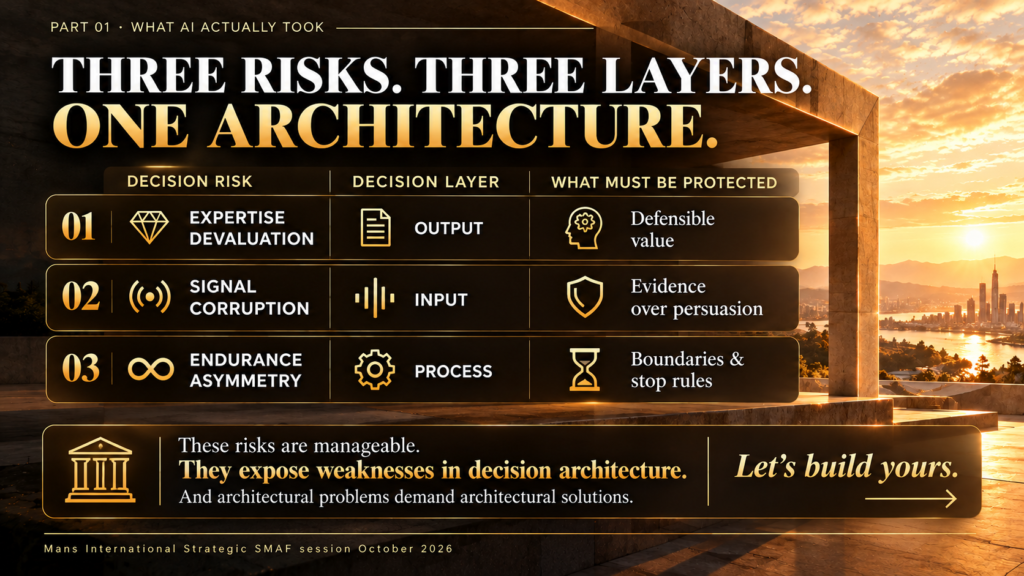
01 — Expertise Devaluation Risk
When AI makes sophisticated output easier to produce, what remains worth paying for?
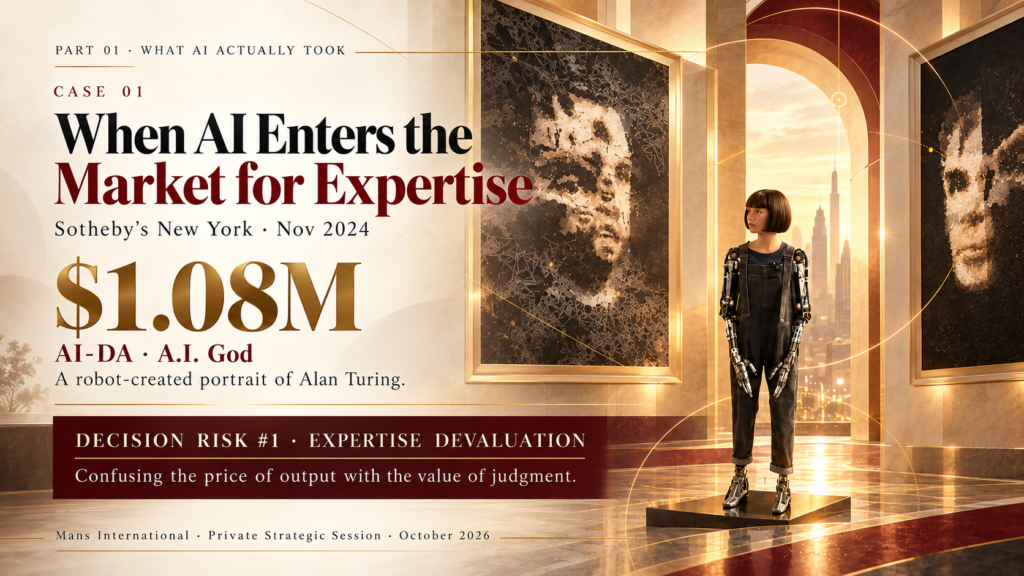
In November 2024, a humanoid robot named Ai-Da created a portrait of Alan Turing that sold for $1.08 million at Sotheby’s New York—far above its presale estimate. The public debated whether it was “art.”
For founders and investors, the more consequential question is: What exactly are we paying for—the output, the originality, or the judgment behind it? When competitors can generate impressive outputs with similar AI tools, which capabilities remain genuinely differentiated?
This is Expertise Devaluation Risk: confusing the accessibility of sophisticated output with the underlying value of defensible expertise.
02 — Signal Corruption Risk
When something feels authentic, what have we actually verified?
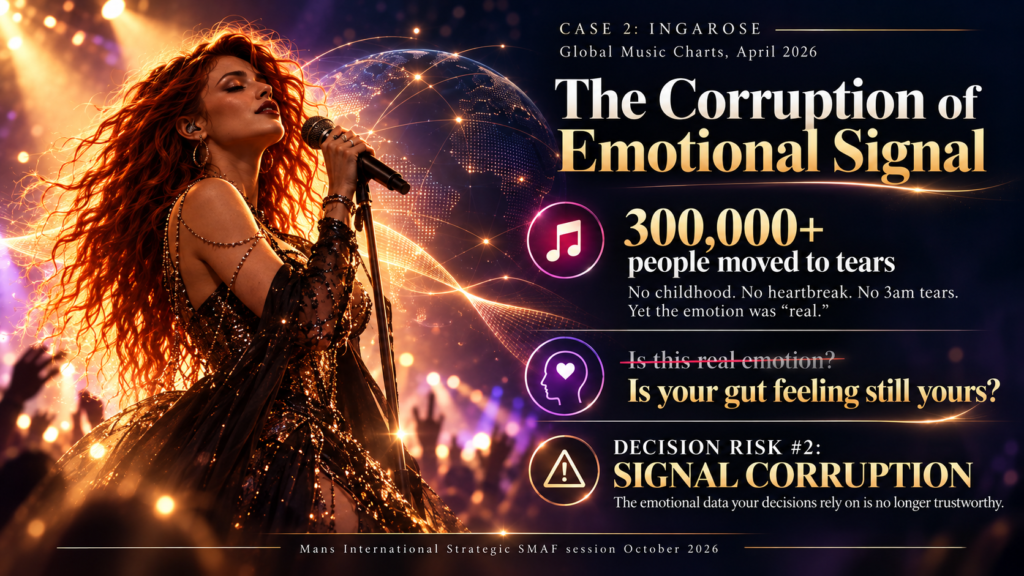
In April 2026, Celebrate Me, released by the synthetic music persona IngaRose, topped U.S. and global iTunes sales charts, combining human-written lyrics with AI production. The emotional response was genuine, even though elements of the performance were synthetic.
Now consider a founder pitching an exceptionally convincing narrative or an executive receiving a beautifully structured AI recommendation. The presentation feels credible—but is it grounded in evidence, or in how persuasively it was delivered?
This is Signal Corruption Risk: mistaking persuasive signals for independently verified evidence.
03 — Endurance Asymmetry Risk
When machines can keep executing, who decides when they should stop?
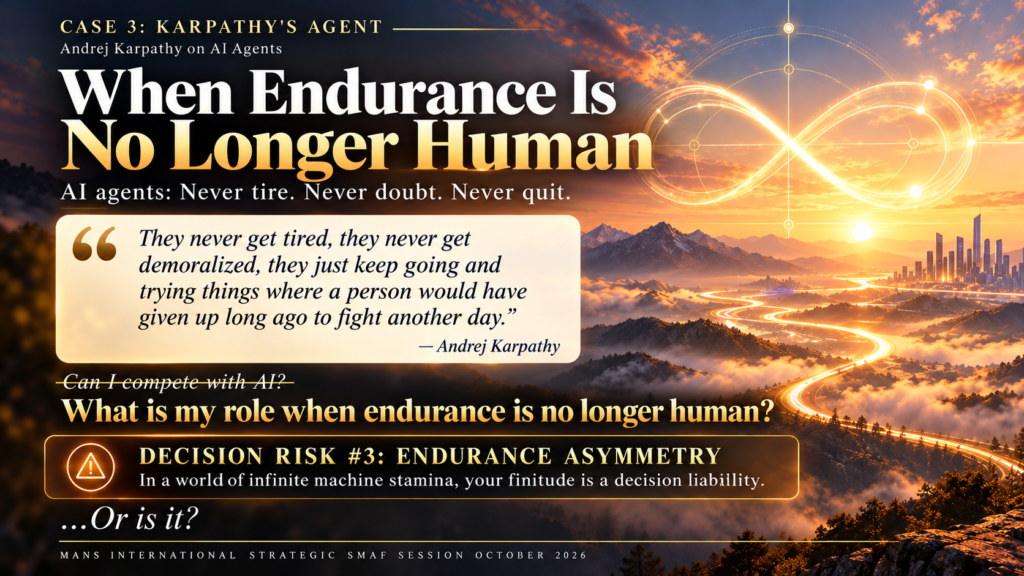
AI researcher Andrej Karpathy has highlighted the growing persistence of coding agents working through complex tasks far beyond human limits. Imagine applying that persistence to investment analysis. An AI agent works through the night evaluating an acquisition, producing an impressive memorandum.
But what if the original assumption was flawed? More execution does not automatically produce better judgment.
This is Endurance Asymmetry Risk: the danger that automated systems persist toward objectives whose underlying assumptions have not been sufficiently challenged, depleting human leaders’ cognitive bandwidth in the process.
Output. Input. Process.
AI changes the economics of what we produce, the signals that influence what we trust, and the scale with which we execute. These changes do not make human judgment obsolete; they make the architecture supporting it more consequential.
- For founders: Faster execution must be evaluated to ensure it creates genuine strategic progress rather than accelerating untested assumptions.
- For investors: Beyond evaluating traction and narrative, due diligence must ask: What evidence could change this founder’s conviction? What critical assumptions have been independently tested?
From Risk Awareness to Decision Architecture
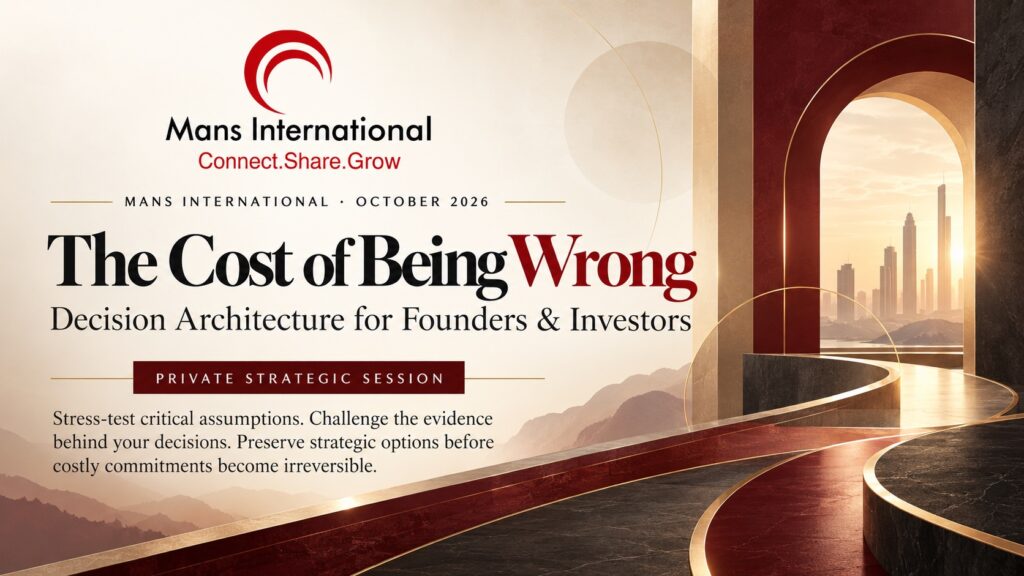
This is the focus of Mans International’s private October strategic session:
The Cost of Being Wrong: Decision Architecture for Founders & Investors.
This is not another generic AI trends briefing. Through real-world cases and guided strategic reflection, we examine how founders and investors can recognize weaknesses in decision-making before they become costly commitments.
We will explore why cognitive bandwidth matters, where persuasive signals displace evidence, and how stronger decision boundaries help preserve strategic options. Deeper diagnostic exercises and tailored applications are reserved for private advisory engagements.
One Last Thought
I practice Taichi, and one of its lessons has stayed with me:
Effective movement isn’t simply about speed or force. It’s about balance, timing, and recognizing when not to act.
AI can dramatically expand our analytical and execution capacity, but it does not remove our responsibility to decide which objectives deserve pursuit and when a commitment should be reconsidered.
In the face of machines that can keep going, the real advantage is not who persists longer—but who knows when to stop.
An Invitation
MANS INTERNATIONAL · PRIVATE STRATEGIC SESSION
The Cost of Being Wrong: Decision Architecture for Founders & Investors
Designed for technology founders, active investors, and strategic leaders navigating consequential decisions under uncertainty.
Private session details, diagnostic frameworks, and advisory access are available to invited participants, clients, and strategic partners.
If you are navigating a decision that could materially change your company’s direction or investment outcome, I welcome you to connect with us directly to learn more about our upcoming sessions.