The Cost of Being Wrong: Why Your Decision Process Matters More Than Ever

The Cost of Being Wrong Decision Architecture for Founders & Investors Mans International

Kelly’s Global Tech Intelligence #244; Issue 56, 2026
The Cost of Being Wrong Decision Architecture for Founders & Investors Mans International
The Cost of Being Wrong Decision Architecture for Founders & Investors

There is a question I’ve been returning to throughout 2026:

Am I making a decision—or simply executing a pattern?

Imagine a founder who has just closed a major funding round. The team is growing. The product roadmap is accelerating. AI tools are making execution faster than ever.

Everything appears to be moving in the right direction.

But here’s the uncomfortable question:

Is the founder’s judgment improving at the same pace as the company’s ability to execute?

I’ve spent much of this year examining how AI changes technology commercialization, investment decisions, and the role of human judgment. One conclusion keeps resurfacing:

Your data can be accurate. Your team can be talented. Your AI can be powerful. And your decision can still be wrong.

Not necessarily because you lacked information—but because the assumptions connecting that information to your decision were never adequately challenged.

This is the core premise behind Mans International’s October strategic session.

The Cost of Being Wrong: Why Your Decision Process Matters More Than Ever

Decision Architecture for Founders & Investors in the Age of AI
The Cost of Being Wrong — Decision Architecture for Founders & Investors, Mans International private strategic session, October 2026.
Decision Architecture for Founders & Investors Mans International Strategic Session Oct.2026

Founders routinely audit their financials, technology, and operational performance. Investors examine market size, competitive moats, traction, and capital efficiency.

But how often do we examine the architecture behind the decisions themselves?

And how often do we account for the finite attention—the cognitive bandwidth—required to make those decisions well?

As AI makes information and execution more accessible, competitive advantage increasingly depends on what we choose to believe, which assumptions we challenge, and when we decide to act.

I call the structure connecting evidence, assumptions, judgment, and action our Decision Architecture. It deserves at least as much scrutiny as the technology we build.

Three AI Shifts. Three Decision Risks. One Architecture.

Recent developments illustrate how the economics and boundaries of strategic judgment are shifting:

01 — Expertise Devaluation Risk

When AI makes sophisticated output easier to produce, what remains worth paying for?
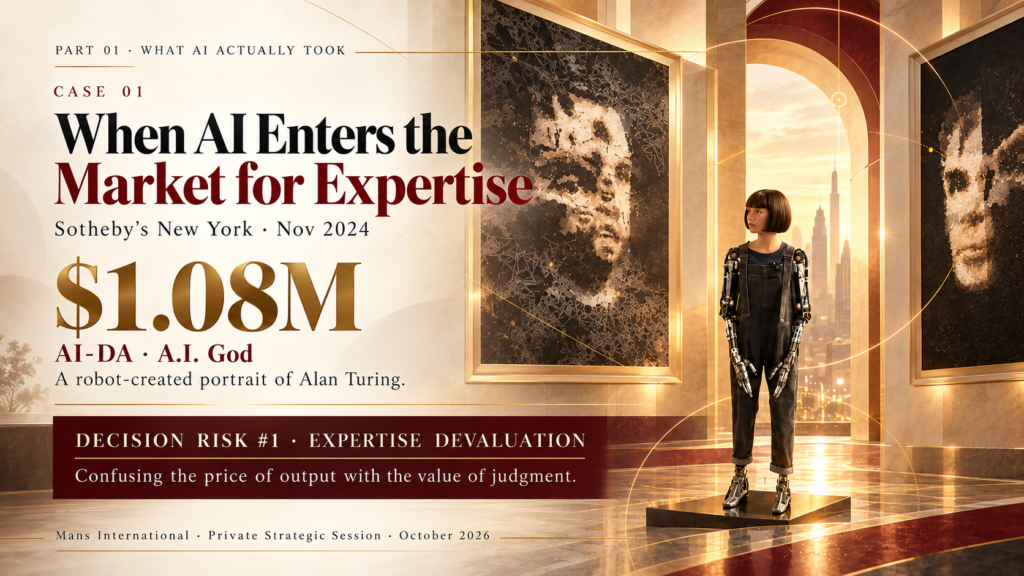
Case 1 AI-Da KellyOnTech Mans International
Decision Risk #1: Expertise Devaluation

In November 2024, a humanoid robot named Ai-Da created a portrait of Alan Turing that sold for $1.08 million at Sotheby’s New York—far above its presale estimate. The public debated whether it was “art.”

For founders and investors, the more consequential question is: What exactly are we paying for—the output, the originality, or the judgment behind it? When competitors can generate impressive outputs with similar AI tools, which capabilities remain genuinely differentiated?

This is Expertise Devaluation Risk: confusing the accessibility of sophisticated output with the underlying value of defensible expertise.

02 — Signal Corruption Risk

When something feels authentic, what have we actually verified?
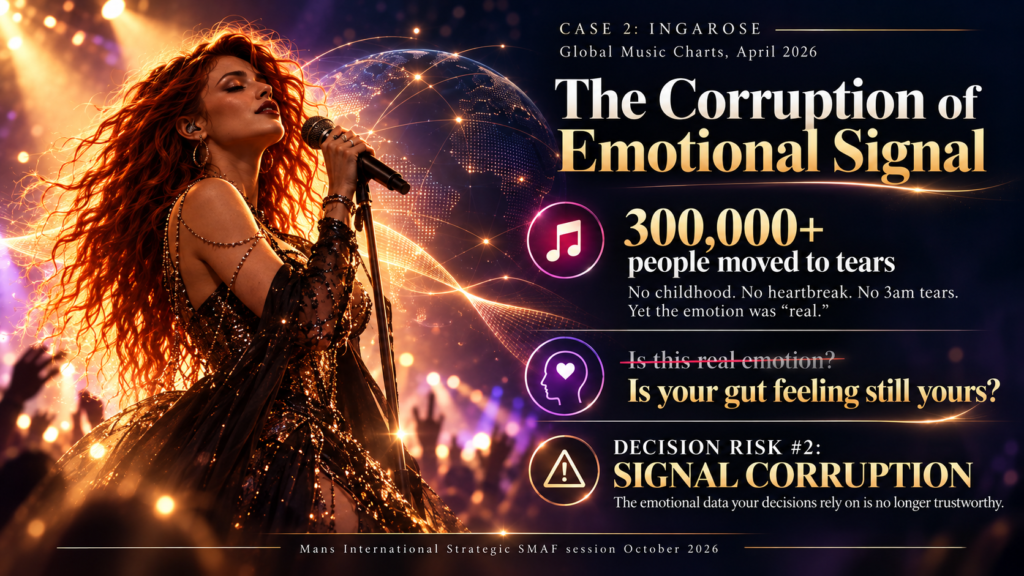
Decision Risk #2: Signal Corruption

In April 2026, Celebrate Me, released by the synthetic music persona IngaRose, topped U.S. and global iTunes sales charts, combining human-written lyrics with AI production. The emotional response was genuine, even though elements of the performance were synthetic.

Now consider a founder pitching an exceptionally convincing narrative or an executive receiving a beautifully structured AI recommendation. The presentation feels credible—but is it grounded in evidence, or in how persuasively it was delivered?

This is Signal Corruption Risk: mistaking persuasive signals for independently verified evidence.

03 — Endurance Asymmetry Risk

When machines can keep executing, who decides when they should stop?
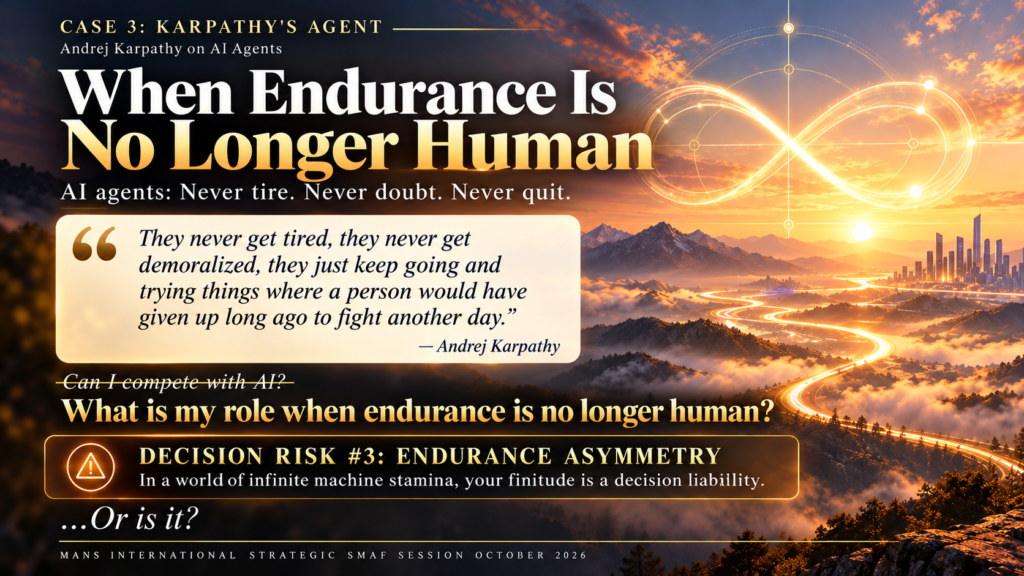
Decision Risk #3: Endurance Asymmetry

AI researcher Andrej Karpathy has highlighted the growing persistence of coding agents working through complex tasks far beyond human limits. Imagine applying that persistence to investment analysis. An AI agent works through the night evaluating an acquisition, producing an impressive memorandum.

But what if the original assumption was flawed? More execution does not automatically produce better judgment.

This is Endurance Asymmetry Risk: the danger that automated systems persist toward objectives whose underlying assumptions have not been sufficiently challenged, depleting human leaders’ cognitive bandwidth in the process.

Output. Input. Process.

AI changes the economics of what we produce, the signals that influence what we trust, and the scale with which we execute. These changes do not make human judgment obsolete; they make the architecture supporting it more consequential.
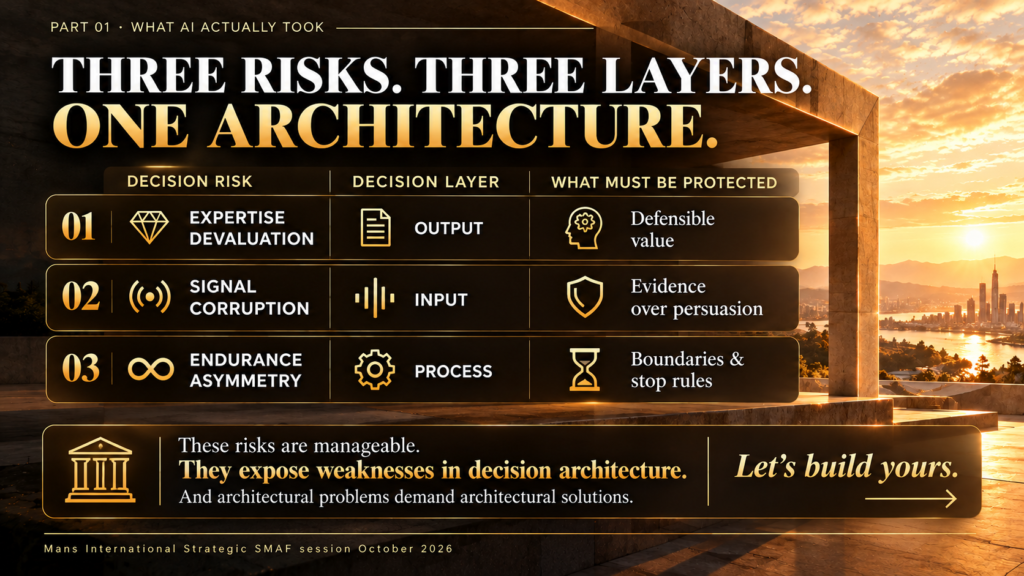
Decision Risks
  • For founders: Faster execution must be evaluated to ensure it creates genuine strategic progress rather than accelerating untested assumptions.
  • For investors: Beyond evaluating traction and narrative, due diligence must ask: What evidence could change this founder’s conviction? What critical assumptions have been independently tested?

From Risk Awareness to Decision Architecture

This is the focus of Mans International’s private October strategic session:

The Cost of Being Wrong: Decision Architecture for Founders & Investors.

This is not another generic AI trends briefing. Through real-world cases and guided strategic reflection, we examine how founders and investors can recognize weaknesses in decision-making before they become costly commitments.

We will explore why cognitive bandwidth matters, where persuasive signals displace evidence, and how stronger decision boundaries help preserve strategic options. Deeper diagnostic exercises and tailored applications are reserved for private advisory engagements.

One Last Thought

I practice Taichi, and one of its lessons has stayed with me:

Effective movement isn’t simply about speed or force. It’s about balance, timing, and recognizing when not to act.

AI can dramatically expand our analytical and execution capacity, but it does not remove our responsibility to decide which objectives deserve pursuit and when a commitment should be reconsidered.

In the face of machines that can keep going, the real advantage is not who persists longer—but who knows when to stop.

An Invitation

MANS INTERNATIONAL · PRIVATE STRATEGIC SESSION

The Cost of Being Wrong: Decision Architecture for Founders & Investors

Designed for technology founders, active investors, and strategic leaders navigating consequential decisions under uncertainty.

Private session details, diagnostic frameworks, and advisory access are available to invited participants, clients, and strategic partners.

If you are navigating a decision that could materially change your company’s direction or investment outcome, I welcome you to connect with us directly to learn more about our upcoming sessions.
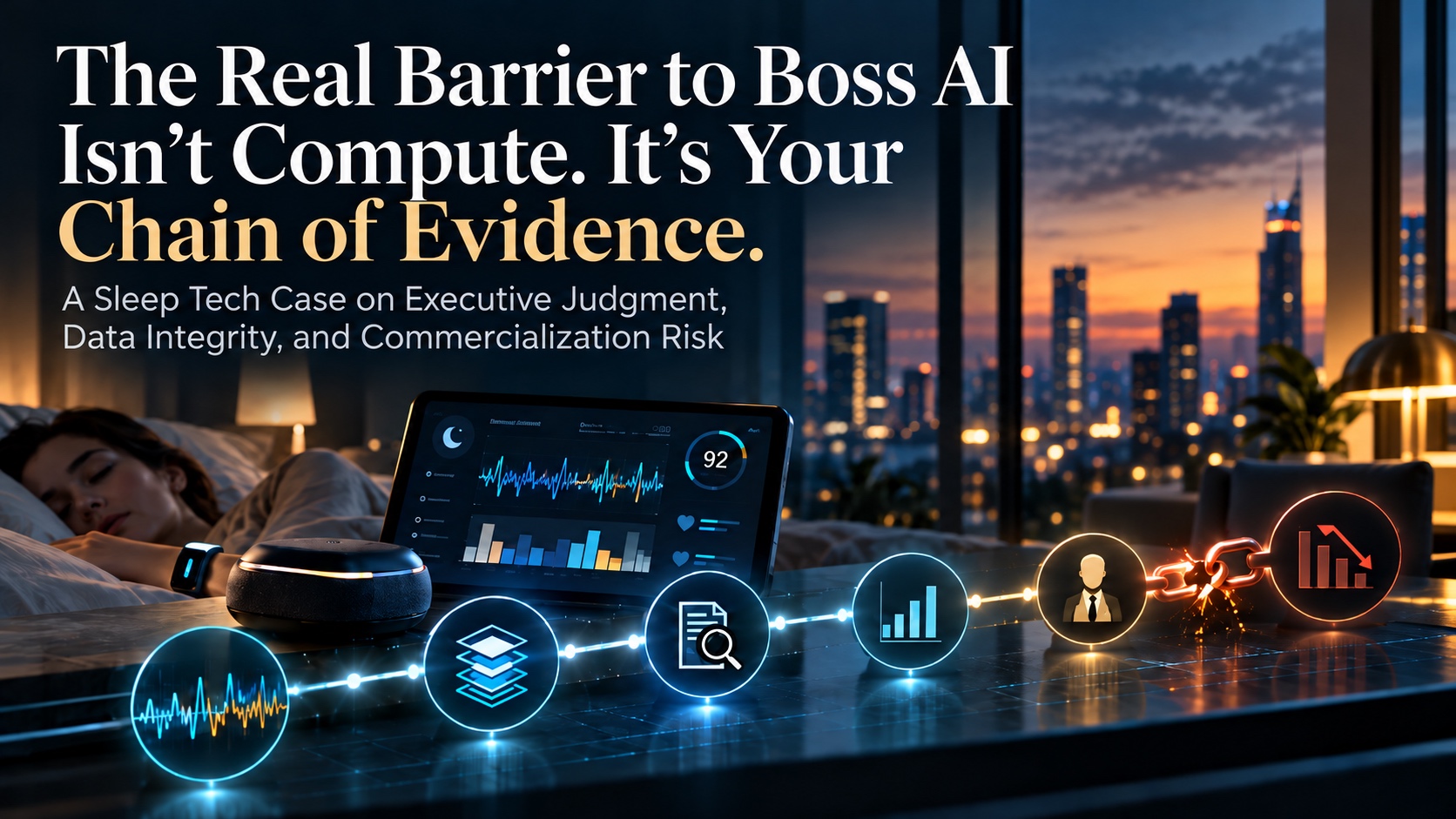
The Real Barrier to Boss AI Isn’t Compute. It’s Your Chain of Evidence.

The Barrier to Boss AI is your chain of Evidence Mans International
The Real Barrier to Boss AI Isn't Compute. It's Your Chain of Evidence. Mans International

A Sleep Tech Case on Executive Judgment, Data Integrity, and Commercialization Risk

Kelly’s Global Tech Intelligence #242; Issue 54, 2026

Imagine a Sleep Tech company reporting steadily improving completion rates and sleep outcomes.

The executive dashboard looks encouraging. User engagement is rising, and nearly every key performance indicator is green.

Yet, one fundamental question deserves more attention than the growth curve itself:

“Who defined ‘completion’ and ‘improvement’ in the first place?”

  • The product team measures whether users consistently operate their devices.
  • The medical team evaluates the technical quality of sleep-monitoring signals.
  • The operations team tracks app check-ins and daily active use.

All three departments may be reporting completely accurate numbers. Yet they are not necessarily measuring the same outcome.

Device activity does not establish clinical adherence. Complete data records do not demonstrate improved sleep. And daily app check-ins cannot prove that an intervention creates lasting health value.

Every number is right. But the conclusion may be wrong. Mans International
Every number is right. But the conclusion may be wrong.

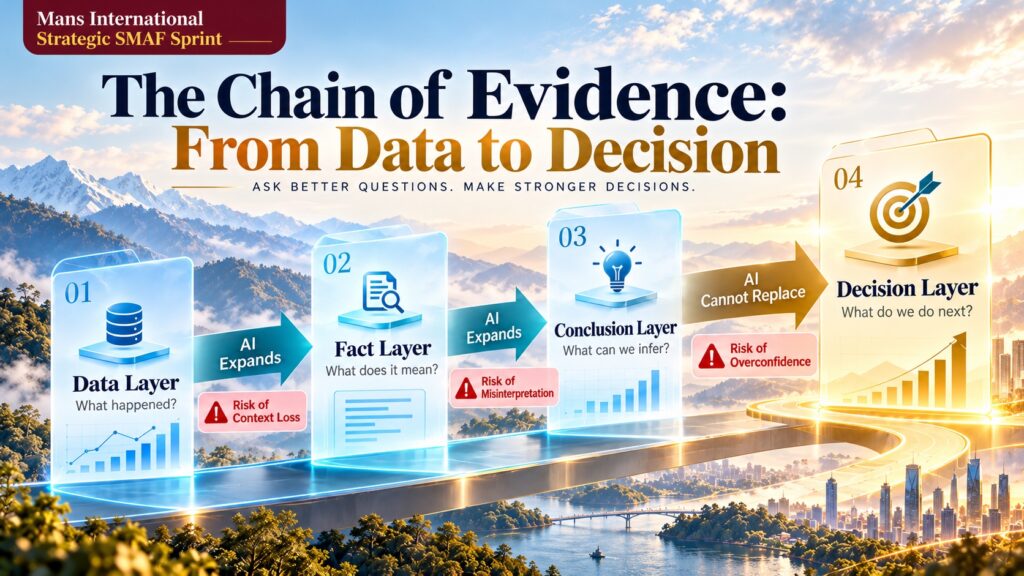
The most dangerous business decisions are rarely built on false data. They emerge from accurate metrics that collectively support the wrong conclusion.

As companies introduce AI-powered executive decision assistants—increasingly described as “Boss AI” (autonomous agents designed to aid and challenge executive decision-making)—this distinction becomes critical.

01 | What Is Boss AI? (And Why Your Dashboard Isn’t Enough)

Traditional dashboards summarize performance, identify trends, and flag anomalies. Advanced analytics platforms provide real-time reporting.

Boss AI must offer something fundamentally deeper.

Its true value lies in helping leadership question the underlying evidence and assumptions behind a conclusion—not simply presenting that conclusion with greater conviction.

Consider a Sleep Tech platform detecting an anomaly in overnight monitoring data.

A dashboard can identify the anomaly. An AI assistant may suggest possible causes. But interpreting the signal requires an understanding of the context in which the data was generated. This is where executive judgment remains essential.

This chain of evidence is further complicated by global market nuances. Over two decades of working across North America, Europe, and Asia, I’ve seen that identical data patterns can reflect very different user behaviours and operating environments. In my experience:

  • In certain North American demographics, missing environmental data often stems from deliberate privacy choices rather than hardware glitches.
  • In multi-generational households, common across Asian markets, ambient noise introduces background variables that alter algorithm interpretation.

These are the weak signals executives cannot blindly delegate to automated systems.

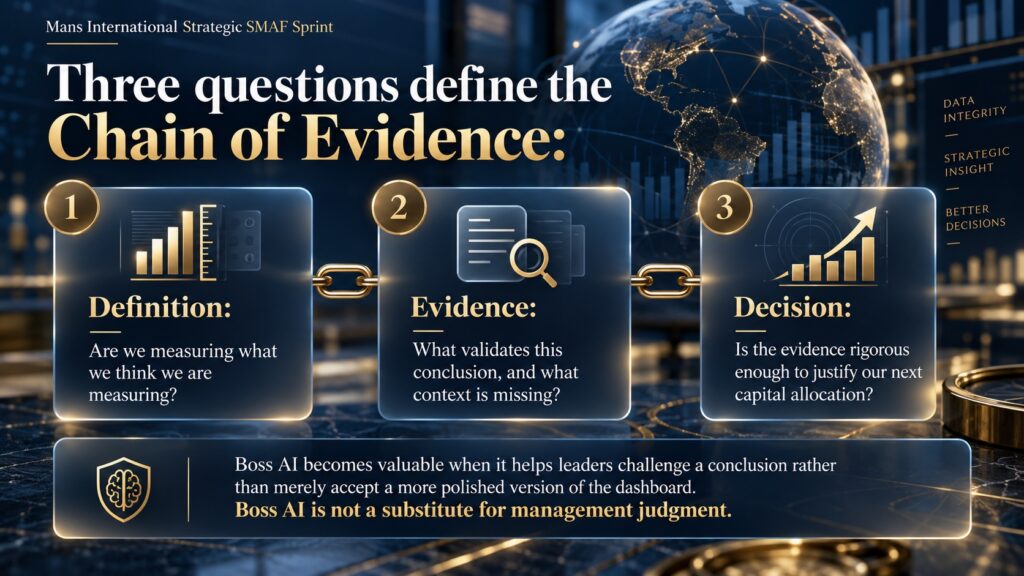
Three questions define the Chain of Evidence Mans International
Three questions define the Chain of Evidence

AI identifies patterns at unprecedented speed, but statistical confidence does not automatically equal commercial significance. For executives and board members facing high-stakes decisions, three questions define the Chain of Evidence:

  1. Definition: Are we measuring what we think we are measuring?
  2. Evidence: What validates this conclusion, and what context is missing?
  3. Decision: Is the evidence rigorous enough to justify our next capital allocation?

Boss AI becomes valuable when it helps leaders challenge a conclusion rather than merely accept a more polished version of the dashboard. Boss AI is not a substitute for management judgment.

It can help leaders explore relationships, challenge assumptions, and evaluate alternatives. But it cannot replace responsibility for determining what the evidence actually supports.

02 | Decision-Making Under Uncertainty: Stress-Test Your Assumptions

Consider a strategic crossroads facing many health tech founders:

Should the company pursue a regulated medical pathway (such as clinical sleep apnea screening) or launch a consumer wellness offering?

Both pathways offer substantial enterprise value, but their risk profiles differ completely:

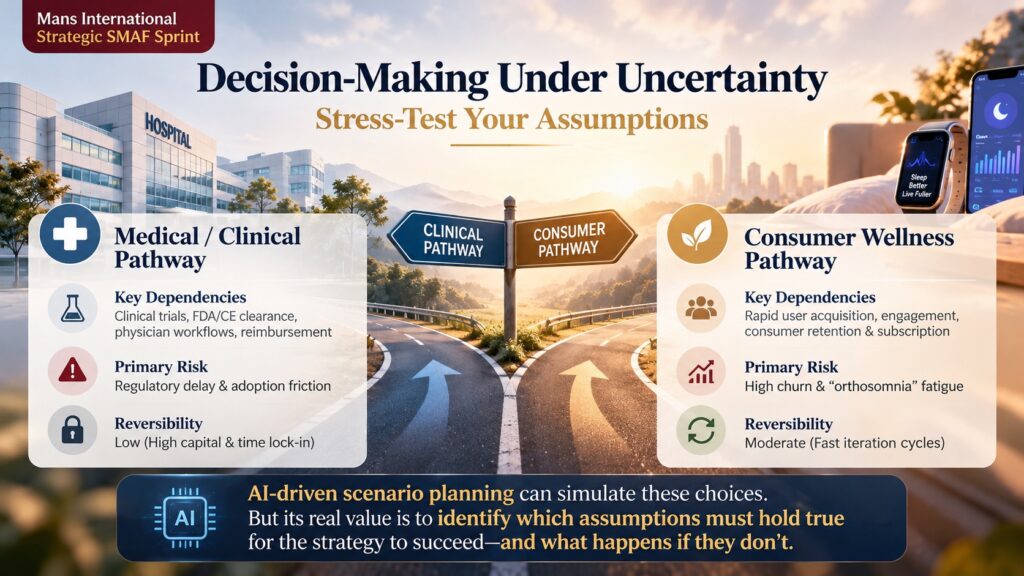
Strategic Dimension

Medical / Clinical Pathway

  • Key Dependencies: Clinical trials, FDA/CE clearance, physician workflows, reimbursement
  • Primary Risk: Regulatory delay & adoption friction
  • Reversibility: Low (High capital & time lock-in)

Consumer Wellness Pathway

  • Key Dependencies: Rapid user acquisition, engagement, consumer retention & subscription
  • Primary Risk: High churn & “orthosomnia” fatigue
  • Reversibility: Moderate (Fast iteration cycles)
Medical Pathway vs. Consumer Wellness Pathway Mans International
Medical Pathway vs. Consumer Wellness Pathway

AI-driven scenario planning can simulate these choices. But its real value is to identify which assumptions must hold true for the strategy to succeed—and what happens if they don’t.

  • Reversible decisions can be tested quickly in market micro-experiments.
  • Irreversible decisions—such as multi-year clinical trials or complex reimbursement submissions—demand an unshakeable chain of evidence before capital is deployed.

For venture and growth investors, this distinction is paramount. A founder who transparently presents the fragile assumptions behind their model demonstrates far greater executive judgment than one who presents a flawless forecast built on unvalidated premises.

AI expands analytical capacity. It cannot assume accountability for capital allocation.

03 | Why Strategic Diagnosis Must Precede AI Scenario Planning

In advisory engagements across North America, Europe, and Asia, one rule holds true:

Technology readiness and commercial readiness are not the same thing.

A company may possess proprietary algorithms, strong pilot engagement, and a compelling technical roadmap while lacking the operational foundations for scalable, repeatable commercial growth.

This is why we position the Strategic SMAF Diagnostic prior to broader strategic advisory at Mans International.

The Scenario Maturity Assessment Framework (SMAF™) evaluates whether a technology venture is truly prepared for its target commercial, clinical, and regulatory environment.

Rather than applying a generic checklist, the diagnostic isolates the specific uncertainties, blind spots, and commercialization risks that could compromise your next major milestone.

Without this baseline, sophisticated AI decision models simply make fragile assumptions look more persuasive.

Proving that a technology works in a trial is not the same as proving that a business can scale in the market.

A Final Question for Health Tech Leaders

Boss AI is not a substitute for executive judgment. It is a tool to challenge assumptions, stress-test evidence, and illuminate hidden risks.

The Chain of Evidence Mans International
The Chain of Evidence
  • For Founders: Before committing to your next growth round or commercial expansion, can you clearly separate demonstrated clinical/commercial value from assumptions about scalability?
  • For Investors: When evaluating a digital health portfolio company, are you seeing evidence of sustainable market pull—or merely well-packaged engagement metrics?

The gap between these two outcomes determines whether your next capital deployment builds compounding enterprise value or funds an expensive misunderstanding.

Partner With Mans International

At Mans International, our Strategic SMAF Diagnostic helps technology founders, investment teams, and family offices examine strategic blind spots and commercialization risks before committing major capital.

If your organization is approaching a critical expansion, investment round, or enterprise AI decision, let’s discuss whether a tailored strategic diagnostic is right for you.

[ Book a 20-minute scoping call]

Connect. Share. Grow.

Mans International

Global Tech Strategy & Growth Advisory

Inside OpenEvidence’s $12B Rise: The Playbook Winning AI Companies Share

Inside OpenEvidence’s $12B Rise: The Playbook Winning AI Companies Share Mans International
Inside OpenEvidence’s $12B Rise: The Playbook Winning AI Companies Share

In eleven months, OpenEvidence went from a $1 billion valuation to $12 billion. By April 2026, the company reported that its platform was being used by approximately 65% of US physicians and supported nearly 27 million clinical consultations that month, with much of its adoption attributed to physician word-of-mouth.

Think explosive growth is just about having the best AI tech? It’s not. If you look at the AI companies truly scaling today, their real competitive edge is deep market insight. Too many founders skip this step because they’re rushing to build something impressive instead.

Many view AI as a dragon coming to burn down their industry. But it also represents transformative and generative power. If you cannot outmuscle a force like that, you learn to ride it to become stronger.

As AI shifts from a simple tool to an autonomous agent, completing complex work with less and less human intervention, founders face a clear choice: draw a sword, or learn to fly.

Qian and the Anatomy of a Founder

The I Ching (Book of Changes), an ancient Chinese philosophical text, uses the dragon as a central metaphor in its first hexagram, Qian (The Creative). It tracks a dragon through six stages of maturation — from total obscurity to full command of the sky. It perfectly mirrors the modern founder’s journey.

Peter Diamandis, founder of the XPRIZE Foundation, describes five mindsets that keep people stable and effective through accelerating change: curiosity, abundance, exponential thinking, longevity, and moonshot thinking. Map them onto the dragon’s ascent and you get an operating system for building through the AI era — one altitude at a time, plus a warning at the top that most founders skip.

1. Hidden Dragon — The Curiosity Mindset

“The dragon is hidden. Do not act.”

1. Hidden Dragon — The Curiosity Mindset Mans International
1. Hidden Dragon — The Curiosity Mindset

At the earliest stage, the market doesn’t know you exist, and that’s fine. This is a research phase. The Curiosity Mindset is the fuel: what specific problem does this technology actually solve, for whom, better than the current alternative? Curiosity prevents premature action and allows you to deeply understand the landscape before making your move.

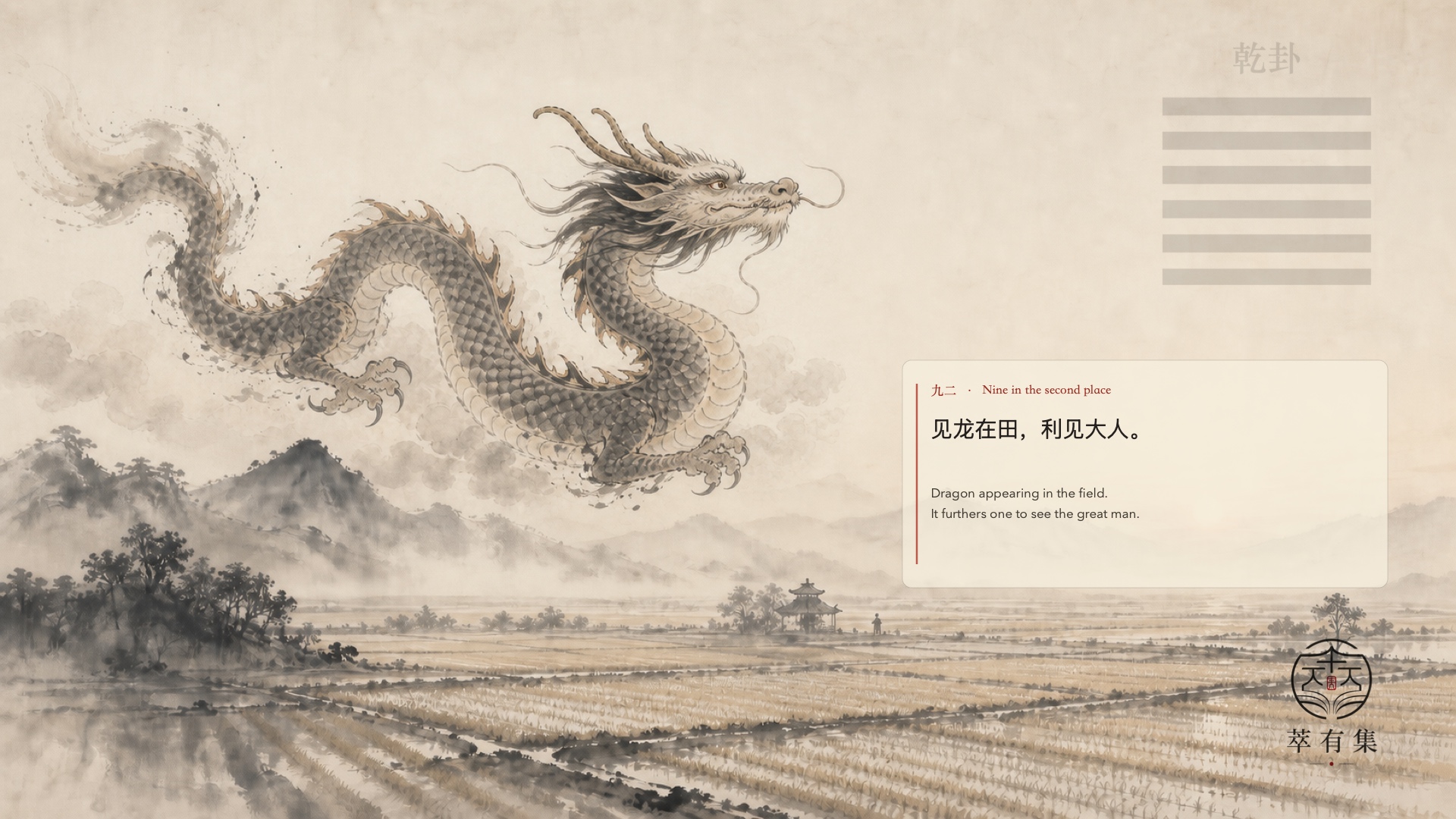
2. Dragon in the Field — The Abundance Mindset

“The dragon appears in the field. It furthers one to see the great man.”

2. Dragon in the Field — The Abundance Mindset Mans International
2. Dragon in the Field — The Abundance Mindset

You launch, and suddenly you’re standing next to other companies with more computing power, more data, and more capital than you’ll ever have. This is where scarcity thinking kills founders, treating AI as a fixed pie that a handful of giants will win.

An abundance mindset realizes that AI is driving the cost of intelligence toward zero, baking an infinitely larger pie. You now have the tools to build things that would have required a much larger engineering team just a few years ago.

3. The Diligent Dragon — The Longevity Mindset

3. The Diligent Dragon — The Longevity Mindset Mans International
3. The Diligent Dragon — The Longevity Mindset

“All day long the superior man is creatively active. At nightfall his mind is still beset with cares. Danger. No blame.”

This is the grind. You have entered the market and are building furiously, but the psychological and physical pressure is immense. You are active all day, yet anxious at night. To survive this perilous phase of non-stop execution, founders must adopt the Longevity Mindset.

A Yale study led by Professor Becca Levy found that older adults with more positive views of aging lived about 7.5 years longer. For founders, the Longevity Mindset applies this same logic to the body and the organization: you cannot reach the next stage on a burned-out founder or a brittle team. Resilience works as load-bearing infrastructure for the leap itself.

4. Leaping Dragon — The Exponential Mindset

4. Leaping Dragon — The Exponential Mindset Mans International
4. Leaping Dragon — The Exponential Mindset

“The dragon leaps over the abyss. No blame.”

This is the scaling phase, the most dangerous part of the journey. To cross the chasm, founders must adopt the Exponential Mindset.

Human brains are wired to think linearly, but AI advances exponentially. The Exponential Mindset means architecting for where the model will be in eighteen months, not where it is on launch day.

Founders who build their product roadmap against today’s capability ceiling are already building a legacy product. You must anticipate the leap, building infrastructure that scales with the compounding intelligence of the models themselves.

5. Flying Dragon — The Moonshot Mindset and Scenario Maturity

5. Flying Dragon — The Moonshot Mindset and Scenario Maturity Mans International
5. Flying Dragon — The Moonshot Mindset and Scenario Maturity

“The flying dragon is in the heavens. It furthers one to see the great man.”

The Moonshot Mindset treats “impossible” as an unsolved engineering problem rather than a wall. But a moonshot without a landing site is just a hallucination with better production values. What separates a flying dragon from an expensive fireworks show is Scenario Maturity — a check on whether the specific use case you’ve chosen, not the technology in general, is actually ready to fly.

That means asking harder questions, such as:

  • Is there a real buyer, with real budget and real urgency, ready to act now rather than someday?
  • Does the workflow generate a feedback loop that compounds in your favor the longer you run it?
  • Can today’s models actually do the job reliably at the point of use?

Get that match right, and the moonshot has somewhere to land. Chase ambition alone, and you’ve built a very well-funded crash.

Case in Point: Open Evidence

Open Evidence is an AI-powered medical search engine and clinical decision-support platform that allows verified healthcare professionals to ask complex medical questions and receive rapid answers grounded in peer-reviewed literature. It demonstrates scenario maturity through a precise, high-stakes alignment of buyer, monetization, moat, and capability match:

  • The Buyer & Monetization: Targeted physicians making time-sensitive decisions at the point of care. Instead of inventing a new budget, it tapped into existing pharmaceutical marketing dollars by keeping the tool free for verified doctors and monetizing via contextually relevant pharma advertising.
  • The Moat: Built exclusively on peer-reviewed medical journals and direct content partnerships with elite institutions like the American Medical Association and the New England Journal of Medicine. The data asset is compounded by proprietary, verified clinical consultation loops that competitors cannot easily replicate.
  • The Capability Match: Bounded the problem domain tightly to clinical medicine rather than attempting open-ended consumer chat, allowing current-generation models to maintain exceptional reliability.

That combination, not a superior model, is what turned a niche physician tool into the fastest-scaling case in the sector.

One Line Further: The Arrogant Dragon

One Line Further: The Arrogant Dragon Mans International
One Line Further: The Arrogant Dragon

The Qian hexagram doesn’t stop at the flying dragon. Its sixth and final line describes a dragon that has flown too high — an overreaching dragon with cause for regret. It’s the founder who mistakes access to a powerful model for scenario readiness, and pours capital into the most exciting application instead of the most prepared one.

The lesson isn’t to stop climbing. It’s to keep re-checking, at every altitude, whether the business, the data, and the technology are actually ready for where ambition wants to take you.

The Human Edge: Judgment Over Data

If AI can already process the available information instantly, where does human advantage come from?

Howard Marks, co-founder of Oaktree Capital, drew this line decades before anyone was worried about AI:

  • first-level thinking stops at the obvious conclusion;
  • second-level thinking asks what everyone else is missing, and what happens next because of it.

AI has made first-level thinking free — any model can summarize the data, the consensus, the obvious take, instantly. That pushes the entire edge left for founders and investors up to the second level:

  • Judging the second-order effects of what the data actually implies, not just what it states.
  • Weighing what can’t be measured — management quality, grit, the structural maturity of a scenario.
  • Deciding, on conviction, which future is worth building toward before the market has agreed with you.
The Human Edge: Judgment Over Data Mans International
The Human Edge: Judgment Over Data

AI is an incredibly powerful engine, but it lacks a soul. It lacks intent. Understanding the limitations of AI allows us to shed the victim mindset and reclaim our natural birthright as creators.

No matter how powerful the machine becomes, the human founder still evaluates the scenario and sets the destination – at least for now. We remain in charge of our lives, fully capable of shaping our own destinies.

Do not fear the dragon. Find your scenario, and ride it.

蔡磊的最后一次创业:当旧地图失效创始人如何重构一个无解场景?

蔡磊的最后一次创业:当旧地图失效创始人如何重构一个无解场景?Mans International

导语:

《易经・乾卦》有云:“天行健,君子以自强不息。” 这份无论处于哪种际遇,都能尽己所能的底层力量,在蔡磊的实践中得到了最极致的印证。

2019 年,41 岁的蔡磊确诊渐冻症(ALS)。彼时他身为京东副总裁、中国电子发票第一人,刚迎来新生命,正处于事业与家庭的双重巅峰。而医生给出的 2-5 年平均生存期,为他按下了冰冷的人生倒计时。

蔡磊的最后一次创业:当旧地图失效创始人如何重构一个无解场景?Mans International
蔡磊的最后一次创业:当旧地图失效创始人如何重构一个无解场景?

七年后的今天,他的身体功能评分从 48 分跌至 4 分,脖颈以下完全瘫痪,声带彻底萎缩,依赖流食与 24 小时呼吸机维持生命,全身上下仅剩双眼可以自主控制。

蔡磊的故事,远不止一场关于抗争与共情的励志叙事,从产业视角出发,用 SMAF(场景成熟度评估框架)拆解便会发现:这更是一场教科书级的深科技场景破局 —— 一套完整的成熟度体系,将全球医学界公认的 “无解绝境”,重构为高成熟度、自循环的科研协作与产业转化生态。

一、SMAF 框架深度拆解:蔡磊的 “破冰之战”,为何是罕见病领域的高成熟度超级生态

在 Mans International,我们使用SMAF(场景成熟度评估框架 / Scenario Maturity Assessment Framework) 来评估深科技与跨国项目的落地潜力。我们见过太多死于“PPT造车”或“实验室自嗨”的项目。

从场景成熟度的角度看,蔡磊的“破冰”行动真正厉害的地方,不只是“相信”,而是把相信之后的每一步,把一个原本高度破碎、长期低效、缺乏足够资源关注的罕见病场景,逐步组织成了一个患者、数据、样本、科研、临床、资金、AI 与公众信任共同参与的协同系统。

1. 数据和工作流:从零散病友到研发基础设施

罕见病研发最大的难题之一,是患者分散、样本稀缺、真实世界数据不足。很多时候,科研并不是没有方向,而是缺少足够稳定、持续、可用的数据基础。

蔡磊牵头搭建的“渐愈互助之家”,是全球最大的民间渐冻症科研数据库(注册量突破18000人),收录了上万份结构化的真实世界病例。

数据和工作流:从零散病友到研发基础设施 Mans International
  • 在工作流端:这套360度动态生命指标跟踪系统,将原本极其低效的临床招募压缩到了令人惊叹的速度——实现以“小时”为单位的极速响应(2小时700人报名,3个月内开启临床)。
  • 在数据端:他启动了“渐冻症科研AI大脑”,全天候训练全网超2000万篇跨学科文献。AI 没有增加研究员的负担,而是“消失”在科研工作中,自动过滤与进化靶点。

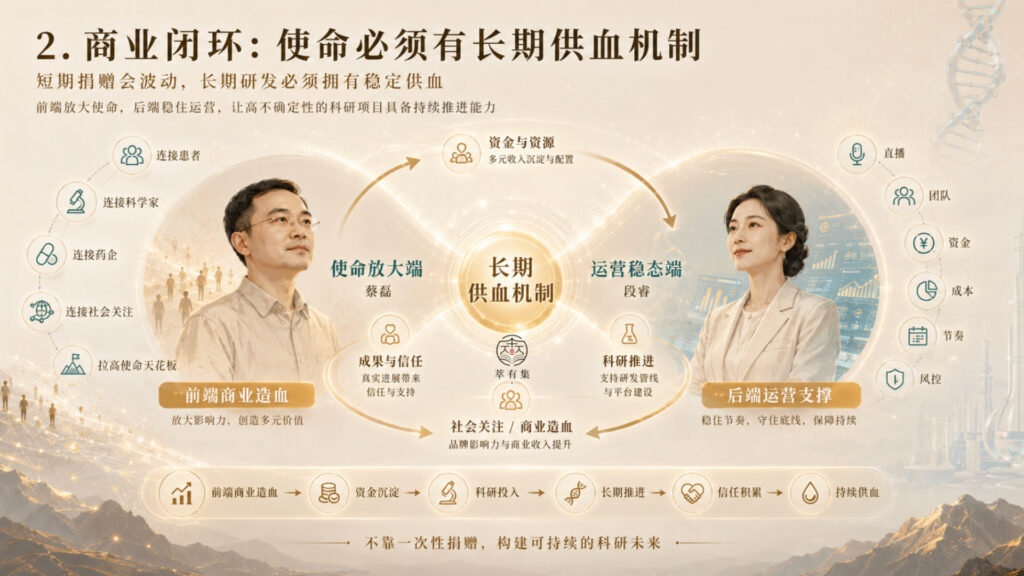
2. 商业闭环:使命必须有长期供血机制

罕见病科研很难完全依赖短期捐赠或单点资助。药物研发周期长、失败率高、资金需求持续,而外部融资环境、公益热度和社会关注度都会波动。如果没有稳定的资金来源,再宏大的使命也很容易在中途失血。

蔡磊和段睿所形成的夫妻共患难组合,恰恰体现了愿景与运营的互补。很多人看到段睿的直播,会首先想到“妻子的牺牲”。这当然是真实的,也是令人动容的。但在商业视角下,这是极其高明的商业闭环设计。

蔡磊负责不断拉高使命天花板,连接患者、科学家、药企和社会关注;段睿则承担大量现实层面的运营压力,包括直播、团队、资金、成本、节奏和风险控制。这种“前端商业造血+后端科研烧钱”的闭环,为一个长周期、高不确定性的科研项目,提供了一种持续供血机制。

商业闭环:使命必须有长期供血机制 Mans International
商业闭环:使命必须有长期供血机制

3. 叙事:从悲情共情到产业行动共识

在蔡磊之前,渐冻症在公众与产业语境中,始终是 “无药可治、无利可图” 的悲情命题 —— 只有泛化的同情,没有明确的行动路径,属于典型的弱叙事场景。

蔡磊完成了叙事层面的本质升维:他没有停留在 “呼吁关注” 的情感表达,而是将罕见病研发拆解为可落地的产业命题,让科研界、产业界、公众都清晰看到自身的参与方式与价值。

这套成熟叙事最终穿透圈层,联动起全球 60 余个科研团队、50 余家生物科技公司,将 “无人敢碰的冷门赛道” 变成了有共识、有资源、有节奏的攻坚战场。

蔡磊在2026 年6月21日世界渐冻人日的《倒计时》演讲,更是进一步强化了全行业的攻坚共识,成为推动场景持续进化的精神内核。

二、 天行健,君子以自强不息:给中国创始人的“心力”启示

蔡磊在最新的视频《倒计时》中说:“我已经终结了一个比他更可怕的对手,名为绝望。”

他把自己比作孙悟空,“纵使不敌,也绝不屈服”。对当下正穿越周期阵痛、直面生死考验的中国创始人而言,蔡磊的“心力”是一面镜子:

第一,摒弃受害者心态。

抱怨大环境、哀叹资本寒冬毫无价值。蔡磊全身瘫痪、彻底失语,从未沉湎于命运不公,而是立刻切换战略,以眼控仪开启 “生死时速”。接受现实,倾尽所能 —— 这是创始人最底层的职业素养。

第二,在绝境中撬开增量缝隙。

蔡磊说:“你觉得前方只有一堵墙,其实未必,低头看有路,侧身有缝,甚至你可以选择翻过去、挖过去。” 当传统融资收窄、出海壁垒高筑,创始人的核心能力,就是借助 AI 杠杆、跨界生态,撬开被主流忽略的增长空间。

在绝境中撬开增量缝隙 Mans International
在绝境中撬开增量缝隙

第三,把事业锚定在更大的命题上。

“战胜恐惧最好的方法,就是把自己置于一个更大的事业当中。” 当企业愿景与硬科技突围、生命科学攻坚、能源变革等社会核心命题绑定,你获得的韧性,将远超世俗名利的支撑。

华大集团 CEO 尹烨是蔡磊科研生态的核心产业合作者:“你说要‘打光最后一颗子弹’,但这颗子弹会形成撞击,产生裂变,唤起更多的社会群体参与进来,共同解决。”

蔡磊以第一性原理与极致执行力,搭建起全球成熟度领先的 ALS 科研与数据基建。而攻克神经退行性疾病,不止关乎 50 万 ALS 患者,更关乎未来数十亿面临阿尔茨海默、帕金森威胁的全人类,这需要一支全球舰队的协同。

结语:倒计时,是胜利的序曲

蔡磊的房间里摆着四个时钟,滴答作响。

媒体说,那是他生命的倒计时。

他却说:“这是我送给渐冻症的倒计时。”

“如果眼睛看不见了,我会连上脑机接口;万一脑子转不动了,就把意识传送到具身机器人。我一路走到绝症面前,不是来向它投降的。”

天行健,君子以自强不息。

敬所有在周期谷底仍步履不停的创始人,敬所有在实验室死磕的科研人,敬所有不屈服于命运的前行者。

不必追问希望在何处 —— 向前走,希望自会显现。只要不退却,四面八方,皆是前路。

全球顶尖科研机构、跨国药企、Biotech 及国际基金:若您希望直通全球最大渐冻症科研生态与极速临床转化通道,请通过 Mans International 对接。我们以 SMAF 框架为您精准匹配患者数据、生物样本与临床招募资源,打通跨境跨界协同壁垒,加速您的管线从实验室走向临床。

从“卖成分”到“卖仪式” : LVMH 8年战略迭代给跨境创始人的核心一课:文化转译力 × 场景成熟度

从“卖成分”到“卖仪式” : LVMH 8年战略迭代给跨境创始人的核心一课:文化转译力 × 场景成熟度 Mans International

所有人都盯着LVMH投了500万美元给WTHN——一个把中医做成高端全渠道仪式系统的纽约养生品牌。他们只看了标题,没看懂底层战略。LVMH投的不是谋种疗法,而是一套重新定义”身份感”的底层架构。

我们正在见证 “奢侈品2.0” 的诞生:长寿、生物优化、仪式化的自我关怀,正在取代上一个时代的皮具和手袋。在这个新周期里,终极炫富不再是”你拎什么包”,而是你能健康、清醒、高质量地活多久。

L Catterton(LVMH旗下消费基金)押注WTHN,压根不是一次简单的“大健康财务投资”。这是一场关于战略转译的教科书级操作。

全球大健康经济规模在2024年已突破6.8万亿美元,年复合增速7.6%,预计2029年将逼近9.8万亿。LVMH不是在试水,而是在提前卡位下一个万亿级市场的定价权。

WTHN凭什么赢?一套四轮驱动的商业转译引擎

WTHN能跑通,核心在于它没有做“文化搬运”,而是搭建了一套可复制的商业转译系统:

WTHN 商业转译引擎 Mans International
WTHN 商业转译引擎

1. 战略叙事重构:(翻译价值)

传统中医讲“气血、经络、阴阳平衡”;WTHN讲“减压、恢复、荷尔蒙优化”。这不是降维简化,而是战略级的话语体系切换。他们没有硬搬文化,而是把东方智慧翻译成了西方市场能听懂、愿买单的品类语言。

2. 精准人群锚定:

WTHN不服务“所有人”。它瞄准的是:

  • 高压都市白领
  • 20-40岁女性
  • 愿意为”自我优化”买单的Z世代和千禧一代

这群人痛感极强(过劳、失眠、焦虑),支付能力在线,而且为“可感知的改变”付溢价。

3. 全栈商业闭环:

传统玩家往往死在渠道割裂。WTHN打通了飞轮:

  • 线下:高端针灸、拔罐体验 → 建立信任背书与品牌势能
  • 线上:高颜值居家产品 + 数字指导 → 拉高复购频次与LTV

直接跑通可防御的单位经济模型:品牌黏性、复购现金流。

4. 体验即奢侈

WTHN从不把自己定位成“诊所”。选址曼哈顿核心、极简高定空间、策展级感官环境、对标奢侈品的定价。每一次到店,都是一场精心策划的“自我投资”仪式。这正是现代奢侈品的溢价逻辑。

案例对标:为什么WTHN跑通了,而“茶灵”卡住了?

LVMH不是第一次碰东方元素。2016年内部孵化的Cha Ling(茶灵),走的是另一条路。对比极其清晰:

案例 WTHN VS 茶灵 Mans International
案例 WTHN VS 茶灵

🔹 出身背景

  • 茶灵 (2016):LVMH内部孵化
  • WTHN (2024):L Catterton外部战略投资

🔹 核心产品

  • 茶灵:以云南普洱提取物为基础的高端护肤
  • WTHN:针灸/拔罐服务 + 居家产品生态

🔹 价值主张

  • 茶灵:“法国研发 × 中式草本传承”
  • WTHN:“临床级养生仪式,专为都市续航设计”

🔹 交付模式

  • 茶灵:产品驱动;专柜与百货渠道
  • WTHN:全渠道;线下体验馆 + 数字指导 + DTC零售

🔹 文化定位

  • 茶灵:异域叙事;强调原料产地故事
  • WTHN:仪式普适化;科学验证;生活方式整合

🔹 战略教训(胜负手)

  • 茶灵:仅有文化遗产无法支撑溢价,缺体验深度
  • WTHN:可规模化的中医,必须配齐服务架构 + 体验设计 + 文化转译

茶灵证明了“东方成分”可以卖奢侈价;WTHN证明了“中式养生仪式”可以被产品化、规模化、溢价化。

LVMH没有放弃第一次实验,而是升级了商业操作系统。

全球启示:未来3-5年的战略窗口

高端大健康与生活方式赛道将进入“整合期”。三种情景正在上演:

  1. 情景A(高端整合):奢侈品集团收购已验证的养生运营商,自建仪式架构。
  2. 情景B(监管摩擦):市场审查未经验证的功效主张。透明溯源、临床合作、合规优先的品牌将吃掉份额。
  3. 情景C(文化反弹):把东方哲学当营销贴牌的品牌将失去信任。真实性成为终极护城河。

对中国创始人的核心判断:

  • 出海并非文化输出,而是精准适配本地需求。
  • 溢价不靠成分稀缺,而靠体验架构。
  • 护城河不在技术本身,而在“文化转译力 × 场景成熟度”。
出海是精准适配本地需求 Mans International

Mans International 战略建议

如果你的产品转化率上不去,问题通常不在技术或供应链。

往往是:故事没击中人心,或者使用场景无法闭环。

在全球市场,传统从来不是你的约束,叙事才是。场景才是。

当两者对齐时:文化资产 → 商业基础设施 → 资本溢价。

Mans International 专注于“东西方商业转译”与“场景成熟度诊断”。我们帮创始人把深厚的文化/技术资产,翻译为可感知、可复购、可溢价的全球化商业系统。

如果你正在布局大健康出海、东方文化资产商业化,或新消费品牌的全球化定价,欢迎预约一对一战略深潜。

萃有集 一对一战略咨询