


Most AI health startups ask the wrong question: “What can our technology do?”
Formation Bio asked something far more valuable: “Where is value already trapped — and who has the budget to unlock it?”
That single shift explains why Formation Bio has become one of the most closely watched AI-native drug development companies. The company has reportedly raised about $615 million, reached a valuation of around $1.8 billion, and attracted investors including Sam Altman, Sequoia Capital, and Andreessen Horowitz.
But the real lesson is not that Formation Bio “uses AI.” The real lesson is that Formation Bio chose a mature commercial scenario before scaling the technology. That is what most AI health startups miss.
The Real Bottleneck Was Never Drug Discovery
For years, the dominant AI drug development story has been about discovery:
- Find new targets
- Generate new molecules
- Predict biological behaviour faster than humans

But Formation Bio’s founder and CEO, Ben Liu, saw a different bottleneck.
“Pharma does not lack promising molecules. It lacks a faster, cheaper, more reliable way to move drugs through clinical development.”
Clinical trials are slow, expensive, operationally complex, and filled with execution risk. TIME recently reported that Formation Bio is focused on accelerating administrative and analytical tasks related to trials. Formation Bio:
- Buys or in-licenses “stalled” assets — drugs already discovered but shelved by big pharma due to budget cuts, strategic shifts, or portfolio pruning
- Uses proprietary AI to “stress-test” and accelerate trials — optimizing patient recruitment, site selection, and protocol design
- De-risks and out-licenses — creating value through speed, not novelty
That distinction matters. Formation Bio is not trying to replace pharma’s entire R&D system. It is attacking a painful, expensive bottleneck in a system already facing budget constraints, urgency, and strategic pressure.
That is Scenario Maturity Thinking.
What Is Scenario Maturity?
Scenario Maturity is the difference between a technology that looks impressive and a business that can actually convert.
A mature scenario has three pillars:
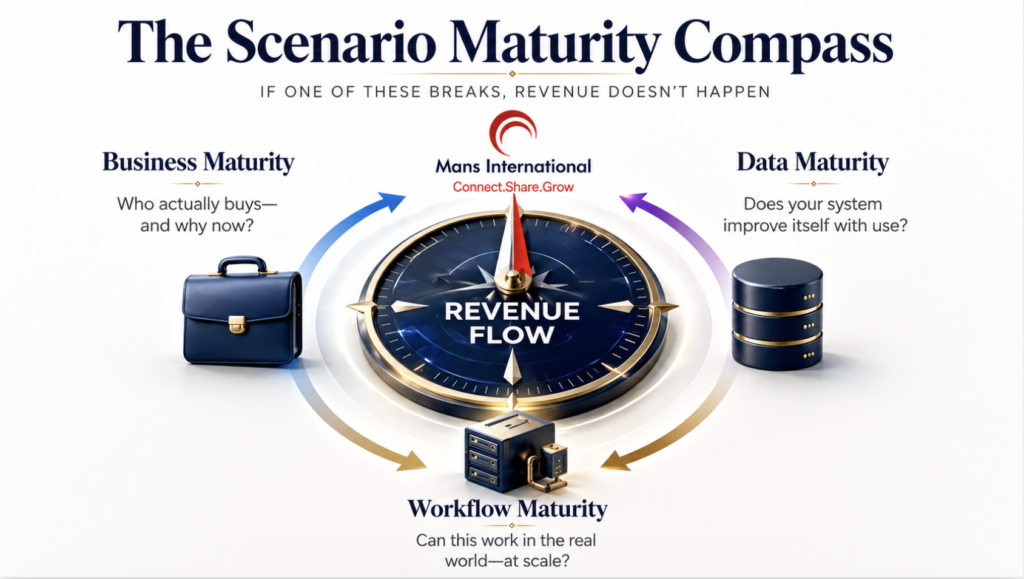
1. Business Maturity
- Who actually buys?
- Who owns the budget?
- Why would they act now?
2. Workflow Maturity
- Can the solution fit into real-world operations?
- Or does it require customers to change behaviour, rebuild infrastructure, and take on new risk?
3. Data Maturity
- Does usage create better data?
- Does better data improve the system?
- Does that improvement compound into a defensible advantage?
When these three pillars align, revenue has a pathway. When one breaks, even excellent technology can stall.
This is why I often tell founders: technology does not generate revenue on its own. Scenario maturity creates the conditions for revenue.
Clear Buyer Convergence: Who Actually Pays?
Many AI health startups fail because they build for users rather than buyers.
They build for clinicians, patients, researchers, or health platforms — but cannot answer the most important commercial question: Who signs the purchase order?
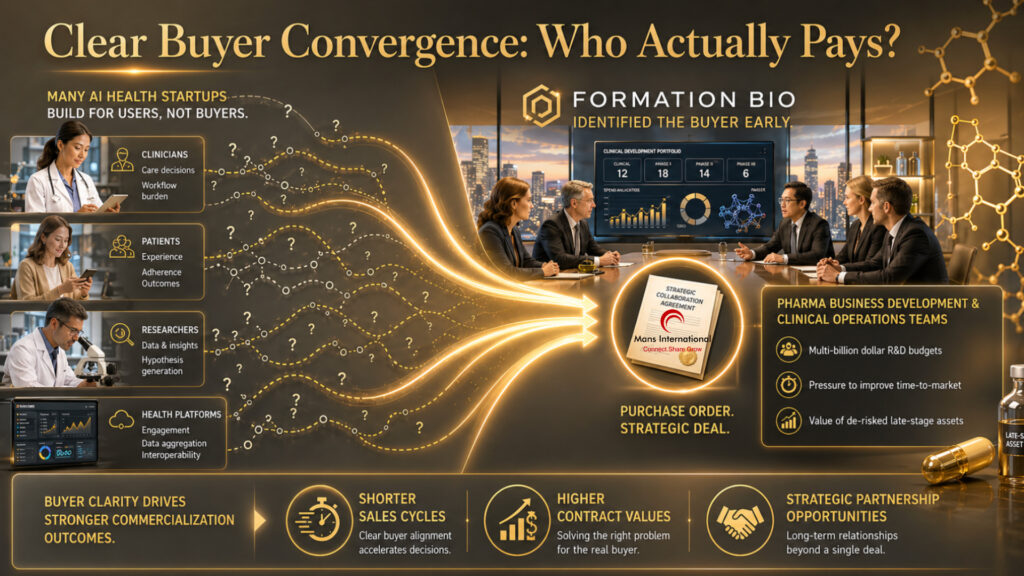
Formation Bio identified their buyer early: Pharma business development & clinical operations teams at companies like Sanofi and Eli Lilly.
- Have multi-billion dollar R&D budgets
- Face intense pressure to improve time-to-market
- Already understand the value of de-risked late-stage assets
This buyer convergence creates:
- Shorter sales cycles (no market education needed)
- Higher contract values (ROI is quantifiable: months saved = millions earned)
- Strategic partnership opportunities (not just vendor relationships)
Workflow Maturity: AI Embedded Into the Real Job
One of the biggest mistakes AI startups make is selling AI as a product.
Formation Bio avoids this trap. In partnership with OpenAI and Sanofi, Formation Bio launched Muse, an AI tool designed to analyze scientific literature and generate tailored patient recruitment materials, cutting recruitment timelines from months to minutes.
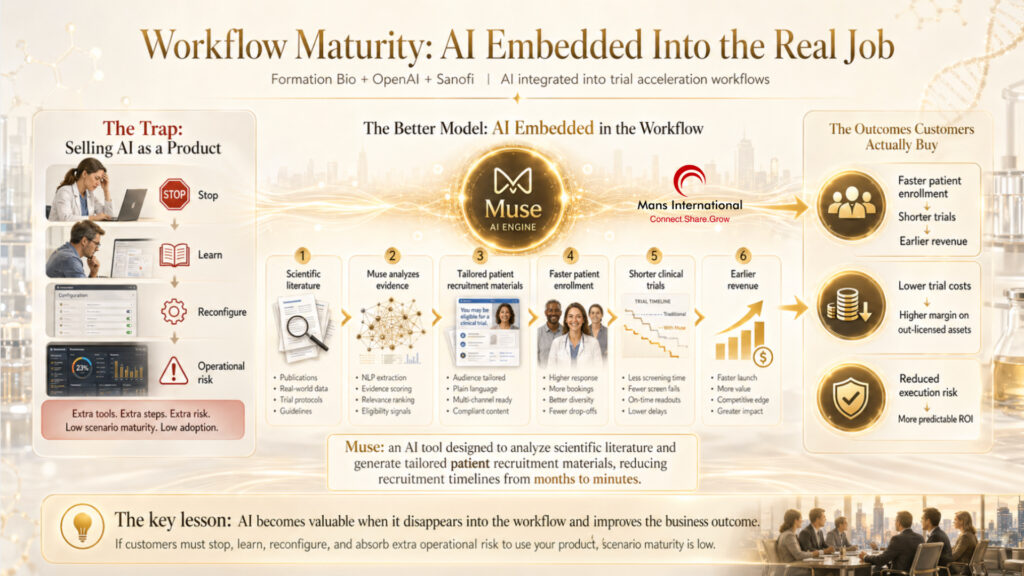
Muse is embedded into Formation Bio’s trial acceleration workflow. Customers don’t buy “AI correlation.” They buy:
- Faster patient enrollment → shorter trials → earlier revenue
- Lower trial costs → higher margin on out-licensed assets
- Reduced execution risk → more predictable ROI
This is the key lesson for founders: AI becomes valuable when it disappears into the workflow and improves the business outcome.
If your customer has to stop, learn, reconfigure, and take on extra operational risk to use your product, your scenario maturity is low.
Data Maturity: The Closed Loop Most Startups Never Build
Most AI health startups face a “cold start” problem:
- Data is fragmented across EHRs, wearables, and trials
- Feedback loops are weak or non-existent
- Model improvements don’t compound into business value
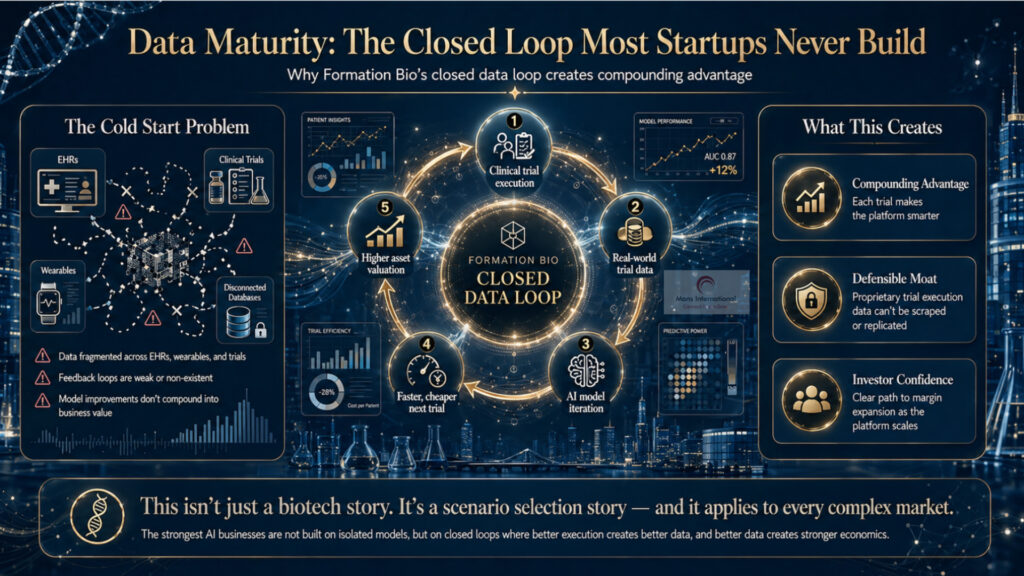
Formation Bio engineered a closed data loop:
Clinical trial execution → Real-world trial data → AI model iteration → Faster, cheaper next trial → Higher asset valuation
This creates:
- Compounding advantage: Each trial makes the platform smarter
- Defensible moat: Proprietary trial execution data can’t be scraped or replicated
- Investor confidence: Clear path to margin expansion as the platform scales
This isn’t just a biotech story. It’s a scenario selection story — and it applies to every complex market.
The Kintsugi Contrast
This is why the contrast between Kintsugi and Formation Bio is so important.
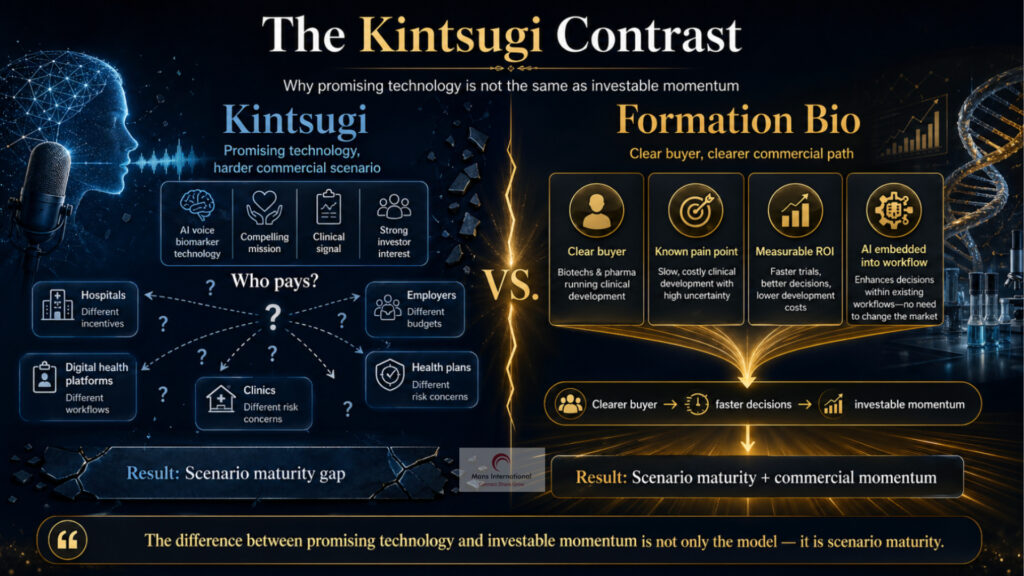
Kintsugi had impressive technology: AI-based voice biomarkers for detecting depression. It had a compelling mission, clinical signal, and strong investor interest.
But the commercial scenario was much harder.
Who pays?
- Hospitals?
- Employers?
- Health plans?
- Digital health platforms?
- Clinics?
Each buyer had different incentives, budgets, workflows, and risk concerns.
That created a scenario maturity gap.
Formation Bio, by contrast, chose a clearer buyer, a known pain point, a measurable ROI, and a workflow where AI could improve execution without requiring the whole market to change first.
That is the difference between promising technology and investable momentum.
Why This Matters for Every Tech Founder
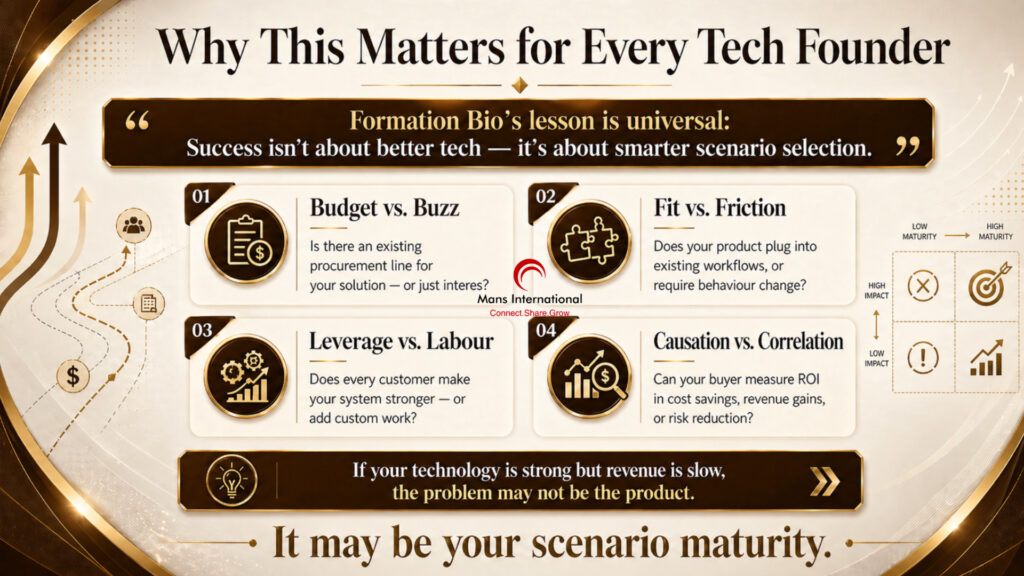
Formation Bio’s lesson is universal: Success isn’t about better tech — it’s about smarter scenario selection.
Before you scale, ask:
- Budget vs. Buzz: Is there an existing procurement line for your solution — or just interest?
- Fit vs. Friction: Does your product plug into existing workflows, or require behaviour change?
- Leverage vs. Labour: Does every customer make your system stronger — or add custom work?
- Causation vs. Correlation: Can your buyer measure ROI in cost savings, revenue gains, or risk reduction?
If your technology is strong but revenue is slow, the problem may not be the product.
It may be your scenario maturity.
At Mans International, this is exactly what we help founders diagnose: where your product is getting stuck, why the market is not converting, and what must change before investors, customers, or strategic partners are ready to move.
Our expertise lies in Scenario Maturity Thinking — helping founders assess whether their technology is entering a market where the buyer, budget, urgency, data, and value-capture logic are mature enough to support real commercialization.
Because in today’s market, the winners are not always the companies with the most impressive technology.
They are the companies that know exactly where value is trapped, who has the incentive to unlock it, and how to convert that insight into revenue, partnership, and scale.