

In the age of AI, starting a company has never been easier. Building one that wins has never been harder.
Execution is no longer scarce. AI can write code, produce content, and automate workflows at speeds once unimaginable. But when everyone can move faster, speed is no longer the edge.

The new scarcity is scenario intelligence: the founder’s ability to judge which market context is ready, which customer pain is worth serving, which workflow can absorb AI, and which problem is truly worth amplifying.
That is the quiet brutality of this era: experimentation is getting cheaper, but strategic misjudgment is becoming more expensive.
The next decade won’t belong to founders with the most resources. It will belong to those who can assess the maturity of a scenario before they scale.
I. The One-Person Company Is Not a Solo Act
Andrej Karpathy has compared large language models to something like a “fresh college graduate”: broadly read, astonishingly capable, but still lacking deep real-world experience.
That analogy is important for founders.
AI can help you execute faster. It can write code, produce content, analyze data, draft a strategy, automate workflows, and compress tasks that once required a full team.
This is why the rise of the One-Person Company is so powerful — and so often misunderstood.

It is not simply about one person replacing a team. It is about a deeper structural shift: once execution becomes massively amplified by AI, the founder’s judgment becomes the bottleneck.
The founder’s question shifts from: “Can I get this done?” to: “What exactly should I be building?” And more importantly: “Is this scenario mature enough to deserve my time, capital, and AI leverage?”
With AI, founders are no longer just operators. They become commanders of an invisible execution army.
But an army is only as valuable as the judgment directing it.
Without scenario intelligence, you are not a company of one. You are just noise moving faster.
II. Narrow Startups: Go Deep, Not Wide
This is where the Narrow Startup becomes essential.
As Anish Acharya at a16z argued in 2025, the next wave of startups will not win by serving everyone. They will win by going deep: solving a painful, specific problem so well that a narrow group of users is willing to pay significantly more.
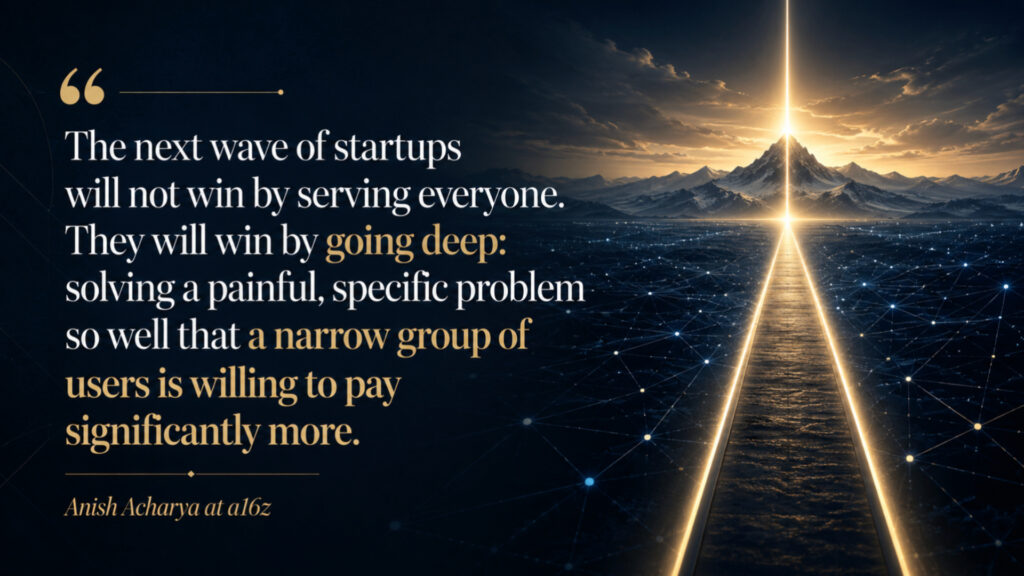
The insight is simple: premium AI products can break the old consumer software ceiling because they deliver what he calls “100x leaps” for specific users.
These are not mass-market tools with slightly better features. They are mission-critical systems for users whose pain, ambition, or workflow intensity makes the product worth paying for.
That changes how founders should think about market size.
Narrow does not mean small. Narrow means dense.
A Narrow Startup asks: Which specific group has a painful, frequent, economically meaningful problem — and can we become the default intelligence layer inside that context?
That is the real opportunity in AI.
III. Medvi: A Narrow Startup Case Study — and a Warning
Medvi shows both the promise and the risk of the Narrow Startup model.
The U.S.-based telehealth company sits at the intersection of GLP-1 weight-loss drugs, direct-to-consumer healthcare, and AI-enabled operations. According to Business Insider, Medvi reported $401 million in revenue and $65 million in profit last year, with projected sales of $1.8 billion this year, all with an extremely lean team.
The headline is tempting: “One tiny team used AI to build a massive business.” But that misses the deeper lesson.
Medvi did not build a general AI health platform. It entered a narrow, high-demand scenario: consumers seeking easier access to weight-loss treatment, GLP-1 medications, asynchronous care, and ongoing support.
Patients were not looking for “AI.” They were looking for access, convenience, privacy, affordability, continuity, and results.
That is what made the scenario commercially powerful.
AI mattered because it helped compress the operating model. It could support marketing, content, customer communication, internal workflows, and software development, while external licensed partners handled clinical care, pharmacy fulfillment, and logistics.
In other words, technology was not just a feature. It changed the company’s cost structure and operating rhythm.

But Medvi also shows the danger of confusing growth with readiness.
Business Insider reported that Medvi’s growth relied heavily on advertising and affiliate marketing, and raised allegations of AI-generated doctor personas and misleading claims. The FDA also issued a warning letter concerning false or misleading representations related to compounded semaglutide and tirzepatide products.
That is where the case becomes strategically important.
Medvi shows that AI can collapse organizational costs and amplify growth velocity. But in healthcare, speed is not durability.
Growth must be matched by trust, operational discipline, and regulatory credibility. When execution moves faster than the surrounding environment can absorb, momentum becomes fragile.
That is the real warning of Medvi: AI can accelerate a business, but it cannot compensate for a scenario that is not ready to scale.
IV. Why Scenario Intelligence Is the Moat
Technology will keep improving.
Models will become cheaper, faster, and more capable. Interfaces will become easier to build. Agentic workflows will become more common. Many technical advantages will compress over time.
But deep scenario understanding does not commoditize so easily.
It grows through immersion: observing users, understanding incentives, mapping budgets, identifying hidden friction, and knowing which pain is urgent enough to trigger action.
That kind of judgment cannot be downloaded overnight.
This is why scenario intelligence becomes the founder’s moat.

Narrowness is the entrance. Context is the container of value.
Scenario intelligence is the founder’s ability to know which container is ready.
V. From Insight to Action
If your AI product is generating interest but not conversion, the problem may not be your technology. It may be your scenario maturity.
At Mans International, we help technology founders and investors pressure-test where value is truly trapped, whether the market is ready to absorb the product, and what must change before customers, investors, or strategic partners move.
If you are building in AI, health tech, or another high-stakes market, reach out, and I’ll share a Scenario Maturity Self-Assessment Checklist to help you evaluate your buyer, workflow, data loop, narrative, and trust architecture before you scale.
Because in the AI era, the winners will not be the companies that execute the fastest. They will be the companies that know exactly which scenario is ready to win.