
I first analyzed Insilico Medicine in my 2023 book, when it became one of the most visible pioneers in AI-driven drug discovery.
By 2025, Insilico’s narrative moved beyond sheer R&D velocity. It had become a test of whether AI could translate biological insight into clinically meaningful, commercially viable assets in longevity and age-related disease — through tools like PreciousGPT and its lead asset, Rentosertib.
In 2026, the story became more complex.
Despite a milestone-based Eli Lilly collaboration worth up to $2.75 billion, including a $115 million upfront payment, Insilico’s public-market narrative remains under pressure after a $352.3 million net loss for 2025 and sharp volatility on the HKEX.
That is why I chose Insilico Medicine as an early case for the Mans International SMAF Sprint 2026.
For founders, the lesson is clear: In AI commercialization, technology maturity does not always coincide with business maturity, capital-market confidence, governance credibility, or narrative maturity.
This is exactly the kind of mismatch the Scenario Maturity Assessment Framework, or SMAF, is designed to examine.
1. Business and Narrative Maturity: “AI-Discovered Drug” Is No Longer Enough
Insilico’s real breakthrough was not simply using AI to discover drugs. It was translating a broad technology promise into a concrete business scenario.
“Aging” itself is not an FDA indication. To build a credible path to market, companies must convert broad healthspan ambition into specific diseases, measurable endpoints, and regulatory logic that investors, pharma partners, and clinicians can evaluate. Insilico did this by targeting IPF, or idiopathic pulmonary fibrosis.
Through an SMAF lens, this is the strategic move. The company did not stay at the level of “AI can discover drugs.” It selected a disease scenario where the technology could be tested against real-world evidence, regulatory, partnership, and business requirements. This is why Rentosertib matters.
The asset moves the conversation from AI discovery speed to a harder question:
Can an AI-enabled biotech company turn discovery into validated assets, strategic partnerships, and repeatable business value?
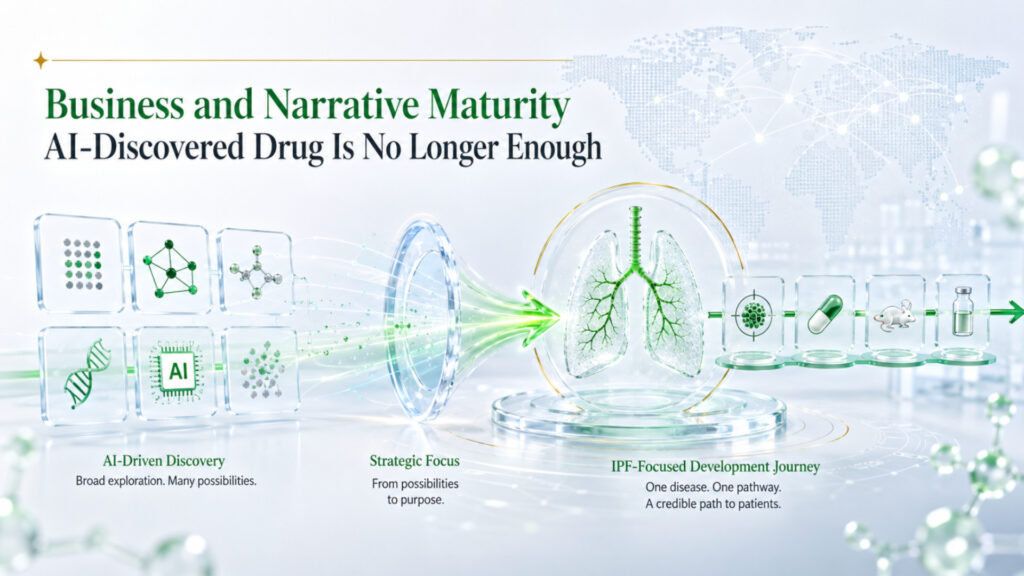
In the early AI wave, “AI-discovered drug” was enough to capture attention. By 2026, it will no longer be enough to sustain the premium.
Markets now want specifics: the target, the indication, the endpoint, the regulatory path, the partner logic, and the platform’s repeatability.
For founders, the lesson is clear: AI novelty may open the door. But only a mature business scenario keeps the door open.
A strong narrative does not exaggerate certainty. It shows how technological possibility becomes clinical evidence, commercial value, and investor confidence.
2. Cross-Border Maturity: Speed ≠ Trust
Insilico is especially important because it sits across different geographies, capital systems, and operating logics.
Its links to Hong Kong and China’s biotech infrastructure give it access to real advantages: engineering talent, biotech clusters, automation capacity, scientific speed, cost-efficient R&D execution, and increasingly sophisticated capital-market infrastructure.
But global commercialization requires another layer.
It requires regulatory confidence, clinical transparency, pharma trust, investor communication, data governance, and geopolitical risk management.
This is where globally operating AI biotech companies with strong Hong Kong, China, or Asia-linked R&D networks face a hidden challenge.

Speed is not enough.
To win globally, they must translate technology, evidence, governance, and narrative into a form that global stakeholders can trust.
Through an SMAF lens, this is not just an expansion strategy. It is a maturity test.
The ultimate question for cross-border founders is: “Can this company become globally legible, credible, and trusted?”
3. The SMAF Takeaway: A Conditional Premium
Did Insilico Medicine pass the SMAF test? Partially.
Insilico has passed some important parts of the SMAF test:
- Its AI drug discovery capability appears strong.
- Its story has moved from a broad AI-discovery promise to a more concrete disease pathway through Rentosertib and IPF.
- The Eli Lilly collaboration strengthens external validation and commercial credibility.
But it has not yet fully passed the broader scenario maturity test.
The remaining question is not whether the technology is impressive.
It is whether the surrounding scenario is mature enough to support repeatable clinical progress, durable commercial value, capital-market confidence, and globally credible governance.
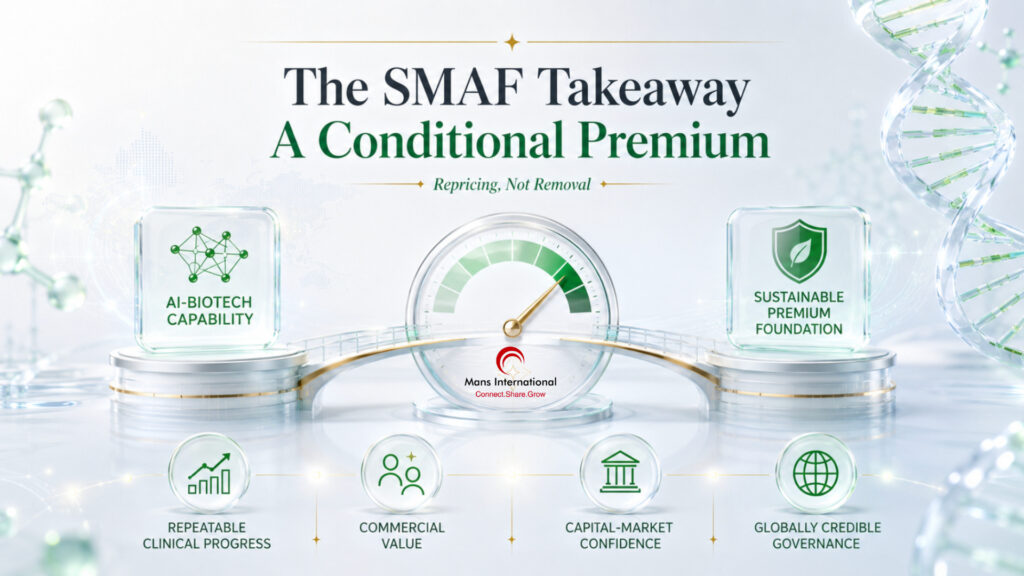
That is why the AI-drug premium is not dead. It is being repriced.
Markets will no longer reward AI capability alone. The premium must now be earned through clinical progress, pharma validation, financial discipline, and globally credible governance.
For cross-border biotechs, the real bridge is not just market access. It is the ability to translate speed into trust, science into evidence, and platform ambition into globally legible value.
This is the core question behind the Mans International SMAF Sprint 2026:
If the technology works, is the surrounding scenario mature enough to turn it into adoption, revenue, and durable strategic value?
This is the exact diagnostic we run at the Mans International SMAF Sprint 2026.
At Mans International, we use the Scenario Maturity Assessment Framework (SMAF) to help founders, investors, and strategic leaders diagnose one critical question: If the technology works, is the surrounding scenario mature enough to convert it into adoption, revenue, and durable strategic value?