


AI is no longer measured by the model, but by the Token.
Two landmark moves have quietly re-indexed the global AI landscape:
- NVIDIA officially reframed the data centre as a “Token Production Factory.”
- Alibaba launched the Alibaba Token Hub (ATH), making token throughput a core corporate pillar.
Together, they signal something much bigger: We are entering a Token Economy.
1. The Token: The Marginal Cost of Thought
A token is often described as the smallest unit an AI processes. For a strategist, that definition is noise.
A token is the atomic unit of cost in digital reasoning.
Every time an agentic system reads, decides, or acts, it is “burning” tokens—and therefore consuming your margin. This reframes AI from a technical capability to an economic system.
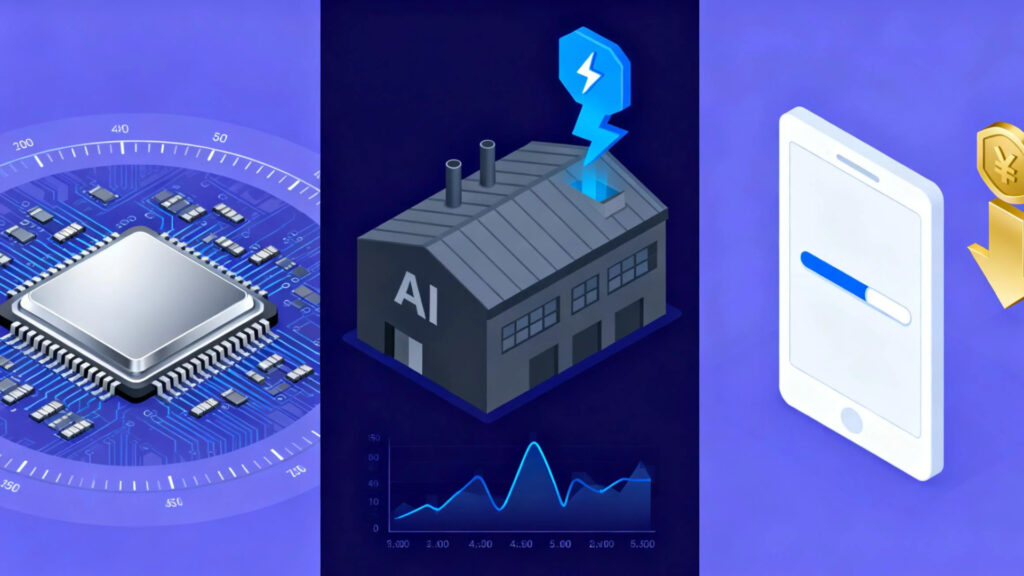
Every token carries a Strategic Trilemma:
- Compute: The silicon cycles required to generate it.
- Energy: The literal wattage consumed by the AI Factory.
- Latency: The time tax imposed on the end-user experience.
The frontier has moved: From Model Scale → To Intelligence Density.
The new objective is uncompromising: Maximize high-order reasoning per token.
2. The Global Infrastructure: Two Visions of the Factory
The race for the Token Economy has bifurcated into two strategic archetypes: The Utility and The Sovereign.
NVIDIA: The Vertical Utility
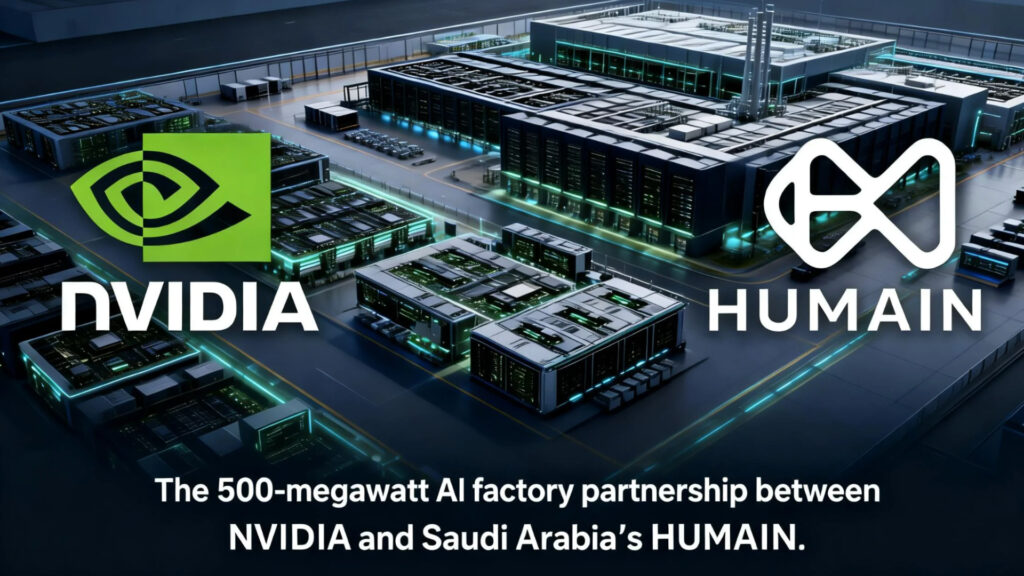
NVIDIA has outgrown the “chipmaker” label. It is now the Foundry of Intelligence. By securing a 500-megawatt “AI Factories” partnership with Saudi Arabia’s HUMAIN, NVIDIA is moving upstream to control the raw materials of reasoning: Compute, Energy, and Scale.
The Goal is to become the foundational utility layer. NVIDIA doesn’t just enable models; it powers the continuous, global production of digital thought.
Alibaba Token Hub (ATH): The Full-Stack Sovereign
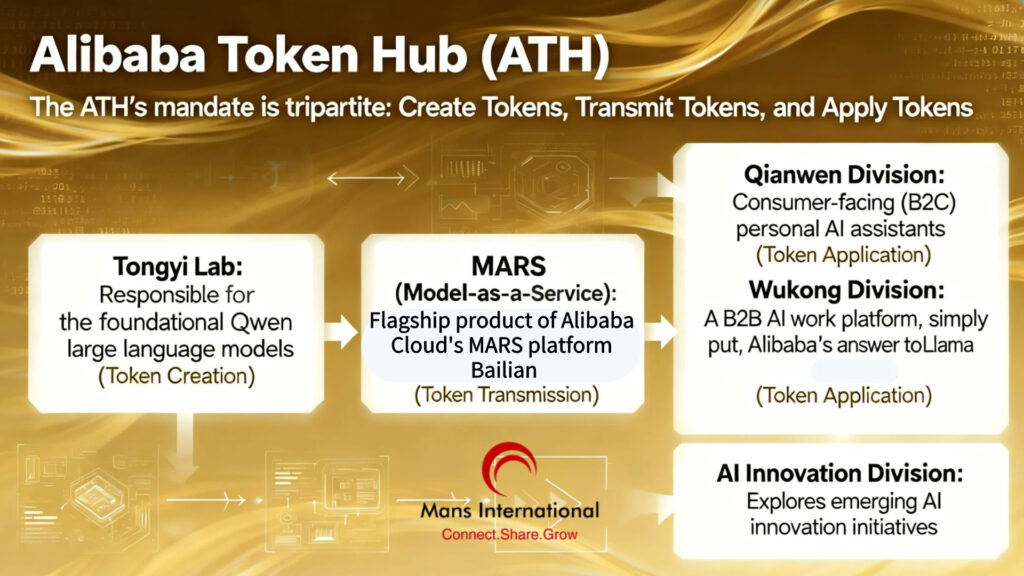
If NVIDIA is building the grid, Alibaba is building the Closed-Loop Economy. Led directly by CEO Eddie Wu, ATH represents a decisive move toward Full-Stack Sovereignty. Alibaba has integrated the entire Token lifecycle into a single operating model:
- Create: Foundational intelligence (Tongyi Lab)
- Deliver: Cloud-scale distribution (AliCloud/Bailian)
- Apply: AI-native ecosystems (B2C – Qwen/B2B – Wukong)
Alibaba is building infrastructure for a market where JPMorgan forecasts Token Consumption in China could grow at 330% CAGR through 2030. Alibaba is positioning itself to own the entire value chain of a digital superpower.
3. The New KPI: Token Efficiency
In the Token economy, the new lead indicator of enterprise health is Intelligence per Token.
More tokens do not equal better results; they equal higher costs and slower cycles. Competitive advantage now belongs to the High-Efficiency Architect —extracting maximum reasoning from minimum inference.
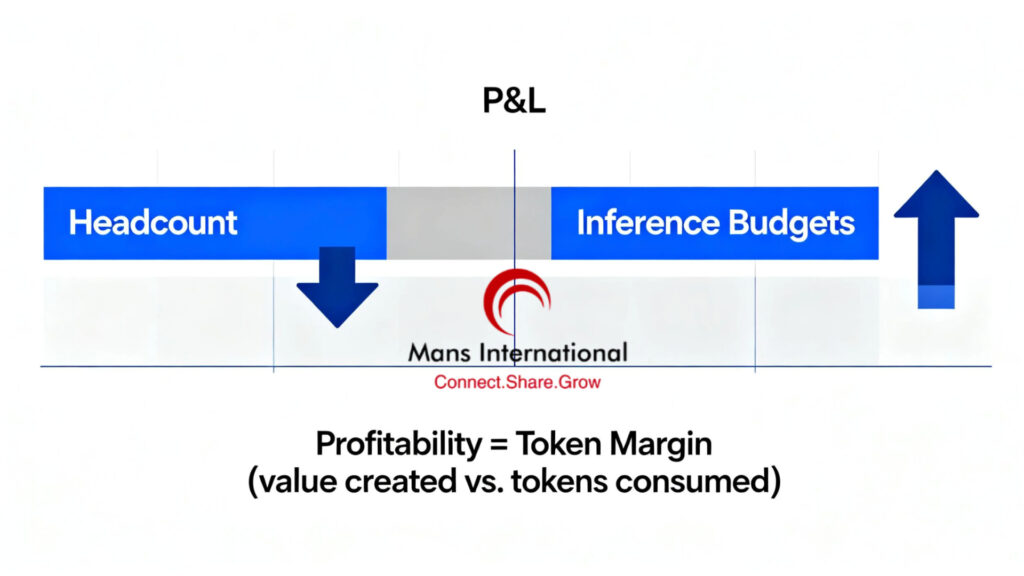
- For the C-Suite: P&L statements will transition from “Headcount” to “Inference Budgets.” Profitability will no longer be determined by how many people you employ, but by your Token Margin—the value created vs. the tokens consumed.
- For Talent: The fundamental career question has changed. It is no longer: “What can you do?” It is: “How effectively can you deploy AI?”
4. The Strategic Mandate
The Token Economy represents the formal industrialization of intelligence. In this new stack, value creation is distributed across four distinct layers:
- Production: The “Factory” layer (Compute, Silicon, Energy).
- Distribution: The “Grid” layer (Cloud platforms and high-availability APIs).
- Application: The “Agentic” layer (AI-native products and autonomous systems).
- Optimization: The “Refinery” layer (Compression, orchestration, and inference efficiency).
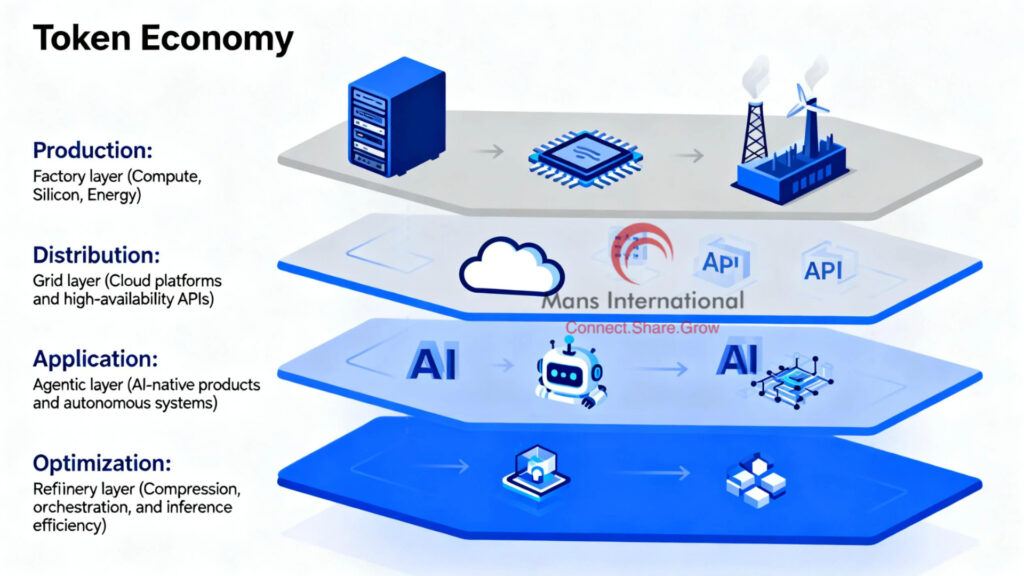
The winners will not necessarily dominate all four layers, but they will control a critical bottleneck within one of them.
The question for founders and investors is simple: What is your stake in the Token Economy? Because in the next decade, competitive advantage will not come from simply “having AI”, but from how efficiently you produce and deploy it.
About Mans International: A global strategic firm specializing in the intersection of AI, China Strategy, and Digital Transformation. We advise the architects of the new economy.