
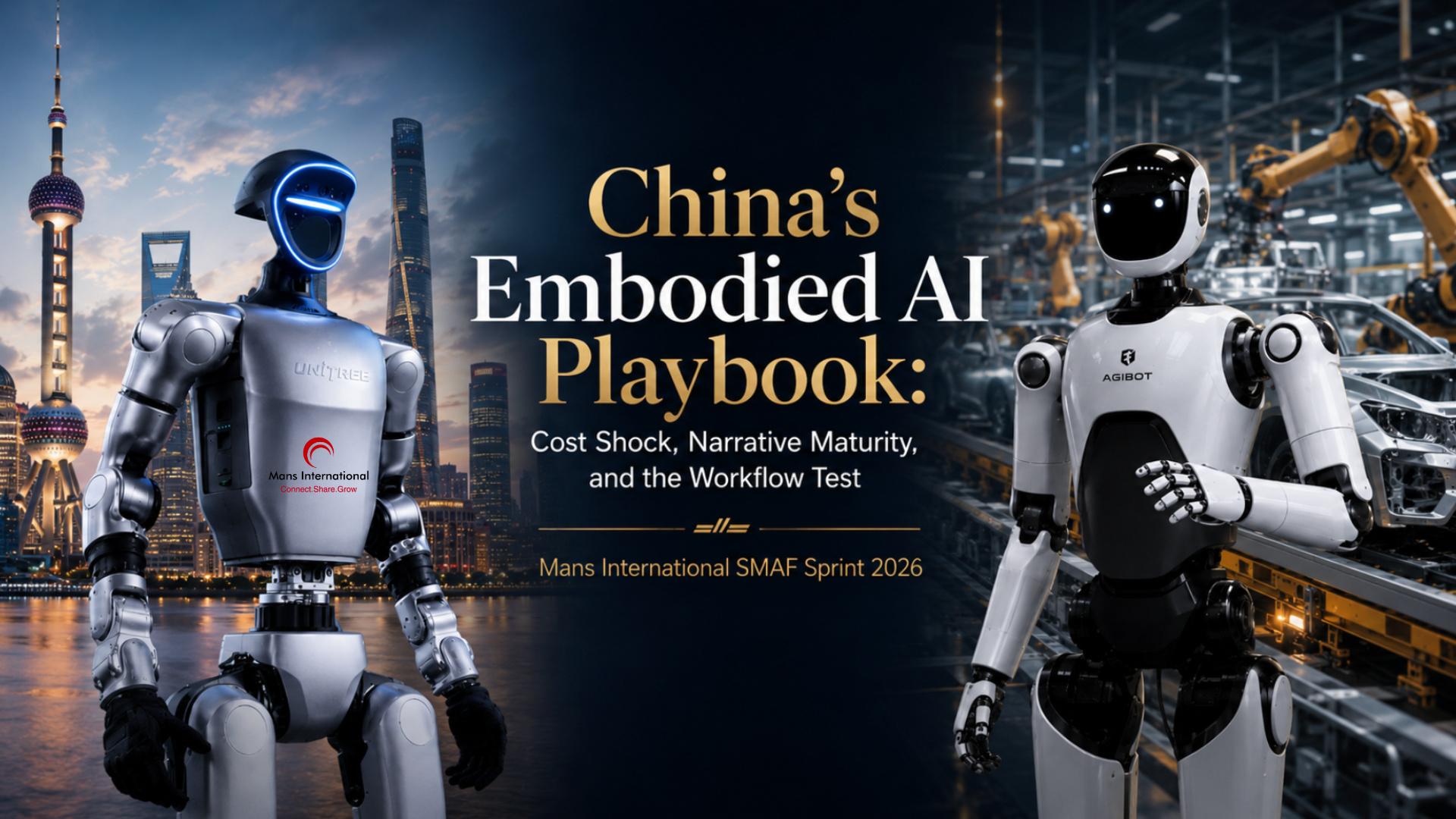
Following our assessments of Insilico Medicine’s algorithmic drug discovery architecture in Case Study 01 and SpaceX’s orbital infrastructure dominance in Case Study 02, the SMAF Sprint now turns to the physical edge of intelligence: Embodied AI.
While Elon Musk packages “infrastructure + AI” into a grand capital narrative, China’s humanoid robotics sector is executing a dual-track playbook.
Unitree drives the market through cost disruption. Agibot drives it through strategic narrative and embodied intelligence.
Through the Scenario Maturity Assessment Framework, or SMAF, these two companies are not just robotics competitors. They represent two different answers to the same strategic question: How does a humanoid robot move from technical spectacle to commercial readiness?
Playbook A: Unitree’s “Cost Shock”
Unitree’s breakthrough is industrial, not just technical.
Leveraging China’s mature electric vehicle (EV) supply chain, they’ve driven humanoid pricing below $20,000 — shifting the market psychology from “futuristic tech demo” to “purchasable hardware.”.
In SMAF terms, this reflects world-class execution in Supply Chain Maturity and Commercial Disruption Potential. It lowers the barrier for widespread developer experimentation while forcing high-cost global competitors onto the defensive.

However, cheap hardware does not guarantee a valuation premium. For enterprise buyers, the real question is:
Can it work reliably inside my operation, reduce labor burden, avoid safety issues, integrate with existing systems, and produce measurable ROI?
If a robot requires a human “babysitter” to constantly reset, maintain, or supervise it, the ROI evaporates.
The real cost isn’t the hardware. It’s the operational burden.
Unitree’s next survival test: Can we make it reliable enough that customers never regret deploying it?
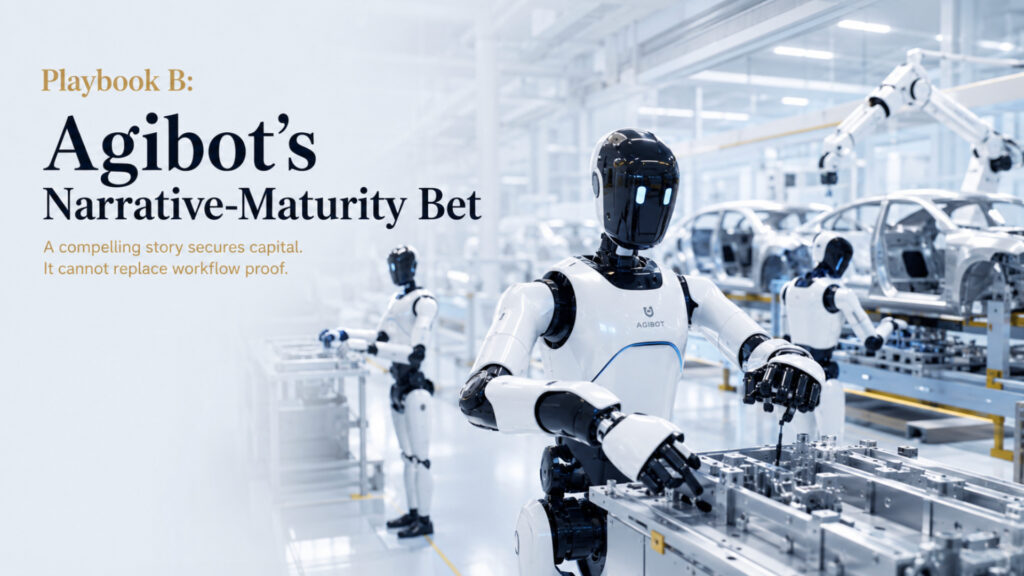
Playbook B: Agibot’s Narrative-Maturity Bet
Rather than competing purely on cost, Agibot is leading with an embodied AI vision: robots that learn, adapt, and improve through real-world deployment.
In SMAF terms, Agibot exhibits strong Narrative Maturity — the ability to translate complex technology into a credible, investable story about AI entering the physical world.
Its maturity profile looks very different from Unitree’s:
- Narrative Maturity: Strong. Positioning embodied AI as a new intelligence layer for physical work is easy for investors to grasp, granting Agibot a higher valuation ceiling.
- Workflow Maturity: Testing. Agibot is moving from demos to real industrial environments to expose hidden frictions. However, field training is not scenario maturity. Performing a single task creates excitement; becoming a reliable, low-friction production tool creates purchasing confidence.
- Business Maturity: Expectation-Driven. Agibot’s commercial viability hinges on a Starlink-style data flywheel: deployment → task data → better intelligence → broader deployment. If successful, they are not just selling hardware — they are building a compounding intelligence system.
The SMAF Strategic Warning: The higher the narrative maturity, the greater the pressure for scenario validation. A compelling story secures capital, but it cannot permanently replace workflow proof.
The Cultural Bridge: Why These Two Paths?
These playbooks reflect two deeper instincts within China’s technology ecosystem:
- Unitree represents supply-chain alchemy. Forged in China’s brutal EV price wars, Forged in the brutal NEV price wars, it turns mature industrial capacity into a global price shock. Unitree is trying to win by industrializing the body.
- Agibot represents leapfrog ambition. Aligned with national priorities for AI-driven industrial upgrades, Agibot bets that software and data can compress years of mechanical refinement. They are attempting to win by accelerating the brain.
While one path begins with manufacturing maturity and the other with intelligence ambition, both eventually face the same question: Can the robot become useful inside real workflows?
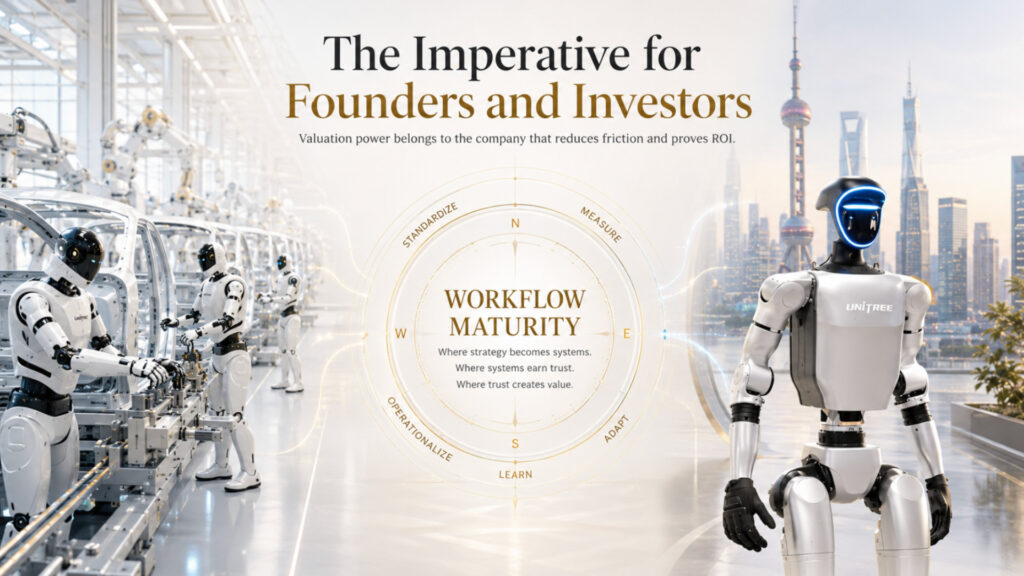
The Imperative for Founders and Investors
Cost shocks open markets. Narrative maturity lifts valuation ceilings. Data loops create compounding power. But both companies must ultimately achieve Workflow Maturity — the threshold where demos become adoption, deployment earns trust, and technology justifies a valuation premium.
The Lesson for Founders:
- Do not confuse technical capability with commercial readiness.
- Do not confuse low cost with customer value.
- Do not confuse a strong narrative with scenario maturity.
- Do not confuse deployment with true adoption.
The Diligence Test for Investors:
- Which company is not just building a better machine, but entering the more mature scenario?
Valuation power won’t belong to the cheapest robot or the most ambitious story. It will belong to the company that proves its robot reduces friction and generates measurable ROI.
That is the core lesson of China’s dual-track embodied AI playbook.
And it is exactly why I built the Scenario Maturity Assessment Framework (SMAF): to help founders and investors identify the gap between technical ambition and scenario maturity before the market does.