
Betting on New Luxury
Everyone thinks LVMH just invested $5 million in WTHN, a New York-based modern wellness platform that operationalizes Traditional Chinese Medicine (TCM) as a premium, omnichannel ritual system. They’re reading the headline, not the strategy. LVMH didn’t fund a treatment modality — they funded the re-architecture of status.
We are witnessing the birth of Luxury 2.0: a shift where longevity, bio-optimization, and ritualized self-care are replacing the leather goods of the past. In this new era, the ultimate flex isn’t what you carry — it’s how long you’ll live to enjoy it.

The recent move by L Catterton (LVMH’s investment arm) into WTHN isn’t a “wellness play.” It’s a masterclass in Strategic Translation.
The global wellness economy reached a record $6.8 trillion in 2024 and is projected to grow at a robust annual rate of 7.6%, surpassing $9.8 trillion by 2029. This represents a significant acceleration, with the wellness sector now accounting for 6.1% of total global GDP. LVMH is not experimenting. It is claiming strategic ground early.
WTHN’s Winning Model: 4-Pillar Commercial Translation Engine
WTHN succeeded because they built a 4-pillar commercial translation engine.
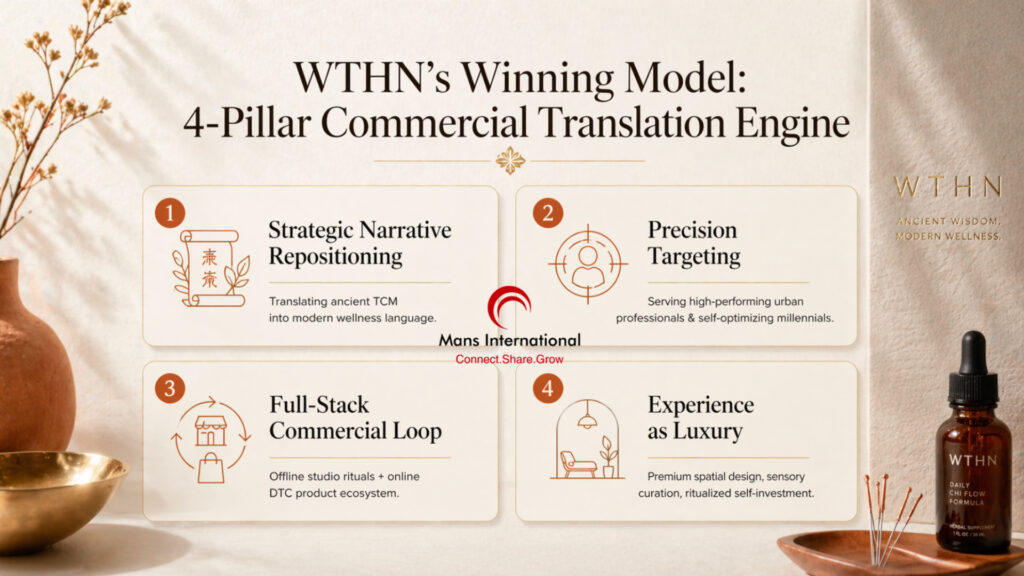
1. Strategic Narrative Repositioning (Translating Value)
Traditional TCM speaks in qi, meridians, and balance. WTHN speaks in stress relief, recovery, and hormonal optimization. This is not a simplification. This is strategic narrative repositioning. They didn’t export culture. They reframed value into a category the market understands.
2. Precision Targeting
WTHN doesn’t serve “everyone.” It targets:
- high-pressure urban professionals
- women 20–40
- Gen Z & Millennials investing in self-optimization
These consumers feel acute pain points (burnout, sleep disruption), have purchasing power, and are willing to pay for measurable transformation.
3. Full-Stack Commercial Loop
Most traditional players break at distribution. WTHN closes the loop:
- Offline: premium acupuncture & cupping experience → trust building
- Online: beautifully designed home-use products → repeat consumption
This creates brand stickiness, recurring revenue, and defensible unit economics.
4. Experience as Luxury
WTHN is positioned not as a clinic, but as an experience. Prime locations (e.g., Manhattan), minimalist, high-end design, curated sensory environments, and premium pricing transform each session into a deliberate act of self-investment. This is exactly what luxury demands.
Case Study: Why WTHN Won Where Cha Ling Stalled
This is not LVMH’s first attempt.
Its earlier brand, Cha Ling, followed a different path. The comparison is revealing:
Cha Ling (2016) vs. WTHN (2024)
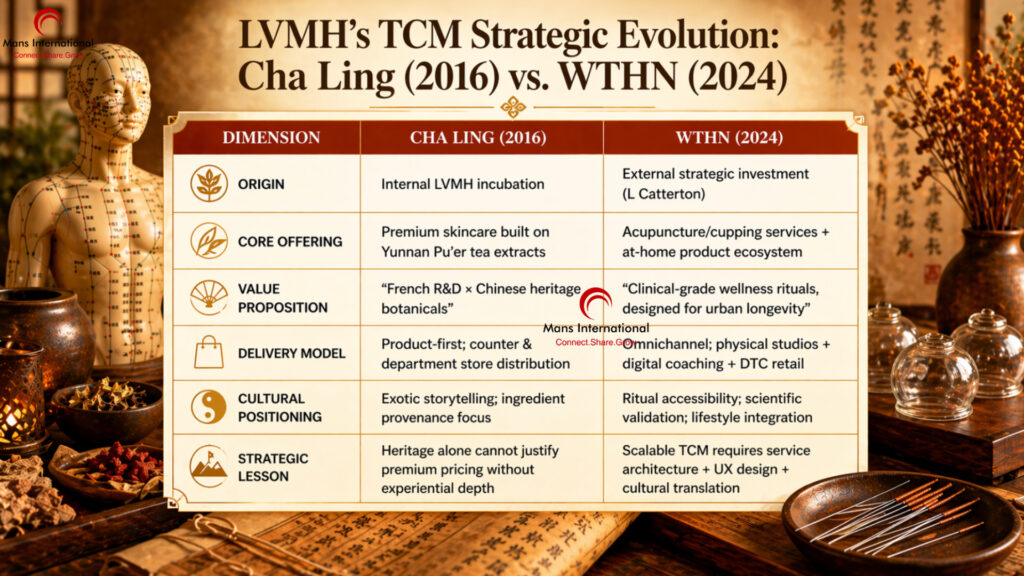
🔹 Origin
• Cha Ling: Internal LVMH incubation
• WTHN: External strategic investment (L Catterton)
🔹 Core Offering
• Cha Ling: Premium skincare built on Yunnan Pu’er tea extracts
• WTHN: Acupuncture/cupping services + at-home product ecosystem
🔹 Value Proposition
• Cha Ling: “French R&D × Chinese heritage botanicals”
• WTHN: “Clinical-grade wellness rituals, designed for urban longevity.”
🔹 Delivery Model
• Cha Ling: Product-first; counter & department store distribution
• WTHN: Omnichannel; physical studios + digital coaching + DTC retail
🔹 Cultural Positioning
• Cha Ling: Exotic storytelling; ingredient provenance focus
• WTHN: Ritual accessibility; scientific validation; lifestyle integration
🔹 Strategic Lesson
• Cha Ling: Heritage alone cannot justify premium pricing without experiential depth
• WTHN: Scalable TCM requires service architecture + UX design + cultural translation
Final Thought: The Cultural Translator’s Edge
LVMH’s investment is a strategic vote for a specific type of founder: The Cultural Translator.
The next generation of winners won’t be pure technologists or pure traditionalists. They will be the ones who can anchor themselves in deep tradition while operating with the surgical precision of modern business systems.
In the global market, tradition is not your constraint — your narrative is.
For Founders
If your product isn’t converting, it’s rarely the technology.
It’s usually:
- The story doesn’t land
- Or the scenario doesn’t close
That’s where we focus.
Selective Scenario Maturity Audits available.