

What Pieter Levels and a Chinese AI founder reveal about commercial viability, risk, and investment judgment.

Kelly’s Global Tech Intelligence #248; Issue 60, 2026
“It’s never been this easy to build software and never this hard to make money with it.”
— Pieter Levels, November 9, 2026
I. The Product She Built—and Chose Not to Launch
She built an AI-powered product in just one week. Then she walked away.
In early 2026, Wang Yubo, a former ByteDance risk-control strategist, used AI to develop a short-term rental information platform for international students. Technically, the prototype worked. But as she examined the business, troubling questions emerged:
- Could she legally use rental listings collected from other platforms?
- What if a student arrived at the destination only to discover that the advertised property did not exist?
- Who would be responsible for customer complaints, financial losses, or failed deliveries?
Realizing that as a solo founder she was not prepared to carry those operational liabilities, she abandoned the project.
Later, Wang founded Shengxu Intelligence, an AI company focused on a very different problem: converting Western staff notation into jianpu, the numbered musical notation widely used by Chinese traditional musicians.
Having played the erhu—a two-stringed Chinese instrument—since age six, she understood a specialized need that general-purpose music AI tools overlooked.

By November 2026, the product had attracted more than 6,000 users, with early reporting indicating positive cash flow during its initial months.
One person. AI-powered execution. A narrowly defined customer problem.
The most revealing part of her story is why she chose not to pursue another one. AI had made execution dramatically easier; it had not made commercial judgment optional.
This tension lies at the heart of the emerging One-Person Company (OPC) movement, raising an urgent question for tech founders and investors: When almost anyone can build a product, what makes a business worth building, sustaining—or investing in?
II. Why Now? The Economics of Entrepreneurship
The one-person company is not a new idea. In his 2019 book Company of One, Paul Jarvis challenged the assumption that businesses must continually expand to succeed. But the AI-enabled OPC represents a structural shift: technology has amplified the productive capacity an individual can organize and deliver.
Three forces are accelerating this shift:
1. AI is lowering the execution threshold. Software development, design, research, marketing, and routine operations increasingly benefit from AI workflows. Founders can build prototypes and test ideas without assembling conventional teams. Yet reducing the execution cost does not reduce the cost of being wrong. A product can be technically impressive, quickly built, and commercially irrelevant. AI amplifies what a founder can execute; it does not guarantee they chose the right problem.
2. Smaller markets are becoming economically viable. Traditional organizations require massive markets to justify staffing and distribution costs. AI changes this equation. As a16z partner Anish Acharya highlighted in The Smartest Consumer Apps Now Cost $200 a Month (July 2025), if a product creates high enough value to charge $200 monthly, only about 41,700 paying customers are needed to approach $100 million in ARR. While acquiring those customers remains difficult, it proves that market breadth is no longer the sole measure of value—value density matters just as much.
3. Policy and ecosystem support are adapting. China has become an active testing ground. In March 2026, Guangdong introduced a provincial plan targeting 100 AI OPC communities, 1,000 benchmark enterprises, and 10,000 talents by 2028. In October, Suzhou published AI industry regulations explicitly addressing OPC ecosystems (effective December 1). While infrastructure is improving, making entrepreneurship accessible is not the same as making businesses sustainable—nor should millions of traditional single-shareholder legal entities be conflated with AI-driven solo businesses.
III. Building a Product Is Not Building a Business
Dutch indie developer Pieter Levels offers a useful contrast. Over a decade of launching independent products, he built durable businesses like Nomads.com, Remote OK, Photo AI, and Interior AI.
In September 2026, Levels disclosed monthly operating revenues of $200,000–$250,000, alongside annual business revenue and investment gains surpassing $10 million (with a self-reported 94.5% profit margin). However, these numbers require careful parsing:
- The $10 million figure mixes operating revenue with unrealized asset and investment appreciation.
- Operating costs vary wildly: Excluding Photo AI, monthly expenses for his other web apps fell to roughly $300, while PhotoAI carried an extra $7,800 in monthly GPU and storage costs.
- Auditing: These are self-reported figures, not independently audited financials.
The Founder Comparison
- Pieter Levels: A decade-long veteran with global reach, diversified apps, and significant technical/infrastructure overhead.
- Wang Yubo: Early-stage traction, thousands of users, cash-flow positive in a hyper-niche cultural vertical, but lacking long-term retention and acquisition data.
Neither story proves that OPCs are a universal shortcut. Both demonstrate that while AI narrows the execution gap, it cannot bridge the gap in customer understanding, domain expertise, and commercial judgment.
IV. The Risks AI Cannot Make Disappear
The abandoned rental platform illustrates a critical truth: AI reduces development costs, but it does not reduce contractual liability, compliance requirements, or the consequences of failure.
Furthermore, Pieter Levels’s cost disclosures dispel the myth of the “zero-cost business.” While traditional headcount expenses shrink, infrastructure expenses—such as model inference, cloud computing, data storage, and cybersecurity—remain very real.
For founders, the question is not just how much work AI can perform, but whether their operational boundaries match the commercial risks they carry.
Conclusion: Judgment Over Execution
AI has redefined the minimum scale of a company, but it has not changed basic business fundamentals: customers must perceive value, someone must pay, delivery must be continuous, and someone must absorb the shock of failure.
- For founders: AI is an operating boundary test.
- For investors: AI is a test of capital judgment.
As building software becomes frictionless, judgment is the ultimate scarce resource.
Mans International | November 2026 Private Strategy Session
The One-Person Company: From AI Capability to Sustainable Commercial Value
AI is changing how companies are built. But is it changing what makes them commercially viable—or investable?
I am hosting a private online discussion for technology founders and investors to examine the strategic questions behind AI-native one-person companies. Using real cases, we will explore where new entrepreneurial opportunities emerge, where commercial responsibilities remain, and how the changing nature of small organizations challenges conventional business and investment assumptions.
- For Founders: Where does AI-enabled execution meet the realities of customer value, business sustainability, and operating responsibility?
- For Investors: When the traditional organizational scale becomes less informative, how should we think about business evidence, founder concentration, growth potential, and investability?
This is not an AI tools workshop or a formula for building an OPC. It is a focused strategic conversation about the opportunities and risks of a changing entrepreneurial landscape.
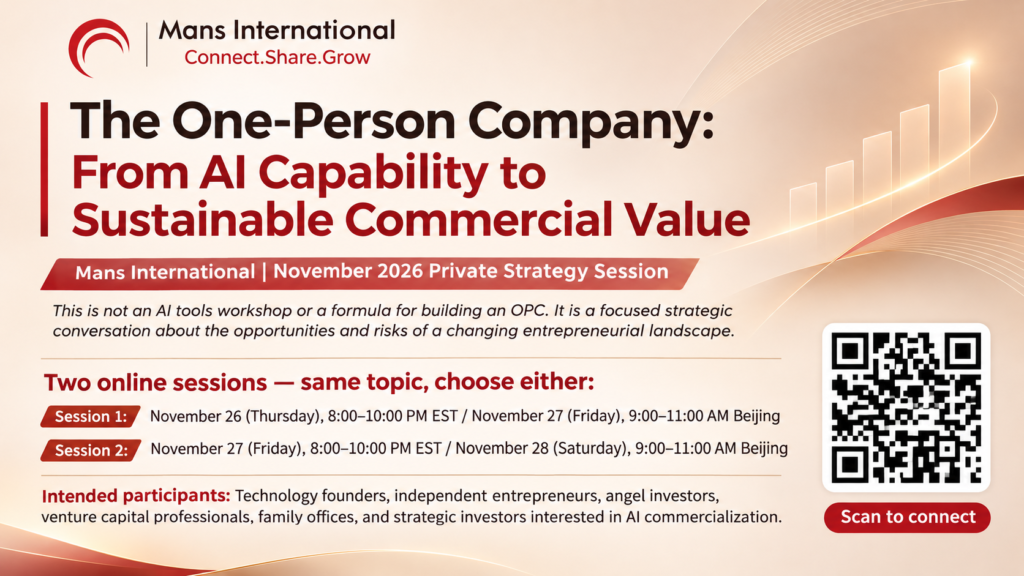
Two online sessions — same topic, choose either:
- Session 1: November 26 (Thursday), 8:00–10:00 PM EST / November 27 (Friday), 9:00–11:00 AM Beijing
- Session 2: November 27 (Friday), 8:00–10:00 PM EST / November 28 (Saturday), 9:00–11:00 AM Beijing
Intended participants: Technology founders, independent entrepreneurs, angel investors, venture capital professionals, family offices, and strategic investors interested in AI commercialization.
To request participation details: Scan the QR code.
Turn Innovation Into Revenue. Precision in the Fog of Progress.