Mans International “Be Your Own Boss” Program is designed to help people from all walks of life around the world who are committed to changing their way of thinking, improving their abilities, and achieving financial freedom and time freedom.
Before You Start
First of all, I’m sorry to tell you that it takes a long time to realize financial freedom and time freedom. If for whatever reason, you have obtained a large amount of wealth, it doesn’t mean that you achieved financial freedom automatically. Because you may not have the ability and psychological capacity to manage large amounts of wealth, the money will be consumed at a rate you can’t imagine.
You might say, can I just ask a financial professional to help me take care of my wealth? The question I asked was do you have the ability to select an outstanding and suitable professional?
If you feel that you ALREADY have independent thinking and various skills, then you do not need to participate in this program! All the best!
Our Values
If you DON’T agree with our values, please do not disturb!
Check Mans International “Be Your Own Boss” program values:
You can either send an email to info@mansinternational.com and we will send you the latest content regularly.
Before You Go
Every year we make plans. Every day we receive tons of information and learn a lot of knowledge, but why most people still can’t make choices that are beneficial to themselves in the long run, achieve their goals, and become a better version of themselves?
A Sleep Tech Case on Executive Judgment, Data Integrity, and Commercialization Risk
Kelly’s Global Tech Intelligence #242; Issue 54, 2026
Imagine a Sleep Tech company reporting steadily improving completion rates and sleep outcomes.
The executive dashboard looks encouraging. User engagement is rising, and nearly every key performance indicator is green.
Yet, one fundamental question deserves more attention than the growth curve itself:
“Who defined ‘completion’ and ‘improvement’ in the first place?”
The product team measures whether users consistently operate their devices.
The medical team evaluates the technical quality of sleep-monitoring signals.
The operations team tracks app check-ins and daily active use.
All three departments may be reporting completely accurate numbers. Yet they are not necessarily measuring the same outcome.
Device activity does not establish clinical adherence. Complete data records do not demonstrate improved sleep. And daily app check-ins cannot prove that an intervention creates lasting health value.
Every number is right. But the conclusion may be wrong.
The most dangerous business decisions are rarely built on false data. They emerge from accurate metrics that collectively support the wrong conclusion.
As companies introduce AI-powered executive decision assistants—increasingly described as “Boss AI” (autonomous agents designed to aid and challenge executive decision-making)—this distinction becomes critical.
01 | What Is Boss AI? (And Why Your Dashboard Isn’t Enough)
Traditional dashboards summarize performance, identify trends, and flag anomalies. Advanced analytics platforms provide real-time reporting.
Boss AI must offer something fundamentally deeper.
Its true value lies in helping leadership question the underlying evidence and assumptions behind a conclusion—not simply presenting that conclusion with greater conviction.
Consider a Sleep Tech platform detecting an anomaly in overnight monitoring data.
A dashboard can identify the anomaly. An AI assistant may suggest possible causes. But interpreting the signal requires an understanding of the context in which the data was generated. This is where executive judgment remains essential.
This chain of evidence is further complicated by global market nuances. Over two decades of working across North America, Europe, and Asia, I’ve seen that identical data patterns can reflect very different user behaviours and operating environments. In my experience:
In certain North American demographics, missing environmental data often stems from deliberate privacy choices rather than hardware glitches.
In multi-generational households, common across Asian markets, ambient noise introduces background variables that alter algorithm interpretation.
These are the weak signals executives cannot blindly delegate to automated systems.
Three questions define the Chain of Evidence
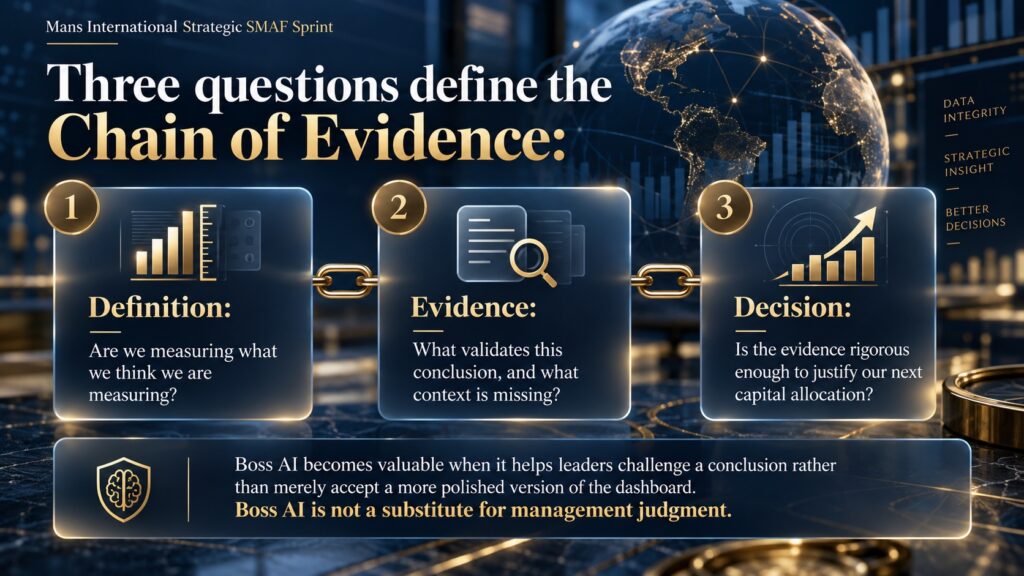
AI identifies patterns at unprecedented speed, but statistical confidence does not automatically equal commercial significance. For executives and board members facing high-stakes decisions, three questions define the Chain of Evidence:
Definition: Are we measuring what we think we are measuring?
Evidence: What validates this conclusion, and what context is missing?
Decision: Is the evidence rigorous enough to justify our next capital allocation?
Boss AI becomes valuable when it helps leaders challenge a conclusion rather than merely accept a more polished version of the dashboard. Boss AI is not a substitute for management judgment.
It can help leaders explore relationships, challenge assumptions, and evaluate alternatives. But it cannot replace responsibility for determining what the evidence actually supports.
02 | Decision-Making Under Uncertainty: Stress-Test Your Assumptions
Consider a strategic crossroads facing many health tech founders:
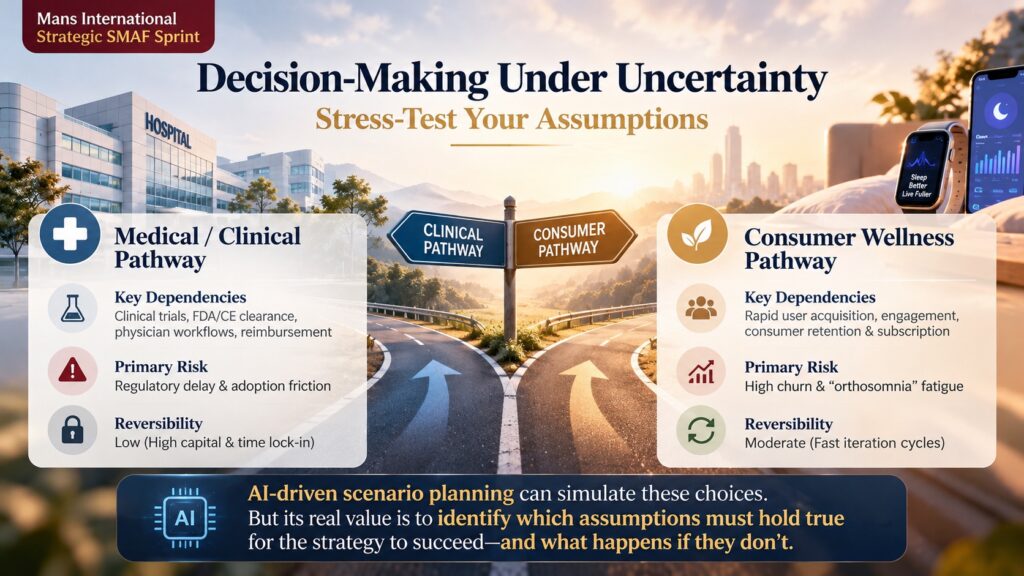
Should the company pursue a regulated medical pathway (such as clinical sleep apnea screening) or launch a consumer wellness offering?
Both pathways offer substantial enterprise value, but their risk profiles differ completely:
Key Dependencies: Rapid user acquisition, engagement, consumer retention & subscription
Primary Risk: High churn & “orthosomnia” fatigue
Reversibility: Moderate (Fast iteration cycles)
Medical Pathway vs. Consumer Wellness Pathway
AI-driven scenario planning can simulate these choices. But its real value is to identify which assumptions must hold true for the strategy to succeed—and what happens if they don’t.
Reversible decisions can be tested quickly in market micro-experiments.
Irreversible decisions—such as multi-year clinical trials or complex reimbursement submissions—demand an unshakeable chain of evidence before capital is deployed.
For venture and growth investors, this distinction is paramount. A founder who transparently presents the fragile assumptions behind their model demonstrates far greater executive judgment than one who presents a flawless forecast built on unvalidated premises.
AI expands analytical capacity. It cannot assume accountability for capital allocation.
03 | Why Strategic Diagnosis Must Precede AI Scenario Planning
In advisory engagements across North America, Europe, and Asia, one rule holds true:
Technology readiness and commercial readiness are not the same thing.
A company may possess proprietary algorithms, strong pilot engagement, and a compelling technical roadmap while lacking the operational foundations for scalable, repeatable commercial growth.
This is why we position the Strategic SMAF Diagnostic prior to broader strategic advisory at Mans International.
The Scenario Maturity Assessment Framework (SMAF™) evaluates whether a technology venture is truly prepared for its target commercial, clinical, and regulatory environment.
Rather than applying a generic checklist, the diagnostic isolates the specific uncertainties, blind spots, and commercialization risks that could compromise your next major milestone.
Without this baseline, sophisticated AI decision models simply make fragile assumptions look more persuasive.
Proving that a technology works in a trial is not the same as proving that a business can scale in the market.
A Final Question for Health Tech Leaders
Boss AI is not a substitute for executive judgment. It is a tool to challenge assumptions, stress-test evidence, and illuminate hidden risks.
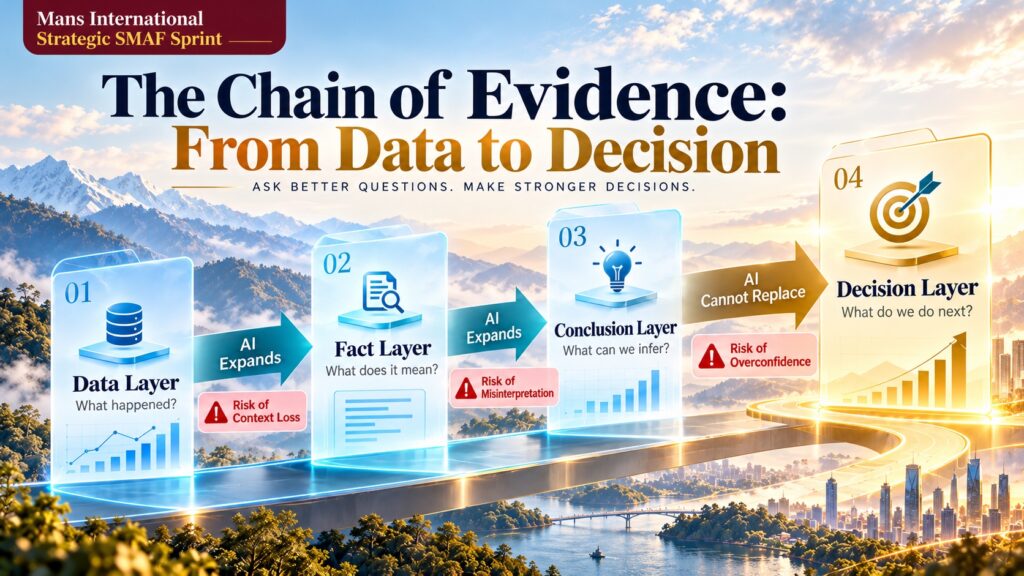
The Chain of Evidence
For Founders: Before committing to your next growth round or commercial expansion, can you clearly separate demonstrated clinical/commercial value from assumptions about scalability?
For Investors: When evaluating a digital health portfolio company, are you seeing evidence of sustainable market pull—or merely well-packaged engagement metrics?
The gap between these two outcomes determines whether your next capital deployment builds compounding enterprise value or funds an expensive misunderstanding.
Partner With Mans International
At Mans International, our Strategic SMAF Diagnostic helps technology founders, investment teams, and family offices examine strategic blind spots and commercialization risks before committing major capital.
If your organization is approaching a critical expansion, investment round, or enterprise AI decision, let’s discuss whether a tailored strategic diagnostic is right for you.
Kelly’s Global Tech Intelligence #239; Issue 51, 2026
Whose Ground Are You Standing On? Inside AMD’s $8.2B World Labs Acquisition
Lisa Su speaks the language of product roadmaps, yield rates, and quarterly delivery. Fei-Fei Li speaks the language of cognitive science, biological evolution, and spatial perception.
After the deal closes, these two languages will need to coexist in the same conference room, deciding the exact same thing: What rhythm does World Labs move to next?
One is the engineering-driven CEO who pulled AMD back from the margins into the main arena. The other is the pioneer who has been chasing the nature of intelligence from ImageNet all the way to spatial AI. They are meeting at the intersection of AI compute and spatial intelligence—a head-on encounter between two distinct organizational cultures.
Two Languages: Lisa Su and Fei-Fei Li
Fact one: The Transaction: On September 28, AMD announced a definitive agreement to acquire World Labs in an all-stock deal valued at approximately $8.2 billion, expected to close by late 2026. World Labs has roughly 70 employees—that is about $117 million per person. Upon closing, Fei-Fei Li will become AMD’s Executive Vice President and Chief Scientist, reporting directly to Lisa Su, while retaining her Stanford faculty position.
Fact two: Why AMD is buying. NVIDIA launched its Cosmos world foundation model platform in early 2025, integrating it with Omniverse for synthetic data and simulation. AMD is not entering a vacuum—it is chasing an essential loop: the direction models take directly shapes how chips are designed. The filing is explicit: World Labs’ modeling research will directly influence AMD’s future hardware technology roadmap.
Fact three: How the money works. It is all stock, and the mechanics matter. AMD’s 8-K says the share count is not yet fixed. It will be calculated from AMD’s daily volume-weighted average price over the ten trading days ending two trading days before closing. In practice, the value is anchored near $8.2 billion and the number of shares floats. World Labs was valued at ~$1 billion after its September 2024 raise, and completed a $1 billion round in February 2026 at a reported $5 billion post-money valuation—making this deal roughly a 60% premium on that baseline.
From “Dare to Leap” to “Whose Ground Are You Standing On?”
A year ago, I closed my article “AI’s Next Frontier: Fei-Fei Li, Spatial Intelligence, and the Wisdom of Navigating Uncertainty” with this thought: the watershed between investing and building is whether you can complete the perilous leap from knowing to doing. That means turning the conviction that “spatial intelligence is the future” into a firm commitment of strategy, resources, and time.
One year later, that leap has landed, just not the way many expected. World Labs did not walk the path to product alone. AMD bought the leap into its own system for $8.2 billion.
The question has shifted. It is no longer “do you dare to leap?” It is “after you land, whose ground are you standing on?”
Fei-Fei Li’s Next Threshold: From Breaker of Barriers to Insider of a System
When the mission stays the same but the organizational container changes completely, how do you redefine the way you lead?
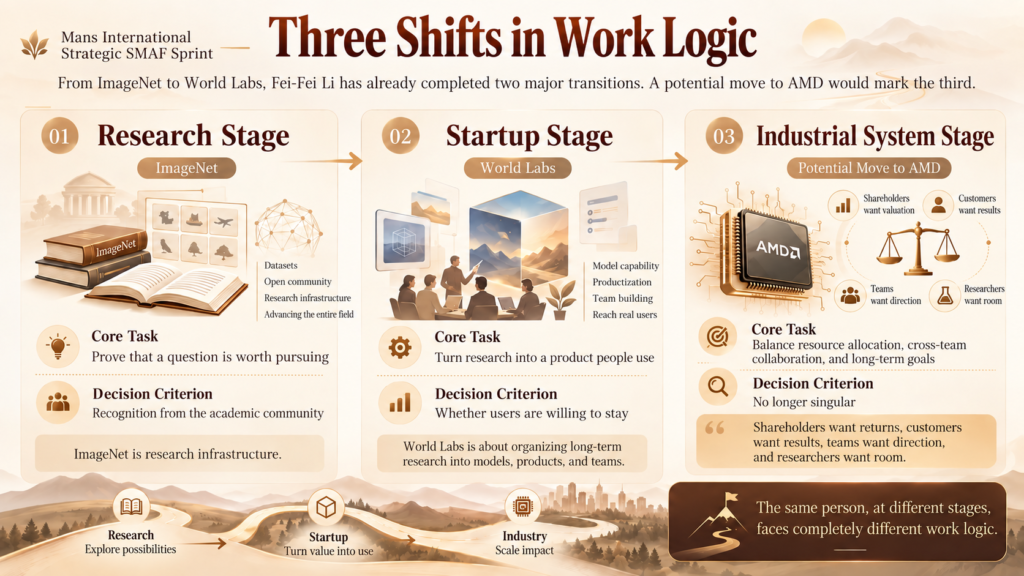
From ImageNet to World Labs, Fei-Fei Li completed two major transitions:
2009 (ImageNet): Organized 48,000 contributors to label 22,000 categories. Driven by raw conviction, she fought against being misunderstood.
2024 (World Labs): Organized a long-term research direction into models, products, and a startup team. The primary yardstick became user retention and technical validation.
Now comes the third transition. This time, the challenge is not opposition, but conflicting expectations: shareholders want financial returns, enterprise clients want stability, the startup team wants direction, and researchers want room to explore.
Three Shifts in Work Logic Mans International
The Three Structural Tensions
Rhythm Disparity: World Labs’ creative tools (like Marble) operate on an exploratory rhythm: discover a spatial capability, refine, release, observe. AMD operates on a quarterly hardware rhythm: tape-out schedules, enterprise SLA commitments, and supply chain constraints. How these two rhythms coexist is a weekly resource allocation battle.
Identity Boundary: Retaining her Stanford faculty title eases academic concerns, but time ownership cannot be dual-hatted easily. The faculty role asks “What is the nature of intelligence?” The corporate Chief Scientist role demands accountability to product execution. The boundary between inquiry and delivery must be renegotiated in every executive decision.
User Identity: When an independent boutique studio becomes a division inside a semiconductor giant, will creative developers who chose Marble for its agility stay, or will they view it as overly enterprise-bound?
Fei-Fei Li did not simply choose to sell; her research roadmap arrived at a point where the compute required exceeds what a 70-person startup can supply on its own.
II. Hold the Core, Change the Method
Last year, I summarized her core philosophy as: Hold the core, change the method. When 3D data acquisition proved difficult, she pivoted away from brute-force data scale toward spatial reasoning with minimal labeled data.
Today, she faces a much harder test. Previously, what changed was the technical path—a shift in experiment design where costs were contained. This time, what changes is the organizational structure, and what is surrendered is absolute autonomy.
This challenge is not hers alone. Every founder scaling deep technology will encounter this exact dilemma: When external constraints shift, how do you defend the underlying vision while completely altering the vehicle?
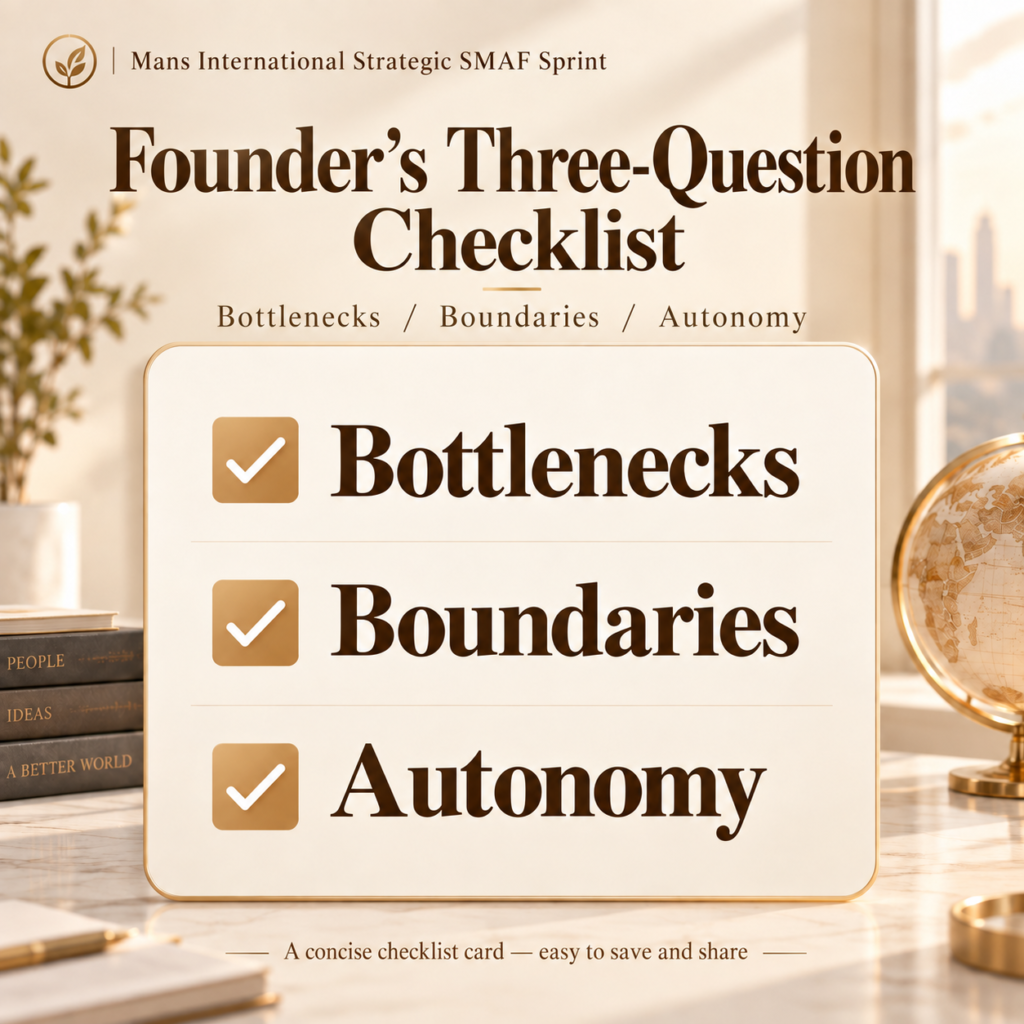
Three Questions for Deep-Tech Founders
Founder’s Three-Question Checklist
What is your critical bottleneck right now? Not the most urgent—the most critical. Urgent issues consume calendar space; critical issues dictate structural survival.
Which capabilities must be built in-house, and which should be acquired via ecosystem collaboration? Fei-Fei Li’s boundary: Keep core spatial research in-house; delegate mega-scale compute and chip architecture integration to a strategic partner.
To gain scale and resources, how much autonomy are you willing to cede? Teams that fail to define this boundary upfront pay the highest tax during post-acquisition integration.
A Note on “Commercial Loop”: Equating an acquisition exit with commercial success is a dangerous comfort. Shareholders getting liquidity and a team joining a platform are preliminary steps. Sustainable commercial success still requires end users paying for measurable utility over time.
Three Signals for Investors to Watch
Here are three verifiable signals worth watching over the 12 months after closing:
Hardware-Model Co-Optimization: Does the combined entity deliver measurable compute efficiency gains for spatial workloads compared to standard hardware stacks?
Ecosystem Adoption: Are third-party developers actively building spatial applications on top of the joint platform?
Commercial Retention: Are enterprise clients continuing to pay for measurable spatial AI outcomes?
If any one of these shows no clear progress within 12 months, it is worth re-examining the assumptions behind this deal.
The Comma, Not the Period
An $8.2 billion deal is a comma in this narrative, not a period.
The I Ching’s Kan hexagram (坎卦)—the hexagram of water flowing through steep terrain—teaches a vital lesson: After every perilous pass, another inevitably forms.
I Ching’s Kan Hexagram
Water pauses in every hollow, gathers strength, and continues to flow. It skips no stretch of danger and is trapped by none—not because it foresees the ocean, but because it maintains its intrinsic nature while adapting to every present constraint.
Hold the core: Remember why you set out.
Change the method: Accept that every new scale brings new constraints.
The next domain for spatial intelligence is forming precisely where foundational research, hardware engineering, and market execution collide.
A question for the founders and strategists in my network:
If you are building in the spatial AI or robotics ecosystem today, does AMD’s acquisition of World Labs open up greater opportunities for your roadmap—or does it squeeze the space for independent players?
I would love to hear your perspective in the comments below.
Author: Kelly Luo, strategic advisor and technology investor, focused on helping technology leaders turn innovation into sustainable commercial growth. This article does not constitute investment advice.
Compounding Intelligence: What MiniMax’s $116M Revenue Reveals About Real AI Moats
In July 2026 at the World Artificial Intelligence Conference (WAIC), Professor Zeng Ming* introduced a powerful idea: Compounding Intelligence.
*Professor Zeng Ming is a globally recognized business strategist and former Chief Strategy Officer of Alibaba Group who served as Jack Ma’s primary architect in building the company into a global e-commerce empire.
The industrial era was built on economies of scale. The AI era, he argued, will be built on compounding intelligence. AI companies may benefit from something different: systems that improve as they complete more real-world tasks, receive more feedback, and learn faster.
The concept is compelling—but founders only care about one thing: who has actually proven it works?
Less than two months later, MiniMax* reported its H1 2026 results.
*For readers less familiar with MiniMax: founded in 2022, it is one of Asia’s prominent AI foundation-model companies and has quickly emerged as a global contender in multimodal AI.
The Numbers Tell a Bigger Story
MiniMax generated $116.6 million in revenue in the first half of 2026, up 283% year over year.
More interestingly, revenue from its Open Platform and other AI-based enterprise services rose from $9.2 million to $73.9 million in one year.
Roughly 8× growth.
The Numbers Tell a Bigger Story
Viewed through the depth of the customer relationship, its AI commercialization can be thought of in three layers:
Direct-to-user: Products such as Hailuo AI put multimodal capabilities directly in front of consumers.
Developer platform: APIs let developers build their own products on top of the model.
Workflow embedding: The model becomes integrated into the customer’s product, process, and operating workflow.
The first two layers are becoming increasingly competitive. But the third layer is where the moat is built. When a model becomes an “organ” embedded within a customer’s business process, the cost of ripping it out becomes exponential.
The Time Gap: From Usage to Compounding Intelligence
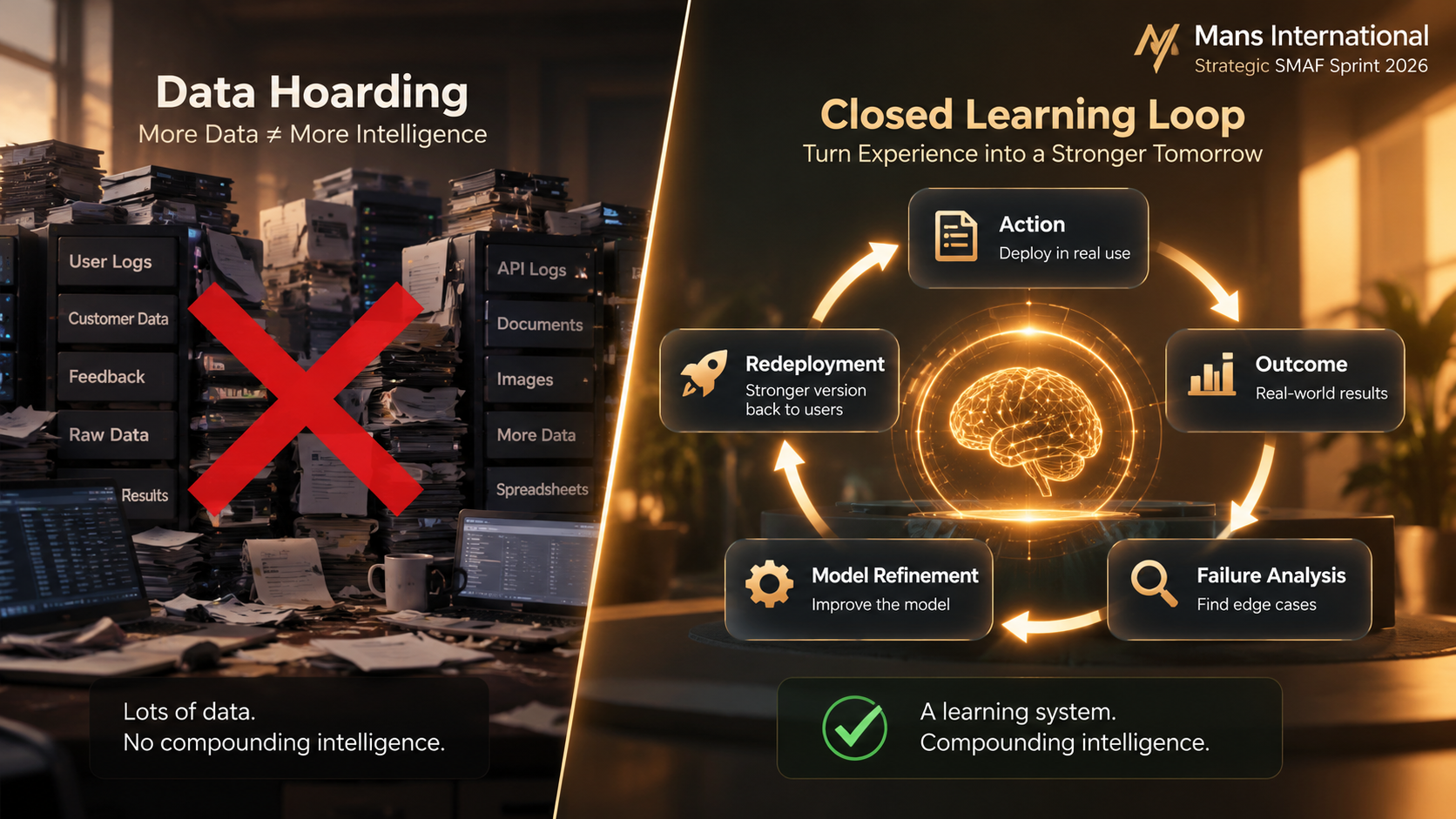
The Compounding Intelligence Loop
More usage does not automatically create a moat.
That is where MiniMax becomes interesting through the SMAF™ lens. A company must be able to turn usage into learning. It fuels the Compounding Intelligence loop:
A well-funded competitor can raise a billion dollars, open-source a larger model, or poach your engineers. But it cannot instantly reproduce months or years of deployment experience, customer context, edge cases, and learning systems.
Architecture can be copied. Time cannot. That asymmetry is the true AI moat.
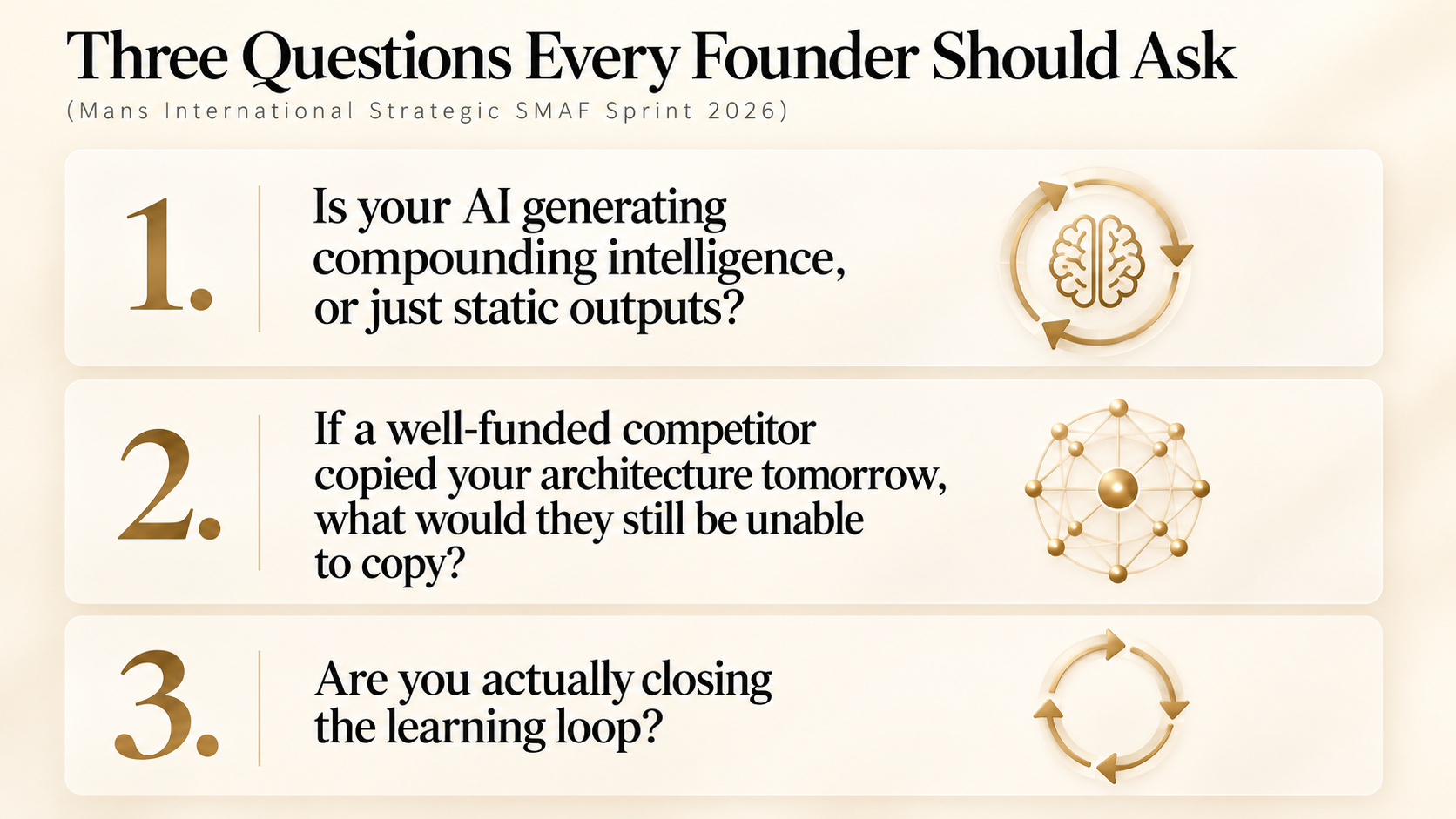
Three Questions Every Founder Should Ask
Three Questions Every Founder Should Ask
In our SMAF™ diagnostics, these three questions frequently expose uncomfortable blind spots:
Is your AI generating compounding intelligence, or just static outputs?
If a well-funded competitor copied your architecture tomorrow, what would they still be unable to copy?
Are you actually closing the learning loop? Collecting data is not enough. Do you have a system that turns yesterday’s failed output into tomorrow’s product improvement?
Data becomes intelligence only when the loop closes.
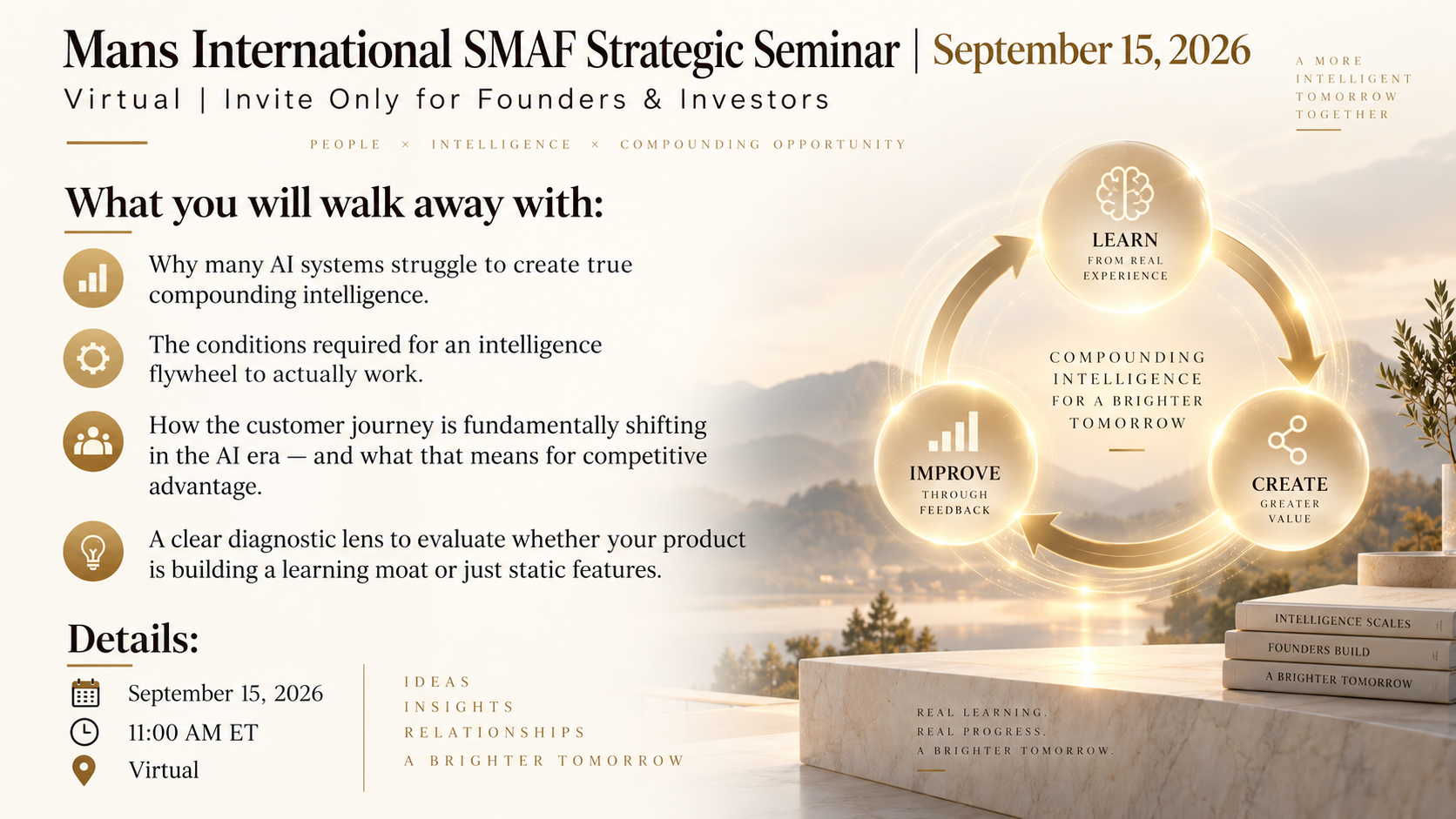
A Closed-Door SMAF Seminar
If these questions expose gaps in your product roadmap, you are not alone.
On September 15, we are hosting a closed-door, invite-only seminar for tech founders, investors, and family offices to explore how AI companies can build competitive advantages that compound over time.
A Closed-Door SMAF Seminar
What you will walk away with:
Why many AI systems struggle to create true compounding intelligence.
The conditions required for an intelligence flywheel to actually work.
How the customer journey is fundamentally shifting in the AI era — and what that means for competitive advantage.
A clear diagnostic lens to evaluate whether your product is building a learning moat or just static features.
Details: 📅 September 15, 2026 🕐 11:00 AM ET 📍 Virtual
How to request an invitation: Send me a direct message with the word “SMAF” to request your seat. (Note: Current clients and partners have reserved seats—confirmation details will follow shortly).
Final Questions
Whether you attend the seminar or not, I will leave you with this:
If AI is the first conversation your customer has, what makes your company the one it ultimately chooses?
And once it chooses you:
Does your advantage compound—or depreciate?
(Note: The core concept of Compounding Intelligence referenced here was detailed in Professor Zeng Ming’s July 2026 book, “Intelligence.”)
AI Made Output Cheap. Judgment Is the New Founder Signal
Canva now expects backend, frontend, and machine-learning candidates to use AI during technical interviews. The real test is whether they can stay in control of the AI while they use it.
Candidates with less AI experience struggled not because they lacked coding ability, but because they lacked the judgment to guide AI effectively and catch its mistakes. Two candidates can produce identical output. One questions underlying assumptions, tests the code, and catches subtle errors. The other accepts what the model hands back.
Same output. Very different judgment.
The old model of evaluation is breaking down
Meta has been piloting AI-enabled coding interviews since 2025 on the logic that they reflect how engineers actually work—and make AI-based cheating beside the point, since the AI is already in the room. CoderPad’s customers alone have run more than 35,000 AI-assisted interviews.
And recent Harvard Business Review research analyzing thousands of screening sessions reached a similar conclusion:
When competence is this easy to simulate, judgment becomes the scarce signal.
The old model of evaluation is breaking down
This shift isn’t limited to technical hiring—it applies directly to how founders make strategic decisions and how venture investors evaluate startups. When AI makes execution outputs instant and cheap, a founder’s pitch deck or product prototype no longer proves strategic insight. Real differentiation lies in how accurately a leader isolates untested market risk and stress-tests core assumptions before burning capital.
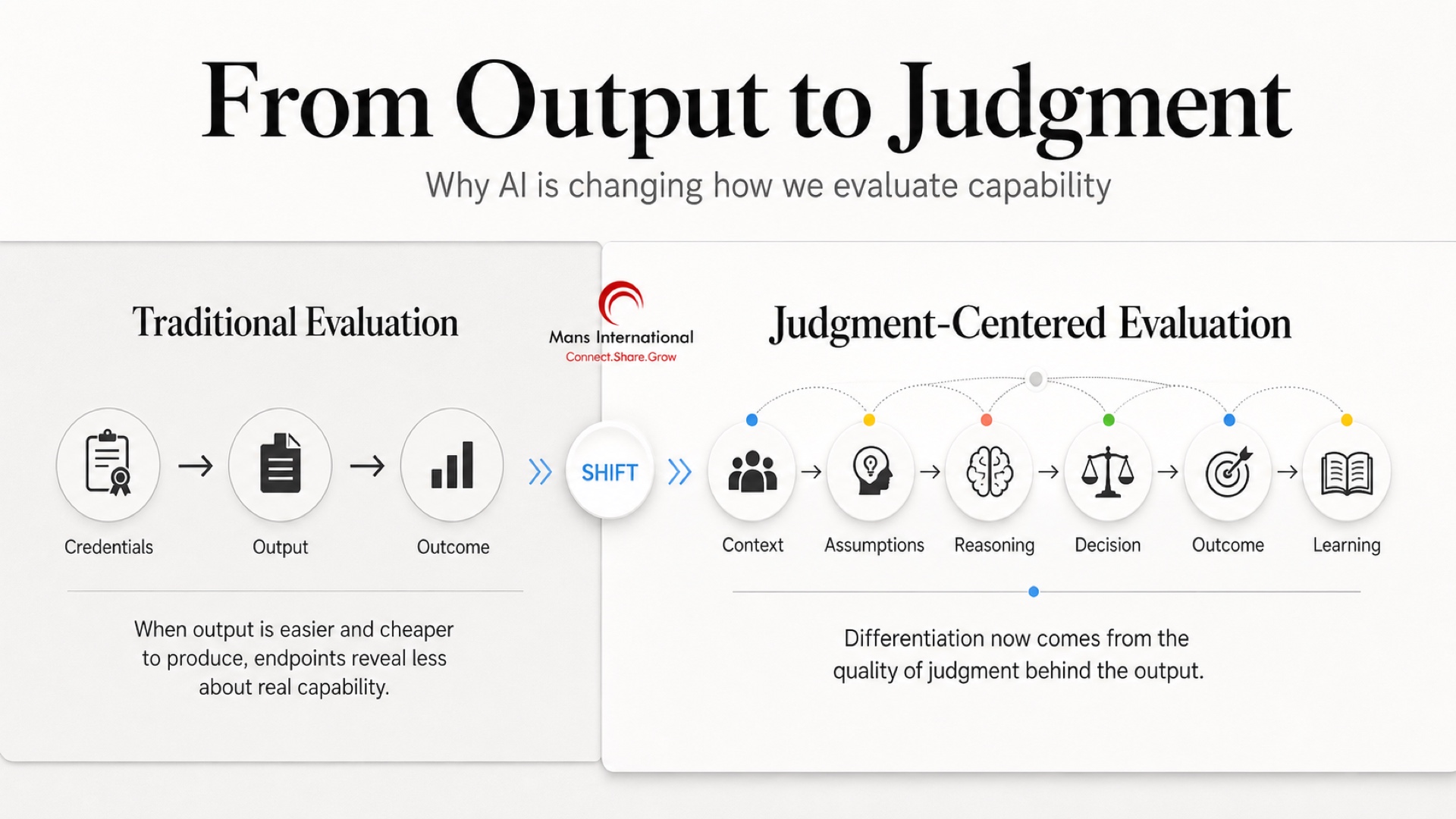
AI is making output easier and cheaper to produce. What’s left to differentiate is the judgment behind it.
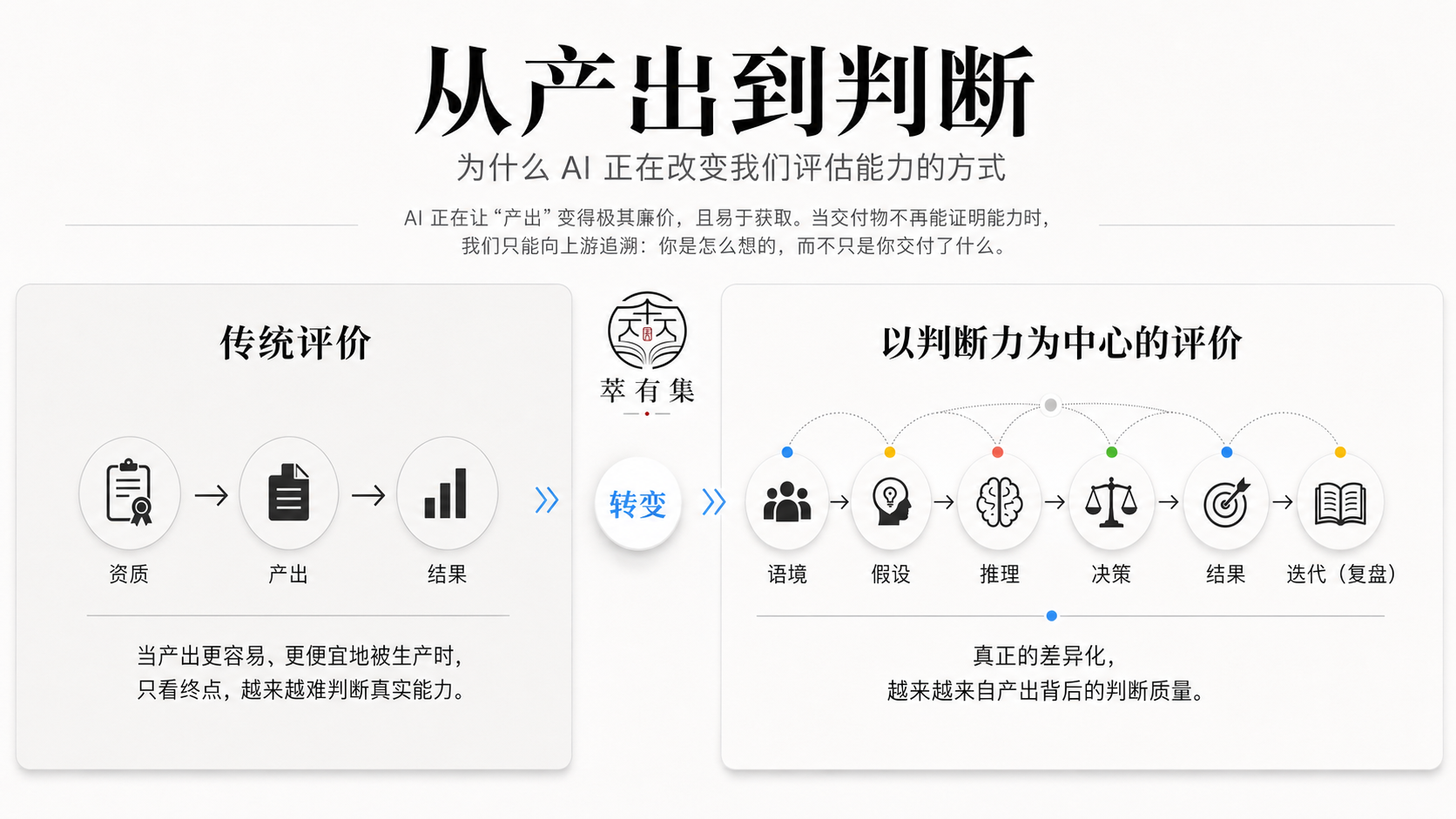
Traditional evaluation looks at endpoints:
Credentials → Output → Outcome
But when output is cheap, the artifact stops telling us much about the capability behind it. We have to look upstream:
I learned this a decade before generative AI made it obvious.
A ten-year lesson, finally measurable
Early in my ten years as a founder, I worked with a Canadian data-services company to explore market opportunities and secure funding. The technology was strong—its models could clean bank card data, detect fraud, and significantly reduce acquisition and retention costs. The company had senior banking relationships, a clear commercial case, and a secured pilot.
The pilot still failed.
A ten-year lesson, finally measurable
Not because the technology didn’t work, but because bank data was fragmented across departments, privacy restrictions complicated access, and internal teams resisted an outside solution that threatened legacy systems. Crucially, the startup lacked the capital to survive a multi-year enterprise sales cycle.
We had confused functional capability with systemic viability. We proved the technology could clean data, but we ignored the complex operational system around it.
If we had maintained a Judgment Trail at the time, our focus wouldn’t have been on tracking code completion or pilot deliverables (output); it would have been on tracking our untested assumptions around enterprise adoption speed and internal stakeholder resistance (judgment).
What That Judgment Trail Might Have Looked Like:
Core Untested Assumption: Executive sponsorship and a signed pilot guarantee fast, cross-departmental data access before our runway runs out.
Operational Risk to Test: Required data is trapped in fragmented legacy systems, stalling the pilot behind multiple, disjointed legal, security, and IT approvals.
Validation Trigger / Pivot Rule: If we cannot secure a named data owner, a clear approval path, and a committed budget within the initial pilot window, then we immediately pause custom development and pivot to customer segments with simpler integration cycles.
Building your own Judgment Trail
Founders keep diaries. Founders keep to-do lists. Very few keep a record of why—the core assumptions they walked in with, what evidence changed their mind, and what they would execute differently now.
A diary tells you how a decision felt. A Judgment Trail tells you how it was constructed. Because a founder’s decisions, tracked over time, are the clearest evidence of how they lead, the Trail isn’t really a record of the business—it’s a record of leadership quality.
Building your own Judgment Trail
Once judgment becomes valuable, people learn to perform it. Two specific diagnostic questions cut through surface-level narratives faster than anything else.
Test the trade-off behind the decision:“You had two viable options and chose A. Why was A better than B?”
Good judgment makes the trade-off explicit. Weak judgment often retreats to vague answers such as “it felt right.”
Test what they challenged before being asked:“What assumption or edge case did you personally test before anyone prompted you?”
What someone chooses to verify on their own often reveals more about their judgment than a polished explanation after the fact.
Applying this framework in practice requires adapting it to your role:
For founders: Skip the heavy decision register—it won’t survive a busy execution week. Focus on lightweight logging: capture the initial context, 2–3 core unproven assumptions, and the specific triggers that would force a strategy pivot.
For investors: Look beyond the polished narrative deck. Ask for the team’s Judgment Trail to evaluate how they process dynamic market feedback and stress-test their own assumptions over time.
Shift your team from evaluating output to evaluating judgment. Contact us and I’ll send you the Mans International Judgment Trail template I use with portfolio founders.
When AI Levels the Playing Field, What Still Makes a Winning Founder?
The 2026 World Cup final gave us a case study in a question that keeps every founder and investor up at night:
When AI hands everyone the same playbook, what’s left to compete on?
I. Data Can Be Equal. Judgment Cannot.
I. Data Can Be Equal. Judgment Cannot.
For the first time, all 48 participating teams received access to FIFA AI Pro, an AI platform developed by FIFA and Lenovo.
It gave every team a common analytical foundation for studying matches, players, and performance data.
But FIFA added one condition:
Once the whistle blew, no team could consult it. No sideline algorithms. No live probability feeds. The models went silent the moment the game started.
Sixty-two minutes into a scoreless final, Spain’s coach pulled his top scorer — solid numbers, nothing spectacular — and brought on Ferrán Torres, whose recent form was unremarkable but whose movement had an unpredictable, disruptive quality.
Torres found a gap in Argentina’s back line in the 106th minute. Goal. World Cup.
That call didn’t come from a model. It came from a coach’s profound perception of the game and the ingrained intuition of experience.
The Business Implication:
“Military tactics are like water… water shapes its course according to the nature of the ground; the soldier works out his victory in relation to the foe. Therefore, just as water retains no constant shape, in warfare there are no constant conditions.” — Sun Tzu
AI is rapidly becoming the world’s infrastructure. Any founder who wants a perfect competitive analysis can have it in seconds.
But business doesn’t happen in a pre-match calm. It happens during the game, when the ground shifts, signals conflict, and you have to decide.
For founders, the truth is blunt:
“Knowing how to use AI” is no longer a differentiator. What separates the winners is judgment in the face of ambiguity.
II. Monetizing the Unknown
II. Monetizing the Unknown
If the World Cup showed the value of judgment under uncertainty, Pop Mart has shown what happens when a company builds an entire business on uncertainty itself.
The Chinese toy company crossed HK$200 billion in market value on the strength of “blind box” retail — genuinely uncertain product bundles that turned unboxing into the product itself.
Their latest financials show overseas revenue exceeding 44%, with the Americas market growing over 700% year-over-year.
They are successfully exporting a methodology of “emotional pricing and scenario construction” to the rest of the world.
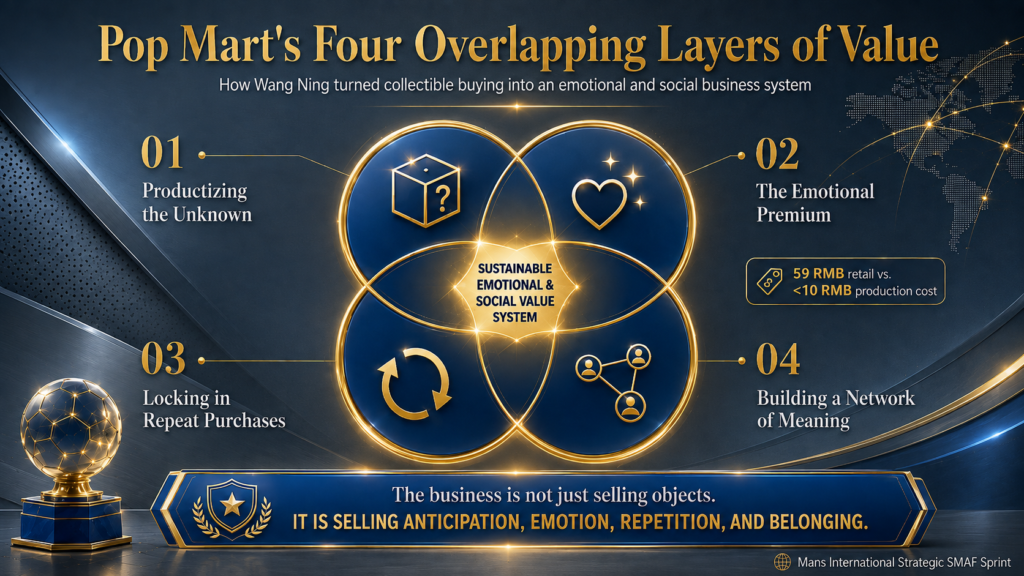
Pop Mart’s four overlapping layers of value
The surface story is “blind boxes” and lottery-style addiction. But Pop Mart’s founder, Wang Ning, has engineered four overlapping layers of value:
Productizing the Unknown: buyers pay for the emotional peak of not knowing what’s inside, not for the object itself.
The Emotional Premium: a Molly doll retails for roughly 59 RMB against a production cost under 10 RMB. That 49 RMB premium is psychological compensation for the total experience, not merely the materials.
Locking in Repeat Purchases: the tension between “not finding it” and “finally getting it” turns single purchases into a habit loop.
Building a Network of Meaning: exhibitions, designer signings, hidden-tier communities, a thriving resale market. Pop Mart isn’t just selling toys anymore — it’s selling belonging.
The Business Implication:
Stop pricing purely for function — learn to price for emotion. Stop staring only at the transaction — learn to construct a “network of meaning” where users voluntarily choose to linger.
III. The Real Differentiator
III. The Real Differentiator
The coach’s substitution and Pop Mart’s emotional engineering are, underneath, the same capability: a deep read of context that no model hands you.
At Mans International, we assess this through our Scenario Maturity Assessment Framework (SMAF), built around three questions.
Can you make a correct, counter-consensus call before the data is complete?
Does your product sell utility, or does it sell a meaning people will pay a premium for?
And is your growth a string of one-off transactions, or a system that reinforces itself?
Most businesses are trapped in the comfort zone of commoditized, standardized earnings. Very few have turned uncertainty itself into their competitive advantage.
Concluding Thoughts
Concluding Thoughts
The cruelest truth of the AI era is that everything standard, quantifiable, and definitive will become infinitely cheap—as ubiquitous and inexpensive as tap water.
The messy, dynamic, uncertain reality is the actual battlefield.
Average managers freeze in front of it. Exceptional founders learn to work with it — and the best ones build it into the business model itself.
When AI neutralizes technical horsepower, your read of what’s really happening in the human, emotional terrain of your market becomes the one card no one can copy.
Which of these three questions is your team still avoiding?
耶鲁大学公共卫生学院 Becca Levy 教授及其团队的长期追踪研究,对衰老持有更积极自我认知(positive self-perceptions of aging)的老年人,平均寿命长出约7.5年。对创始人而言,长期主义心智的本质,是把韧性当成组织的核心基础设施 —— 你永远不能靠透支的身体、涣散的团队去完成关键跃迁。